Irish Examiner poll: People willing to pay €17.15 a week on average to offset red meat consumption
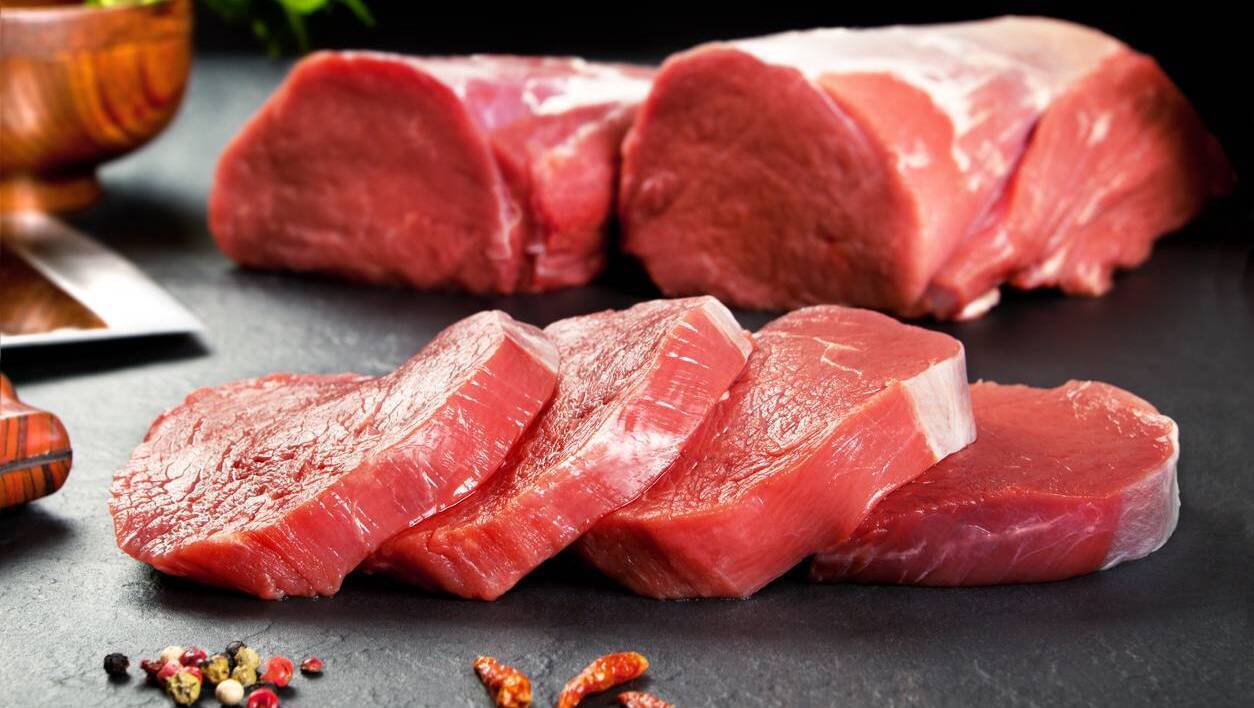
People would be willing to pay €17.15 a week on average to offset all their personal red meat consumption.
One third of people regularly change their shopping and transport-related behaviour to act more sustainably, but are not as willing to eat less meat or attend a protest calling for climate action, a poll has found.
In the poll of 1,056 adults for the by , it also found that people would be willing to pay €17.15 a week on average to offset all their personal red meat consumption, while over one third of adults (35%) wouldn’t be willing to pay anything.
Amy Brogan, a senior clinical psychologist and member of the Psychological Society of Ireland’s Special Interest Group for Addressing Climate and Environmental Emergency, said that the findings highlight a gap between current behaviours and emerging social norms.
“Actions known to have the greatest environmental impact, such as reducing meat consumption, flying less, or shifting to active and public transport, do not always feature prominently in people’s responses,” she said.
CLIMATE & SUSTAINABILITY HUB
Today, Monday June 1, the 'Irish Examiner' publishes an in-depth analysis — in print and online here — of its new Ipsos B&A poll on Irish people's attitudes to issues including climate change
Read More
“This suggests not only gaps in knowledge and confidence, but also in values.
“[But] behaviour and values are closely linked. Supporting people to take small, practical steps towards sustainable living can, over time, help reshape both.”
When given a list of items and asked if they did it to help contribute to sustainable behaviours, the only one that a majority of people said they never did was protesting or demonstrating at 56%.
When it comes to calling for a sustainable future or action on climate change, only 9% of people said they had attended a demonstration.
By far, the action that people said they did most often was recycling – including the deposit return scheme – with 66% of people saying they recycled all the time and another 20% saying they did it often.
The next most common behaviour was composting, with 51% said they did often or all of the time.
Other popular actions were upcycling or creative reuse at 38%, taking more public transport at 32%, flying less at 32% and second-hand shopping or thrifting at 31%.
On the other hand, one in five people said they’ve never eaten less meat to try to act more sustainably, while another one in five said they’d done so rarely, compared to one in 10 who said they do this all of the time.
Even fewer people have switched to a vegetarian or vegan diet to act more sustainably, with 54% said they’ve never done so or have only done so rarely.
The issue of eating less meat came to the political fore as far back as seven years ago, when then-taoiseach Leo Varadkar provoked a backlash after saying he was cutting down his consumption of meat to help reduce his carbon footprint.
The Healy-Raes were among those critical, with Danny Healy-Rae saying it was ridiculous that people should stop eating meat to change or protect the weather, while Michael Healy-Rae said it was easy to know he wasn’t a farmer and that Mr Varadkar should be “the taoiseach for all the country, not just for Dublin city”.
In the Dáil, Mr Varadkar defended his comments, saying he did not give anybody dietary advice or suggest that anyone else do anything.
“I was specifically asked what I was doing on climate change, and I said that I was trying to eat less red meat,” he said. “I am not giving it up. Indeed, I had a very nice Hereford steak last night.”
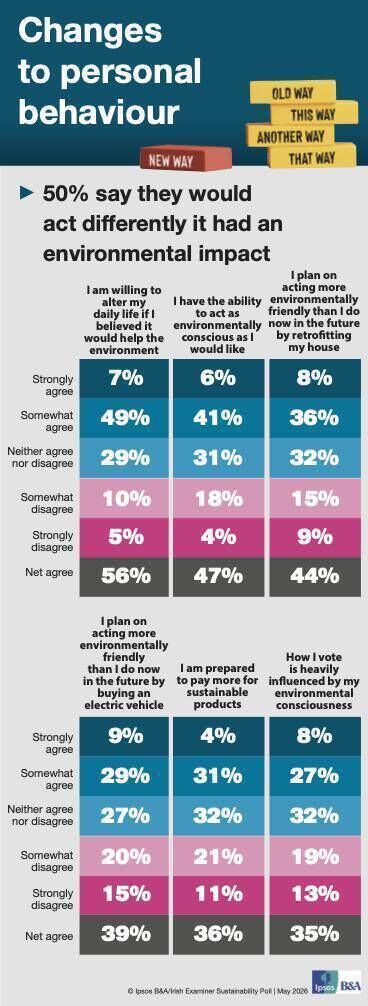
Elsewhere in the poll, when it came to what would have the most impact, the behaviour that was ranked the most beneficial was flying less at 19%, followed by recycling (17%), and taking more public transport or retrofitting your house (both at 12%).
Specific questions were also asked about how much people would be willing to pay to offset their activities, such as eating meat and flying.
While two in four adults (41%) aren’t willing to pay anything to have their personal flying offset, this rose to 53% among over-55-year-olds. On average, however, personal flying was perceived to be worth €129.28 a year.
Respondents, meanwhile, overestimated how much carbon is emitted by a reusable cup but underestimated the environmental benefits of buying second-hand. However, there is a good understanding of emissions for flying, eating red meat and shopping.
James Green, a health psychologist specialising in behavioural science at the University of Limerick, said that many of the behaviour changes reported seem to focus on low-impact activities such as recycling and while positive, this can have the unintended consequence of potentially diverting attention from changes that would have a far greater effect.
“From a behavioural perspective, it is more realistic and effective to encourage incremental, high-impact shifts, such as reducing meat consumption, particularly beef, or making partial substitutions rather than expecting entirely new lifestyles,” he said.
“Similarly, while electric vehicles are important, their cost remains a barrier, highlighting the importance of accessible alternatives.
“Ultimately, the findings underscore the need for stronger, more coordinated government action to enable change, rather than relying on individuals alone.”
Read More
CLIMATE & SUSTAINABILITY HUB
CONNECT WITH US TODAY



Be the first to know the latest news and updates