A victory with no clear winners, just one loser
As French politicians struggle to make sense of heavily split election results, they can rest assured that Marine Le Pen will not yet be at the country’s helm
A victory with no clear winners, just one loser

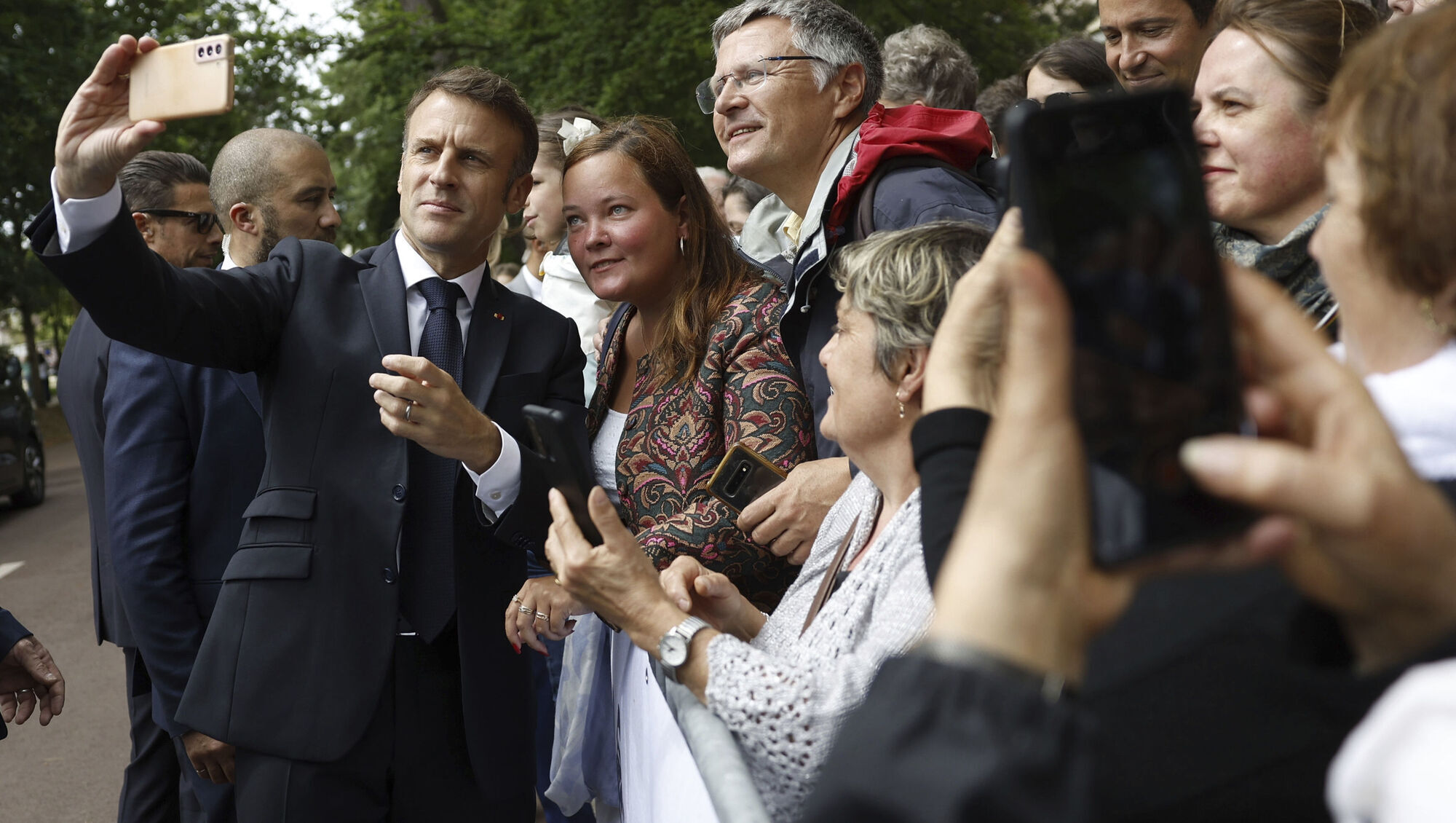
French President Emmanuel Macron takes selfies with supporters after voting for the second round of the legislative elections in Le Touquet-Paris-Plage, northern France, last Sunday. Picture: Mohammed Badra/Pool/AP

As France struggles to make sense of hopelessly split general election results, Emmanuel Macron knows he will be remembered as the president who asked for clarity and got none.

In a gesture likened to a toddler’s tantrum by opponents and, privately, some colleagues, he called the snap poll in response to humiliation at elections for the European Parliament. Marine Le Pen’s far right National Rally (RN) had trounced his party, winning more than twice as many votes.

France is hardly alone in Europe in witnessing support for populist answers to issues from immigration to the cost of living. Keir Starmer’s Labour bucked that trend in Britain but his success owed much to the irretrievable unpopularity of the Conservatives.

With his high-risk gamble, Mr Macron counted on two factors: the disunity of the French left and the cordon sanitaire that traditionally unites opposing factions in the common cause of denying power to the far right. That is what he meant by seeking “clarity”.

It was a gamble he almost lost in spectacular fashion. And despite the most alarming outcome — a RN majority in parliament — being averted, it leaves him further weakened and France mired in political chaos.

“Ungovernable” was the one-word headline on one Sunday newspaper’s front page even before voters began heading to polling stations for the decisive second round. That is not a reassuring description of a country preparing to host the Olympic games and occupying a central role in European policy.

But how did France veer in a week from embracing the simplistic solutions of Ms Le Pen and Jordan Bardella, earmarked as her prime minister, to a vote divided between three groups united only in animosity towards one another?

From a projected victory that would have made it the biggest parliamentary party, with every possibility of an absolute majority, RN was relegated to third place behind the left-green alliance, the New Popular Front (NFP), and even the Macronist bloc Ensemble.

In a week of frantic horse-trading, a strategy of “desistement” — third-placed candidates standing down to combine the anti-RN vote — somehow paid off. The old-fashioned “republican front”, the coming together of mutually antagonistic forces to defeat the supposedly non-republican far right, again came to the rescue of the status quo.

It was not as easy as in 2002, when even left-wing voters metaphorically wore nosepegs to block Marine Le Pen’s father, Jean-Marie, and elect the centre-right Jacques Chirac by a crushing margin.

Supporters of French far right leader Marine Le Pen react after the release of projections based on the actual vote count in select constituencies , Sunday, June 30, 2024. Picture: Thibault Camus/AP

In the febrile atmosphere of French politics today, not everyone played ball. Macronists and mainstream conservatives, Les Republicains (LR), balked at giving way to any contender from the left alliance’s most radical wing, France Unbowed. To them, far right and far left are equally repellent. Some conservatives, including LR’s president Eric Ciotti, were more selective in their condemnation of extremism, standing on joint LR-RN tickets, leading to a post-election party split.

Petulance also played its part. Francois Dubois, a conservative member of the dissolved parliament, refused to step aside for the former socialist president Francois Hollande, who sealed his comeback in the ensuing three-way decider.

But the left and, in many areas, Macronists proved impeccably mobilised. In constituency after constituency, Le Penist candidates who had led in the first round were relegated to second place.

To Mr Bardella, visibly deflated after being so close to high office, it was an “alliance of dishonour”. To those aghast at the prospect of a France governed by a party with roots in racism, antisemitism, and the collaborationist Vichy government, the relief was palpable.

The French football team, led by its captain Killian Mbappe, had urged voters, especially the young, to reject extremism, meaning the far right. Marianne magazine devoted nine pages between rounds to examining possible consequences of a National Rally victory ranging from a rise in racially motivated acts and drift into authoritarianism to the loss of foreign investment.

Yet on the evening of June 30, this hazardous journey into the unknown seemed to be exactly what the French wanted. Thirty-nine Le Pen candidates sailed into parliament, votes of 50% or higher making runoffs unnecessary. In more than half of France’s 577 constituencies, RN was ahead.

The campaign to marshal anti-RN resistance sprang into action. By the time second round polling began, there had been 229 “desistements”.

The effect was explosive, establishing the left-green NFP as the biggest parliamentary bloc, with 180 seats followed by 163 for the Macronist Ensemble, the hapless Le Pen and Bardella camp languishing in third place on 143.

Mr Macron, not a man given to humility, would never admit that calling the snap election was unnecessary and foolish. It was a decision reminiscent of David Cameron’s attempt to placate Eurosceptic Tory rebels by holding the 2016 referendum on withdrawal from the EU; far from producing the win for Remain he expected, the outcome imposed Brexit on Britain and cost Mr Cameron his job.

The European election results, though dismal, were not fatal to Mr Macron’s government, already hampered by the lack of an absolute majority. With his second term only halfway completed, his presidency was under no threat. A more logical response might have been to dismiss his young prime minister, Gabriel Attal, whose offer to resign now has been rejected by Mr Macron in the interests of short-term stability.

No one knows what lies ahead for this deeply divided country. Convention suggests the new prime minister should come from the left as the biggest grouping. But who might that be? Certainly not Jean-Luc Melenchon, the fiery figurehead of France Unbowed, marginally the senior partner in the alliance and by far the most left-wing. Loathed by the centre and right, he hardly commands universal support on the left.

French far right leader Marine Le Pen says victory has merely been delayed. Emmanuel Macron’s second and final term ends in 2027 and no one is currently better placed to succeed him. Picture: Thibault Camus/AP

In an open letter to the French people, Mr Macron says no one won the election and that the need is to build a coalition that, reading between his lines, excludes both the Melenchon and Le Pen parties.

Yet a viable alliance in government seems implausible, given the huge disparity of philosophies between the three big blocs.

Macronists rule out sharing power with either extreme. But a massive leap of faith is needed to envisage them finding common ground with both conservatives and moderate socialists.

Another idea that has been floated is that of an emergency patch-up, a temporary government of unelected civil servants and experts unaligned to partisan politics. But this would be a negation of democracy. Green and mainstream socialist names have been mooted for the role of prime minister but it is by no means certain any of these would attract broad support;

There are also questions about the fragility of the left-green alliance. Impressively cobbled together to fight the election, it has internal strains over Europe, Ukraine, and Gaza that will grow and potentially blow it apart.

Where this leaves Ms Le Pen is clearer. Having won 10.5m votes, more than either rival bloc, her party is furious at being left lagging behind in terms of seats.

All across south-eastern France, along the Mediterranean coast from the eastern Pyrenees to the Italian border, the far right is dominant. It is the same story in much of the north and east of the country, and to the west of the Massif Central.

Not unlike Donald Trump supporters in red-hot Republican states, these voters feel cheated, robbed of a historic triumph by electoral sophistry. If their party is routinely described as extremist, RN voters either disagree or don’t care.

Their day may yet be to come. Marine Le Pen says victory has merely been delayed. Mr Macron’s second and final term ends in 2027 and no one is currently better placed to succeed him.

  • Colin Randall writes on French affairs, dividing his time between France and the UK, and is a former Paris bureau chief for The Daily Telegraph.

x

More in this section

Revoiced

Newsletter

Had a busy week? Sign up for some of the best reads from the week gone by. Selected just for you.

Cookie Policy Privacy Policy Brand Safety FAQ Help Contact Us Terms and Conditions

© Examiner Echo Group Limited