Elaine Loughlin: Why did Government remove services from Occupied Territories Bill? It's the economy, stupid
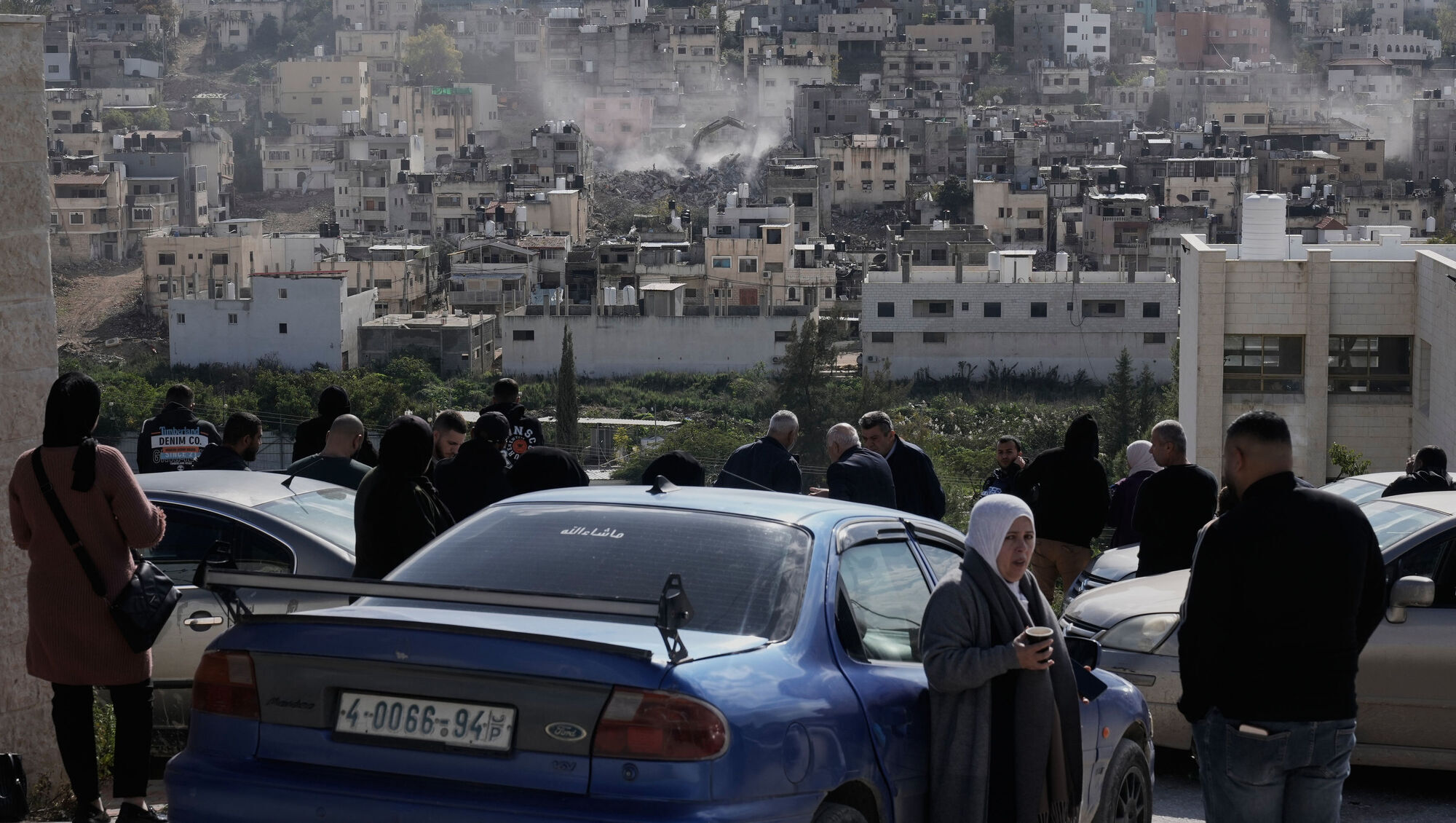
An Israeli army bulldozer demolishing homes in the Palestinian urban refugee camp of Nur Shams, near the West Bank city of Tulkarem. Pictures: AP /Majdi Mohammed

In luring US multinational companies here, Ireland has become economically tangled up with Israel, which is now defining how we act against a genocidal regime.
This week, after eight years of foot dragging, the Government finally admitted the real reason for excluding services from the long-discussed and debated Occupied Territories Bill.
Economics trumps humanity.
"The moral instincts of the people should be a dominating force when it comes to Ireland's foreign policy," former Irish president Michael D Higgins told an event in Trinity College on Thursday evening.
While Ireland may be extremely vocal in its condemnation of Israel, the Government has opted to take a protectionist stance in its actions instead of being guided by a moral duty to do everything in our power to stand with a population that is being ethnically cleansed.
First introduced by Senator Frances Black in 2018, the Occupied Territories Bill proposed to ban all trade between Ireland and Israel’s illegal settlements on Palestinian land.
Increased extremist settler violence and the unprecedented expansion of illegal settlements in the West Bank, including East Jerusalem, in the wake of the October 7 Hamas terrorist attack, put the bill back in the spotlight, with the opposition pressing hard for its adoption.
In the wake of the last general election, the current Government agreed to proceed with the bill, but claimed significant amendments as well as further legal advice was required to get it across the line.
The services element of the bill was then cited as a sticking point, with the Attorney General consulted on the matter.
Now renamed the Israeli Settlements (Prohibition of Importation of Goods) Bill, the proposed legislation limits the ban on trade to goods, which places any consequences of the legislation firmly in a symbolic sphere — a move that might briefly gain international headlines, but will have miniscule impact.
In the Dáil, Taoiseach Micheál Martin put the value of goods, which he described as "fruit and vegetables", exported from illegal settlements at about €200,000.
Then came the nugget, an honest admission of what the wrangling over months and years has really represented: “There is an issue in terms of what will happen if services were included in terms of our own jobs in this country and potential attacks on multinationals who are based here."
Amid intense heckling, the Taoiseach continued: "I have to protect about 250,000 jobs in this country too, and there is a real issue that people are turning a blind eye to in terms of that this is something we can do casually and nobody is going to pay a blind bit of notice. There have been a lot of attacks on Ireland because of the leadership stance we have taken as a Government."
To quote a much used phrase: It’s the economy, stupid.
Ireland and Israel, both relatively small states, have developed as global tech hubs. Both share very similar success stories that can be tracked back to policy shifts taken in the 1960s.
Here, a dogged pursuit of foreign direct investment and an outward-looking approach was initiated under Seán Lemass and paved the way for European Economic Community (EEC) membership in 1973.
Over the decades, this strategy of luring multinationals, particularly from the US, was bolstered by a favourable corporation tax regime, grants and other incentives.
In Israel, a decision by French leader Charles DeGaulle to slap an arms embargo on the region on the eve of the 1967 Six Day War forced Israel to expand trade ties with the US, but more importantly, sparked investment in its own domestic high-tech sector and sophisticated military industry.
While Ireland has enjoyed economic success through enticing large-scale global tech and pharmaceutical firms here, Israel has focused on incubating its own indigenous start-up sector.
Speaking after a trade mission to Tel Aviv in 2016, Brian Breslin, then a project executive with the IDA, highlighted just how entangled both Ireland and Israel had become as a result of their booming tech sectors.
"What is interesting is the amount of large tech companies that are present in both countries, Intel, Facebook, Google, Salesforce to name a few. It is worth looking at what these company do in each location and see if that can define the best working relationship between the two countries.
“I think what you will find is that Israel is great for the blue sky, conceptual research. When that needs to be then commercialised and brought to market it comes to Ireland."
This bilateral trade relationship is now valued at between €4bn and €5bn each year.
Economist David McWilliams has pointed out that as diplomatic relations have deteriorated over the years, commercial relations have actually expanded.
Both Ireland and Israel took what McWilliams described as "massive bets" on the tech sector in the early 1990s.
"We took a bet, and we said to the Americans: 'We will host your best companies here, we will give you our best graduates, you will create your best products, and we will take a big chunk of tax off you'. That was our thing.
"The Israelis said: 'We don't want your companies so much ... but we'd really like your capital, your Silicon Valley capital, and we will create our own companies here, and they will feed into your multinationals'.
"But as a result of that, both countries have become quite enmeshed in international trade together by virtue of the fact that large tech companies are based both here and there,” he said on his own podcast in 2024 after the Irish Government moved to recognise the state of Palestine.
Read More
Our own economic fortune and the ties we have built to ensure continued success has significantly compromised us when it comes to taking meaningful and significant action against Israel.
Academics Patrick Bresnihan and Patrick Brodie argue by excluding services from the Occupied Territories Bill, the Government has shielded companies with headquarters in Ireland from being subject to Irish law for their operations in East Jerusalem, the West Bank, and the Golan Heights — companies like Airbnb, or insurance brokers, who advertise lets and services in these illegal settlements.
In doing so, the Government has refused to leverage its strongest position: Its role as a platform for multinationals between the US and Europe.
But what are the consequences of not acting?
The day after the bill went to Cabinet, head of Trócaire Séan Farrell laid bare the chilling reality of what is already being witnessed on the ground: "What happened in Gaza is going to happen in the West Bank, which is you take a large population, you basically corral them into a dense urban environment, and you try then to manage the security issues, or whatever, that will arise from that."
This week, Israeli ministers approved 22 new Jewish settlements in the occupied West Bank, the largest expansion in decades, that no doubt will involve further violent attacks on Palestinians and the removal of families from their lands and homes.
Inaction is a form of quiet complicity.


CONNECT WITH US TODAY



Be the first to know the latest news and updates