ieExplains: What is the Occupied Territories Bill and why is it in the news?
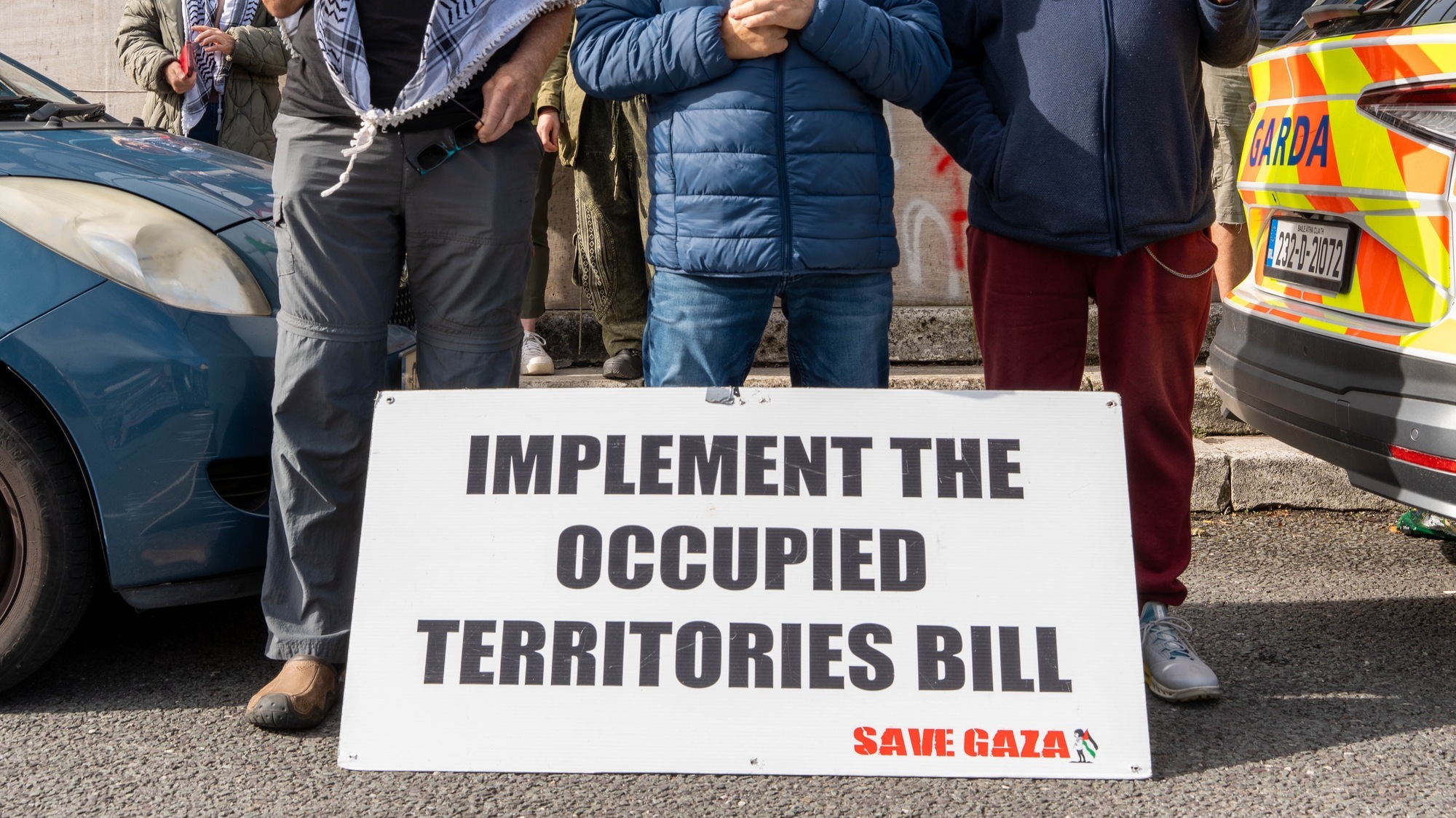
A sign calling for the implementation of the Occupied Territories Bill at a protest outside Taoiseach Micheál Martin's Cork office last year. It has been thrown into sharp focus again after Irish activists were among many detained by Israeli forces while part of a Gaza-bound flotilla in the Mediterranean Sea. Picture: Noel Sweeney
Last week, foreign affairs minister Helen McEntee said the Government is set to bring back the Occupied Territories Bill to the Dáil within the coming weeks.
A long-debated piece of legislation, the issue had been thrown into sharp focus again after Irish activists were among many detained by Israeli forces while part of a Gaza-bound flotilla in the Mediterranean Sea.
At home and abroad, Israeli’s national security minister Itamar Ben-Gvir drew widespread condemnation for footage showing him walking among some of the detainees and taunting them.
Which brings us back to the Occupied Territories Bill.
First introduced by Senator Frances Black in 2018, the Occupied Territories Bill would ban trade between Ireland and Israel’s illegal settlements in the West Bank.
Under international law, such settlements from Israel are illegal as they violate Article 49 of the Fourth Geneva Convention, which prohibits the transfer of an occupying power’s civilian population into occupied territory, according to the United Nations’ Office for the Coordination of Humanitarian Affairs (Ocha).
Read More
Ocha says that “settlements and settler violence have deprived Palestinians of their property and sources of livelihood, restricted their access to services and triggered displacement”.
When first introducing the legislation, Ms Black said it “is a chance for Ireland to state strongly that it does not support the illegal confiscation of land and the human suffering which inevitably results”.
“This is not simply about taking a stand, but offering a real and practical step that other states can follow,” she said.
As well as many political parties, NGOs such as Trócaire and unions such as Fórsa have backed the Occupied Territories Bill.
In the case of Trócaire, it has said it works with partners on the frontline in both Gaza and the West Bank and believes it is “unjust for innocent families to be evicted from their homes and land, pushed further into poverty, to make way for illegal settlements”.
“Furthermore, with the large-scale death and destruction in Gaza and the West Bank, it is crucial for Israel to be held accountable for its violations of international law and war crimes,” it says.
“Ireland must ensure it is not complicit in these actions.”
While Fórsa has called for the Government to strengthen the proposals to include both goods and services, it has also faced criticism with former Israeli ambassador to Ireland Dana Erlich, calling it “anti-Israeli” and a “discriminatory attempt that aims to target Israel”.
Several US politicians have also taken aim at Ireland over the proposals, including the US ambassador to Israel Mike Huckabee who said to “sober up” and asked “did the Irish fall into a vat of Guinness”.
When this Government was formed in early 2025, it signalled that it would replace the existing bill with its own legislation, which was criticised by the Opposition as a delaying tactic. Despite some developments last year, we enter the summer of 2026 still without this legislation enacted.
While Ireland has been among the EU countries most outspoken about the violence in Gaza and illegal settler activity in the West Bank, critics have said this has not been met with concrete action.
EU sentiment regarding Israel has shifted somewhat in the wake of Mr Ben-Gvir's actions against the flotilla activists and other recent developments. The Government has now said it will progress the legislation.
Ms McEntee told the Dáil last week: “The only way in which we can respond to this effectively is by making sure Europe uses its voice and takes action in response to what we have seen today, what we have seen in recent weeks and what we have seen in recent months. I stress again that the approach from Ireland has always been to try to build a consensus.
“I have always said that I believe moving on our legislation would be better if done in tandem, and I have not changed that position.
"That is why I am working with colleagues from the Netherlands, Belgium, Slovenia and other countries who are also progressing their own legislation, so we do this collectively and send a very strong message.”
The Taoiseach Micheál Martin also said last week that the taunts from Mr Ben-Gvir “accelerated the momentum” for action by the EU.
One of the main debates has centred on whether the bill should ban trade on both goods and services from the occupied territories with the Opposition and other groups calling for both, but the Government indicating it will just include goods in the legislation.
Expect that to be the subject of much debate in the weeks to come, when the Government publishes its fresh legislation and brings it before the Oireachtas.

CONNECT WITH US TODAY



Be the first to know the latest news and updates