Michael Moynihan: Using AI in the urban environment has some not-so-shocking results

Are people really considering what AI is going to mean for them? The Chinese example is instructive
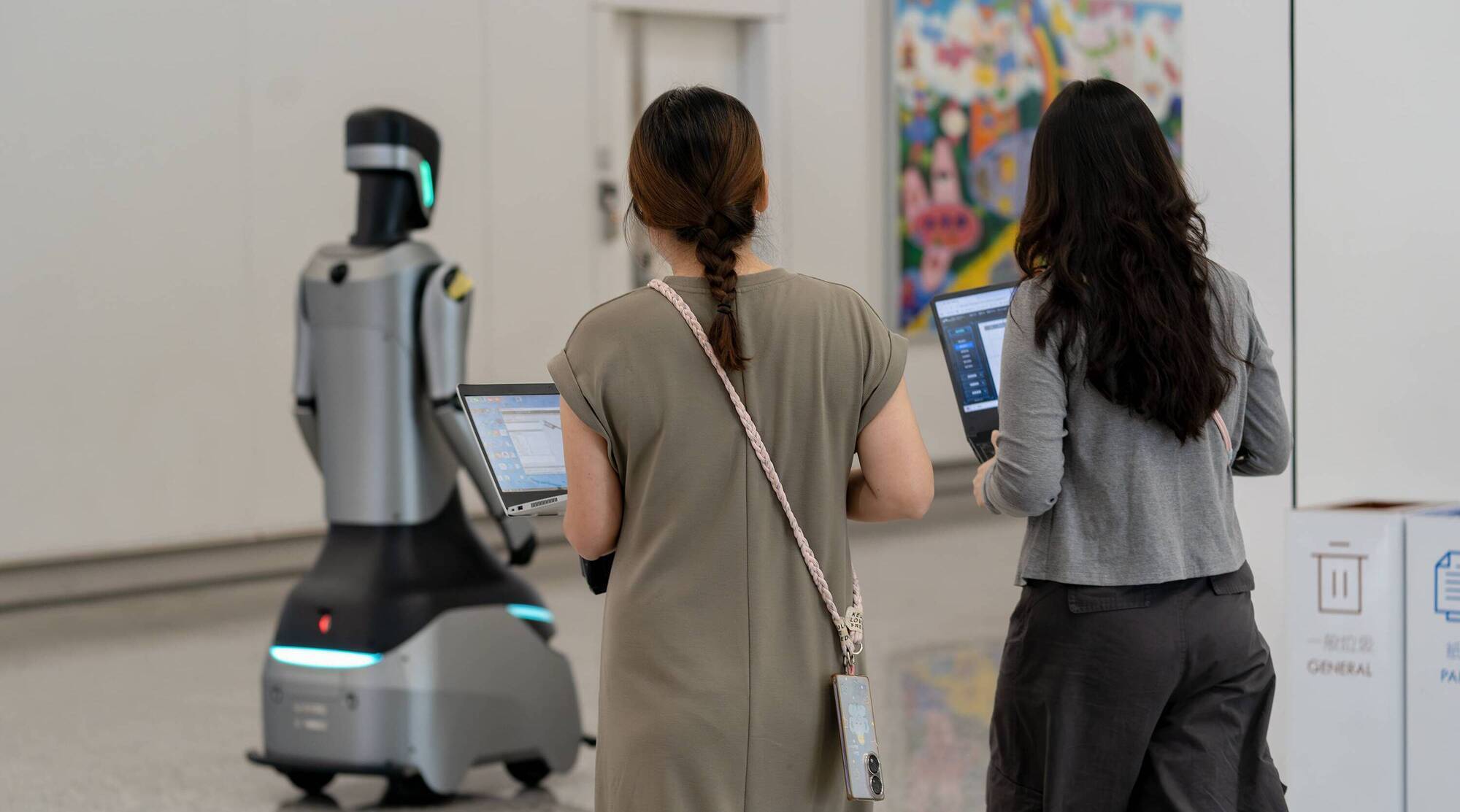
A service robot on the departure level of Hong Kong International Airport last year. 

A service robot on the departure level of Hong Kong International Airport last year. 

Another day, another new frontier in the slow ooze of artificial intelligence (AI) across the world.

The term used above is not an accident: yours truly is not a fan of our new artificial intelligence overlords. You may differ, of course, and you are entitled to your view — if it is your view, that is, and not one cooked up for you by AI (sorry).

I wonder sometimes, though, if people really consider what AI means for them apart from turbocharging their own dependence on it and hastening the general fall of civilisation as a by-product (not sorry).

If you’ve considered that, fine. If you’re okay with loss of privacy, environmental devastation, theft of intellectual property, the devastation of education and ethics, implications for security, and the installation of a new religion of laziness and shoddy semi-thinking, that’s your prerogative. 

I wish you well as you rationalise your own looming extinction.

I don’t like contemplating the Singularity myself, but one or two things I read recently offered a glimpse of what is lurking around the corner. And because I am not a chatbot, I’m happy to share those with you.

The usual excuse given for deploying AI is efficiency: it’s quicker and therefore more helpful. There have been examples — even in Cork — where AI use has had to be clarified or explained, which undercuts the efficiency argument more than somewhat, but depending on your own particular area of interest the efficiency argument may hold water. 

Or AI may be telling you it holds water, which is not quite the same thing.

Anyway, reasonable to say that many of us focus on the implications for our own areas of interest rather than the general impact of AI. But what does its growing use mean for the urban experience, for instance?

AI in China

Reading Evan Osnos’s recent piece in the New Yorker about a trip to China was eye-opening in that regard. 

Tradition dictates that Osnos be described as an old China hand, which adds credibility to his observations. 

Take his description of China’s incredible technological and industrial output: “China produces at least seventy per cent of the world’s drones, electric vehicles, lithium-ion batteries, and solar cells,” wrote Osnos.

“It deploys more industrial robots than the rest of the world combined, and, in medicine, it has surpassed the United States in the number of registered clinical trials. Its shipbuilding capacity is roughly two hundred times that of the U.S. . . (etc, etc)” 

Yet those are statistics, and statistics don’t always have a real-world, visible correlative. 

However, Osnos found Beijing less noisy than when he lived there 20 years ago because many of the vehicles driving around are electric. 

He also pointed out that China has the world’s busiest e-commerce market, which means online shopping rather than thronging the streets looking for bargains. AI can be found on the streets, however. 

Osnos reported that in the city of Guangzhou residents who do not separate their waste properly — into recycling, compostable, and other categories — are disciplined by AI: pictures of those residents are posted on “exposure stations,” digital screens near rubbish bins.

AI and local police

It’s not just rubbish, either. A couple of years back the Hired China website reported that in another city, Shenzen, the Intellifusion company had been working with local police to set up AI-powered boards alongside busy intersections.

Cameras covering those intersections captured the faces of jaywalkers and projected them onto those boards — alongside the jaywalker’s family name. Intellifusion was reportedly looking to work with mobile carriers and messaging platforms to notify jaywalkers of their transgression directly via those platforms.

There wasn’t too much detail on what the views of ‘local police’ were on this development, but a piece published by the InterestingEngineering.com site last May may be more informative.

It reported on a Shanghai initiative, China’s “first urban management enforcement pilot program featuring collaboration between human officers and a humanoid robot, marking another step in the country’s push to move embodied AI systems from experimental demonstrations into real-world public operations.” 

Yes, you read that correctly. Robot police in the form of “. . . Lingxi X2, the humanoid robot developed by the Shanghai-based firm AgiBot, to assist officers with routine urban management tasks, such as legal education, policy explanation, and answering questions from street vendors.” 

Yet another news site, YiCai, reported on municipal bodies resorting to AI to monitor the natural environment. It stated that Jiangsu province had installed 98 bird sound recognition devices across 20 biodiversity observation stations and collected nearly 440,000 monitoring data points on 243 species of birds.

Osnos encountered more human-oriented products at a Beijing trade exposition, including ”a tall white kiosk made by Langxin, a company that applies AI to psychology. The machine was marked 'Emotion Recognition Training Enhancement System'.” 

"I stood in front of a camera for an assessment of 'micro-gestures' in my face. . . similar products for teachers, including the Comprehensive Risk Early Warning system, which scans students for signs of disruptive behaviour; by combining data from classes, dormitories, spending, and psychological records, it assigns each pupil an “alert” level of red, yellow, or blue.”

Ominously, Osnos added: “Police have more powerful options.” Like Lingxi X2, presumably.

The scale of AI in China

It should be pointed out that China is on a different scale to Ireland, obviously enough. (Osnos visited the most famous car assembly plant in the country — “Hyperfactory, a campus the size of a hundred soccer fields that was built in 14 months” which is enough to set one dreaming about the National Children’s Hospital in Dublin.) 

Some of the measures outlined above were implemented in urban areas which are difficult for us to comprehend — Shenzen, with the jaywalkers, has a population of 18 million people, while Guangzhou of the rubbish-separating miscreants has about 16 million. 

The robot police on the streets of Shanghai are dealing with almost 23 million citizens, while Jiangsu province is monitoring a natural environment which is also home to 85 million human residents.

Not all the experiences have been positive, by the way. There was traffic chaos in Wuhan last March when a mass robo-taxi outage caused at least a hundred self-driving cars to stop mid-traffic.

According to various reports, passengers in the Baidu company’s robo-taxis were locked inside vehicles that wouldn't move, SOS buttons didn't work, and traffic piled up behind frozen machines that stopped in the middle of streets and expressways.

The robo-taxis use an AI-powered autonomous driving platform, and the incident sparked more debate about large-scale AI-driven transport systems. 

It doesn’t look as if that debate had much of an impact, to judge by Baidu’s successful partnership with other companies. Just last month it started testing its robo-taxis in London along with partners Lyft and Freenow.

Another side-effect of the AI roll-out in services in China is far more predictable. It’s estimated that Jiangsu province’s use of AI to monitor birdsong eventually led to a 90% reduction in labour monitoring costs.

You don’t need AI to know what a 90% reduction in labour costs really means.

More in this section

Revoiced

Newsletter

Had a busy week? Sign up for some of the best reads from the week gone by. Selected just for you.

Cookie Policy Privacy Policy Brand Safety FAQ Help Contact Us Terms and Conditions

© Examiner Echo Group Limited