AI weather forecasts up to 1,000 times more efficient 
Computer-driven advances have 'completely upended' storm prediction and 'saved countless lives' globally, according to leading Irish academic 
AI weather forecasts up to 1,000 times more efficient 

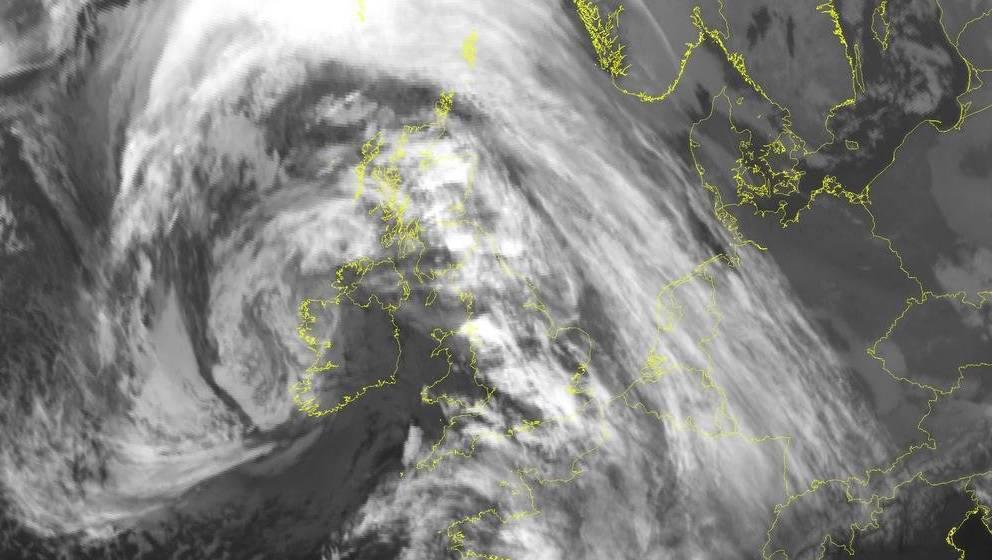
In the early 2020s, the margin of error in tracking an Atlantic storm was about 100km. According to Andrew Parnell from UCD’s Aimsir research centre, AI has cut that to below 50km. Picture: Met Éireann

Weather forecasting has become 1,000 times more efficient because of new artificial intelligence (AI) systems, with advances saving lives, a leading expert will tell politicians.

Professor Andrew Parnell, director of UCD’s Aimsir research centre, will outline how weather forecasting has been “completely upended” by AI over the past three to four years, when he appears before the joint Oireachtas committee on AI.

“Our traditional weather forecasts are based on mathematical equations of the atmospheric system and have served us well over the last 70 years,” he will say.

“For example, back in the 1960s, our error in estimating the track of an Atlantic storm for where it would be in three days’ time was over 700km. By the early 2020s, with satellites and our modern computational systems, it has fallen to around 100km.

“The one-day forecast is now below 50km. These advances have saved countless lives both in Ireland and across the world,” Mr Parnell will tell the committee.

An arial view of Midleton during flooding from Storm Babet in October 2023. Picture: Guileen Coast Guard

In 2022, the European Centre for Medium Range Weather Forecasting, funded by 23 European countries including Ireland, released its AI weather forecasting system AIFS, which now beats the latest traditional weather forecasting approaches by 10-15%.

“Perhaps the most remarkable statistic about this new AI method is that it is estimated to be 1,000 times more efficient at producing a weather forecast than our previous approaches,” the academic will say.

“Weather forecasts can be obtained in a fraction of a second, even on a standard laptop that you or I might have on our desks”.

Mr Parnell will tell the committee that the purchase and deployment of the new Caspir high-performance computing system through the Irish Centre for High-End Computing is “vital” for keeping Ireland at the forefront of the data-driven prediction aspect of AI.

Concerns over data centre climate impact

However, professor Jennie Stephens, of the Icarus climate research centre at Maynooth University, will warn of the damaging impact AI is having and will call for a ban on new data centres here.

“Despite decades of scientific evidence demonstrating the urgent societal necessity for fossil fuel phaseout, the rapid deployment of AI has led to a dramatic increase in fossil fuel exploration, extraction, and use,” she will say in her opening statement to the committee.

She will warn that there are currently no “guardrails exist to prevent the ecological devastation” of data centres, so a ban on data centres in Ireland is urgently needed, and new corporate payments for damages are required for existing centres.

Hannah Daly, a professor of sustainable energy at UCC, will echo this by stating that Ireland is among the first countries in the world to experience the consequences of large-scale growth in data centres, which are now accelerating rapidly to serve AI growth.

“Unfortunately, Ireland is increasingly being viewed internationally as a cautionary tale rather than a model to follow,” professor Daly will tell the committee.

“Electricity demand growth from data centres has outpaced planning, grid development, and the pace at which renewable energy is displacing fossil fuels.”

More in this section

Politics

Newsletter

From the corridors of power to your inbox ... sign up for your essential weekly political briefing.

Cookie Policy Privacy Policy Brand Safety FAQ Help Contact Us Terms and Conditions

© Examiner Echo Group Limited