'You can look down on me, but you could be down here too. Nobody knows what put me here'

Donal O'Keeffe examines addiction, homelessness and rough sleeping as calls grow for expanded support services across Cork city
By 7am most mornings, there will be half a dozen people or more hanging around the Lapp’s Quay area, rough sleepers waiting for the homeless service’s day centre to open at 9am. Picture: Larry Cummins

By 7am most mornings, there will be half a dozen people or more hanging around the Lapp’s Quay area, rough sleepers waiting for the homeless service’s day centre to open at 9am. Picture: Larry Cummins

“People are afraid of the big, scary, heroin addicts,” said the young man sitting on the pavement outside Cork Simon, “but there’s way scarier than us out there.”

He is one of the many people living with addiction in Cork City, tramping the streets during the day, begging — or stealing — the price of the next fix, their drug-taking often open and increasingly visible.

“People look down on us, and they think they’re better than us, but there are people attacking us, and it’s like nobody cares, but we’re human beings too,” he said.

“You can look down on me, but you could be down here too. Nobody knows what put me here, nobody knows what goes on behind closed doors.”

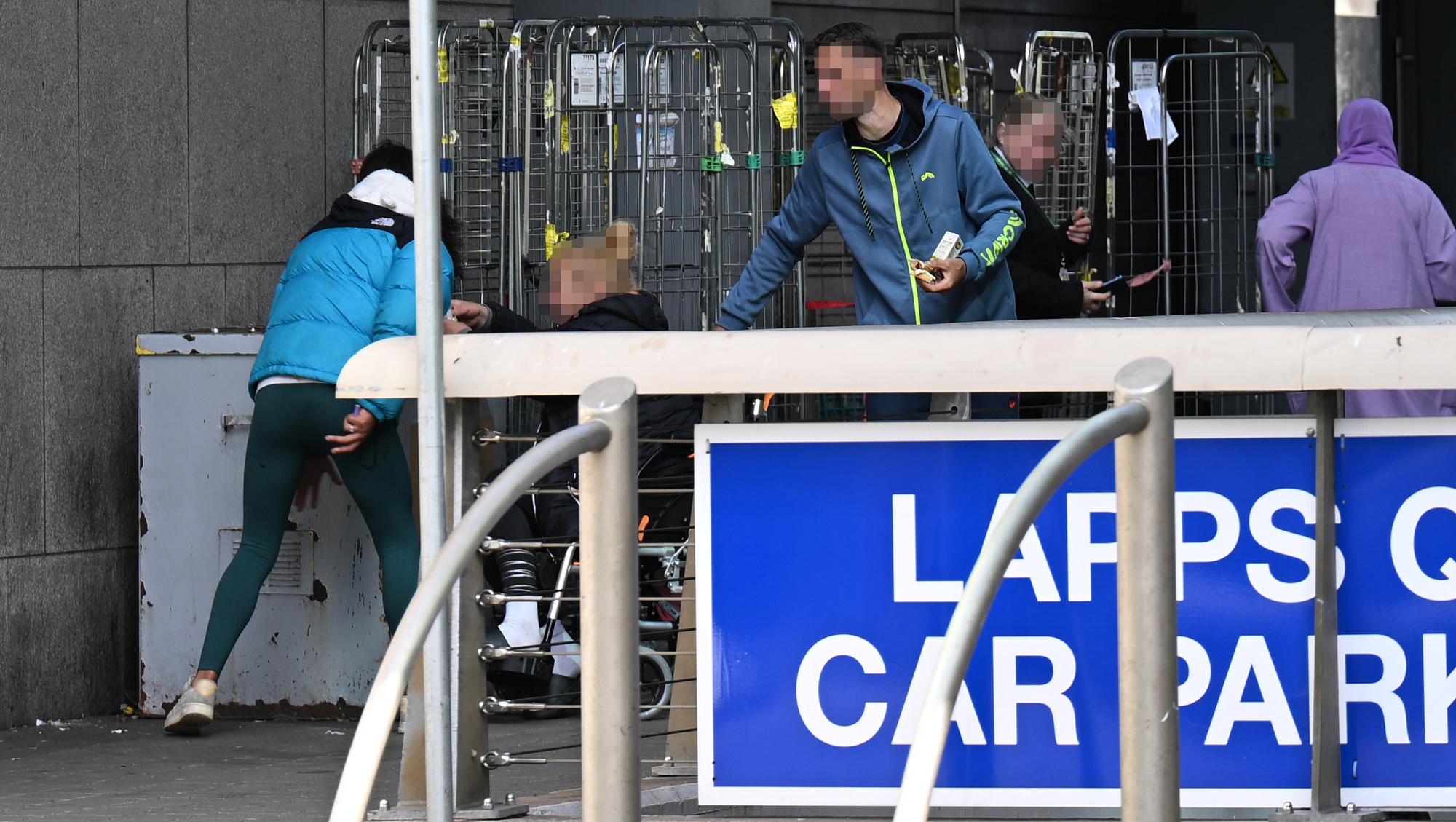
Early morning on the Lapp’s Quay boardwalk, inside the broken rear door of the Fly Coffee shop, another man, perhaps in his 40s, struggled to pull his trousers up after injecting himself in the groin with heroin. 

A woman, possibly in her 30s, attempted to help him. Both were dishevelled and disoriented.

A rough sleeper in a sleeping bag near the cafes on the boardwalk on Lapp's Quay, Cork City. Picture: Larry Cummins

Taoufik Hammami has owned Fly Coffee for almost five years. The back door of his premises is routinely broken open and used for shelter while addicts shoot up.

“I contact the gardaí all the time, and they are very good, but there is only so much they can do, but every single morning there are needles left here, and not just needles, but people sleep here and defecate and urinate here,” he said.

I feel sorry for the poor people, and I know it’s not their fault, but my business is attacked and robbed many times, and I find it hard to keep staff. It’s really sad, but I have to deal with it myself.

“It’s a lovely area here, but all the businesses have the same problem.”

Homeless people and rough sleepers are drawn to the area because of its proximity to Cork Simon, but also because it has multiple CCTV cameras offering a sense of security.

Every day, Cork Simon sends out workers with specialised training and equipment to gather and safely dispose of discarded needles, as does Cork City Council’s cleansing department, but there are always more to be found.

Street drinkers gathered on Merchants Quay, Cork City. Picture: Larry Cummins

By 7am most mornings, there will be half a dozen people or more hanging around the Lapp’s Quay area, rough sleepers waiting for the homeless service’s day centre to open at 9am.

Around 9am last Wednesday, a thin young man crouched in one of the doorways at the back of the Clayton Hotel, by the vehicular entrance to the Lapp’s Quay underground car park. He had in his hand a syringe filled with a diluted bloody liquid.

Other men huddled together in doorways, performing painfully obvious handovers of money or drugs.

Towards the corner by Lower Oliver Plunkett Street, another thin young man, this one in a heavy black coat and sitting against the wall of the hotel, came suddenly awake, his face deathly pale. 

Over by Cork Simon, a queue of eight people waited. 

Its day centre is open to service users from 9am to 1pm five days a week. There, they can get some brief respite and access medical assistance, counselling, food, and showers; and outreach workers help them to fill in forms for vital services.

Coffee cup, orange juice carton, and syringe wrapper discarded near Lapp's Quay, Cork City. Picture: Larry Cummins

On the pavement outside Cork City Council’s Accommodation Placement Services (APS) office and the side of Tequila Jack’s restaurant, a young red-haired woman slept fitfully, lying face down with her hands clasped to her ears. 

From overhead speakers, Rossini’s William Tell Overture pumped out on a permanent 24-hour loop, its tinny, galloping strains modulating in volume over the same three-minute snatch of the orchestral piece.

Later in the day, the young woman described it as “a pure torture”, saying: “If you’re off your head, you’ll go to sleep anywhere, but you’ll be waking all night with that music tormenting you.

“The music won’t stop you from being there, it’ll just make life even more miserable.”

The Clayton Hotel, Cork City Council, and Tequila Jack’s all said they were not responsible for the music. Efforts to contact the company managing the building proved unsuccessful.

According to the 2026 EU homeless figures, as many as 40 people sleep rough most nights in the city, in shop doorways, on the boardwalk, or on the few remaining green areas in Bishop Lucey Park. In the morning, you can count the sleeping bags, some discarded and soiled, some folded neatly.

Monthly homeless figures in the city break records with depressing regularity, and the latest Government figures show there were 828 adults in homeless accommodation in Cork in June, up from 819 in May and a 25% increase from 606 in June 2025.

As is repeatedly stressed by homelessness charities, those figures do not reflect the number of people living in precarious housing conditions, on the brink of homelessness.

It’s important to say many who are homeless do not sleep rough, and there is a broad spectrum from losing a home to sleeping outside Penneys. 

Similarly, not everyone sleeping rough is an addict, just as not everyone who is an addict is homeless or sleeping rough. 

However, as has often been observed by those living on the streets, “you wouldn’t do this sober”.

There was a time when addiction was a reliable predictor of homelessness, but the housing crisis has meant that, in some cases, homelessness has now become the gateway to addiction.

A walk through the city most days will offer abundant evidence of drug-taking, with drug paraphernalia abandoned in doorways, green spaces, and alleyways across Cork.

Needles related to drug use are often visible on city centre streets. Picture: Noel Sweeney

Used syringes and burnt tin foil can be found in corners all over the city centre, often accompanied by signs of human waste, and since high-visibility policing was introduced in November, drug taking has also moved out to the areas around the centre, and to the suburbs.

On Oliver Plunkett Street, traders say they regularly see rough sleepers being brought to the GPO by dealers, themselves often living with addictions, and having benefit payments taken from them to cover drug debts.

“There’s usually guards watching the GPO, and they’re very good, particularly the community guards, but they can’t catch everything,” said one shop-owner.

“You’d see them, like lost souls, being led up to the door, God love them.

“There’s definitely more addicts around nowadays. Mostly, they’re harmless, but then you’d see them after taking drugs, and they’d be zombified.

“Sometimes you see some of them fighting, and it can be scary.

You’d wonder what the tourists make of them falling around the place.

Garda sources say despite some perceptions of a worsening of the situation in the city, statistics do not bear them out, with little or no change to the numbers of incidents or investigations over the past six months.

“There are more areas than ever before for people to sit down in the city, with the new flowerbeds on Patrick Street, Bishop Lucey Park being open 24/7, and the space on the South Mall, so maybe in what has been an exceptional summer, people with addictions have been more visible, but our gardaí will tell you there’s no one around that hasn’t been around previously,” one garda said.

“There is drug activity around the city, and drug dealing, but as long as people have addictions, they will feed those addictions, and there will be people to take advantage of those addictions.

“We have drug taking in the city, and we have had some displacement of that, but we have more gardaí in the city than we have ever had before, and while there are isolated incidents, this is actually a very calm time of the year.”

Some business sources dispute such incidents are isolated, saying they occur with increasing regularity.

Just after 4pm on Wednesday afternoon, four Garda cars and a van attended a scene off MacCurtain Street, around the corner from the Met Tavern, and a man in a state of distress was arrested at the scene.

Outside Cork Simon on the same afternoon, five people were hanging around with nowhere to go. 

One was a woman in her 30s, sitting in a wheelchair. 

The thin young man in the black jacket, who had that morning awoken against a wall, was there, as was the young red-haired woman who had earlier been trying to sleep beneath the woodwind and hoofbeats of William Tell.

The wheelchair user gave her name as Fiona and said she had been homeless “on and off” since she was 13.

“I’m a recovering heroin addict, and I was on the streets years before I ended up on heroin,” she said.

“I was in care, and I ended up on the streets. I have three children, but I don’t see them, since I got sick,” she said.

It’s very hard. The streets are very dangerous. A lot of men approach a woman on the street and automatically think she’s a prostitute, or they can force themselves on her.

She pointed to the young man, still wearing his heavy black jacket despite the day’s heat, and said: “That lad saved me from getting raped only two nights ago.”

She added she was hoping to stay clean and to get an apartment of her own.

“It’s the time that’s the worst on the streets,” she said. “There’s nothing to do all day, the guards just move you on all the time, you’d be down around here, you’d be in town, the guards move you and move you again. There’s nowhere to go.”

At this, the young man in the black jacket said: “You just try and black out and get away from the pain for a few hours, you numb the pain, and you black out.

“You’re gone for a few hours, and then you have to come back again until you can numb the pain again.” 

In his early 20s, the man wouldn’t give his name but said he had been on the streets since he turned 18.

“I was in care, and that was shit, but at least you’d have somewhere to go.

“Once you turn 18, nobody gives a fuck about you,” he said.

“I came from a good background, but that means nothing. You wouldn’t believe what was done to me.”

He became upset and walked away, and the young red-haired woman went after him.

Asked what her immediate wish would be, Fiona said a place of her own, and to stay clean. Then she added: “And somewhere to go for all the people with nowhere else to go, and a medical centre where people could inject in safety”.

In the city centre, scenes of homelessness and substance abuse has become commonplace. Picture: Noel Sweeney

An older man, aged perhaps somewhere between 40 and 65, butted in and then walked on, saying: “We need our own Merchants Quay”, referring to Ireland’s sole supervised injection facility.

Run by the homeless and drugs charity Merchants Quay Ireland, it first opened officially in Dublin in December 2024 as part of an 18-month pilot scheme to safely monitor drug injection in controlled circumstances.

Earlier this summer, Taoiseach Micheál Martin told this newspaper the Merchants Quay project had been “effective, impactful, and successful”, adding he believed Cork “absolutely” needed a supervised injection centre, but he conceded agreeing on a location might be an issue.

“Certainly, we have to be innovative in helping people to come off addiction and deal with addiction,” Mr Martin said.

The Department of Health has indicated it will consider calls to expand drug injection centres to Cork and Limerick, once an evaluation of the Merchants Quay facility is published.

New day centre planned

Separately, last December, the HSE tendered for a premises for Cork’s first dedicated day centre for homeless people, a concept long championed by Colm Burke, Fine Gael TD for Cork North Central.

Mr Burke, who previously served as minister for state with responsibility for drugs policy, said such a facility would give people sleeping in shelters a safe, dignified alternative to spending their days on the streets.

“We currently have homeless people in Cork City, many of whom do have accommodation at night, but there is no place for them to go during the day,” he said.

"This day centre will have a number of different services in there from the HSE, and I very much welcome that there is now progress being made on it."

It is understood funding has been secured for the centre, and talks are currently at an advanced stage with the owner of a large city centre premises.

For Fiona, in her wheelchair, among her small community on the pavement outside Cork Simon, that facility cannot come quickly enough.

“If we had this day centre, that’d be great, that’s badly needed, where you could go and have a sit down and a bit of dignity,” she said.

A doorway on a side street near Kent Station where needles and remnants of IV drug use and prescription drug abuse is openly visible to passersby. Picture: Noel Sweeney

And a supervised injection facility, that’s badly needed too, people are dying on the streets, and if they had a place where they could shoot up with medical people watching out for them, they mightn’t die.

David Lane, HSE South-West general manager and regional lead for social inclusion, said he was optimistic a positive announcement was “imminent” regarding a day centre which would be open 12 hours a day, seven days a week in Cork city centre.

“I would be expecting that it should be operational by the first quarter of 2027, although there is a lot of work to be done in terms of refurbishing the premises to make it suitable for very vulnerable people who need lots of different kinds of help,” he said.

“The HSE and Cork City Council will be working with a Section 39 identified to support this work over the coming years. This is something we have been working at for over two years, and it has been frustrating at times in terms of the slowness of it being implemented, but there were a lot of moving parts for us to manage.”

Mr Lane said he was excited by the potential for such a service to give people in Cork a place to go during the day, every day.

“People deserve dignity and respect, and people need to have the support of the State and community voluntary sector to help break the cycle that they’re in and try to get a bit of stability back into their lives, and look at getting long-term accommodation,” he said.

Supervised injection facility

On the separate issue of a supervised injection facility, Mr Lane said the HSE was looking even beyond that now; and examining the need for a medically supervised consumption facility.

“While I have been very focused over the past 10 years on the challenges around heroin misuse in the city, and overdose deaths and preventable deaths, we’re moving into a broader space regarding the nature of drug use; and being able to support people who are using other kinds of drugs, and ensuring that they don’t suffer overdoses,” he said.

There are between 18 and 30 deaths annually in Cork city from problem drug use, not just heroin use, but polydrug use as well, with people mixing drugs and getting into overdose situations.

“That’s why I would be saying we need to look beyond a medically supervised facility for just heroin and looking instead at a broader issue that we need to tackle head-on.”

At 8am yesterday, the scene around the boardwalk was the same as it is most mornings.

There were people in sleeping bags behind Fly Coffee, and outside the APS office, while on the speakers that nobody seems to own, William Tell was still going by on the gallop.

As usual, some people shuffled between the doorways at the back of the Clayton, some of them recognisable from other mornings, picking their way over sleeping bags, searching for the next blackout, and trying to get through the time on endless days with nothing to do and nowhere to go.

x

More in this section

Lunchtime News

Newsletter

Get a lunch briefing straight to your inbox at noon daily. Also be the first to know with our occasional Breaking News emails.

Cookie Policy Privacy Policy Brand Safety FAQ Help Contact Us Terms and Conditions

© Examiner Echo Group Limited