Irish farmers more environmentally conscious than public, while Gen Z turns to influencers for climate information
Farmers are also much less likely to support government policies on higher tax on petrol and diesel, higher carbon tax, and reducing the national herd to tackle climate change.
Irish farmers are more likely than the wider public to say they are environmentally conscious, while nearly one in five Gen Zers place their trust in online influencers for climate knowledge and information.
Farmers are also much less likely to support government policies on higher tax on petrol and diesel, higher carbon tax, and reducing the national herd to tackle climate change.
In an Ipsos B&A poll of 1,056 adults for the , farmers were more likely than the general public to say they feel personally prepared for climate change at 41% compared to 17%.
However, feeling prepared does not mean farmers think they will escape the effects of climate change. They remain significantly more worried than the average person — 42% of farmers are concerned about extreme heat compared to 28% nationally, while 38% are worried about flooding compared to 26% of the wider population.
Read More
CLIMATE & SUSTAINABILITY HUB
Sinéad Sheehan, who researches climate action and eco-emotions based in University of Galway’s Ryan Institute and School of Psychology, said: “I think this report is useful in promoting the understanding that farmers are potentially environmentalists, with 90% of farmers reporting altering their behaviour.
“Every effort needs to be made by society — for example in relation to climate-related policy — to empower, educate, and enable farmers to be environmental stewards and custodians.”
As farmers were a “key interest group” in the study, and the online methods of the pollsters wouldn’t have given a large enough sample of farmers, face-to-face interviews were conducted with a “booster sample” of around 50 farmers.
Ipsos B&A said that this sample was combined with the main sample and weighted so as to not distort the results.
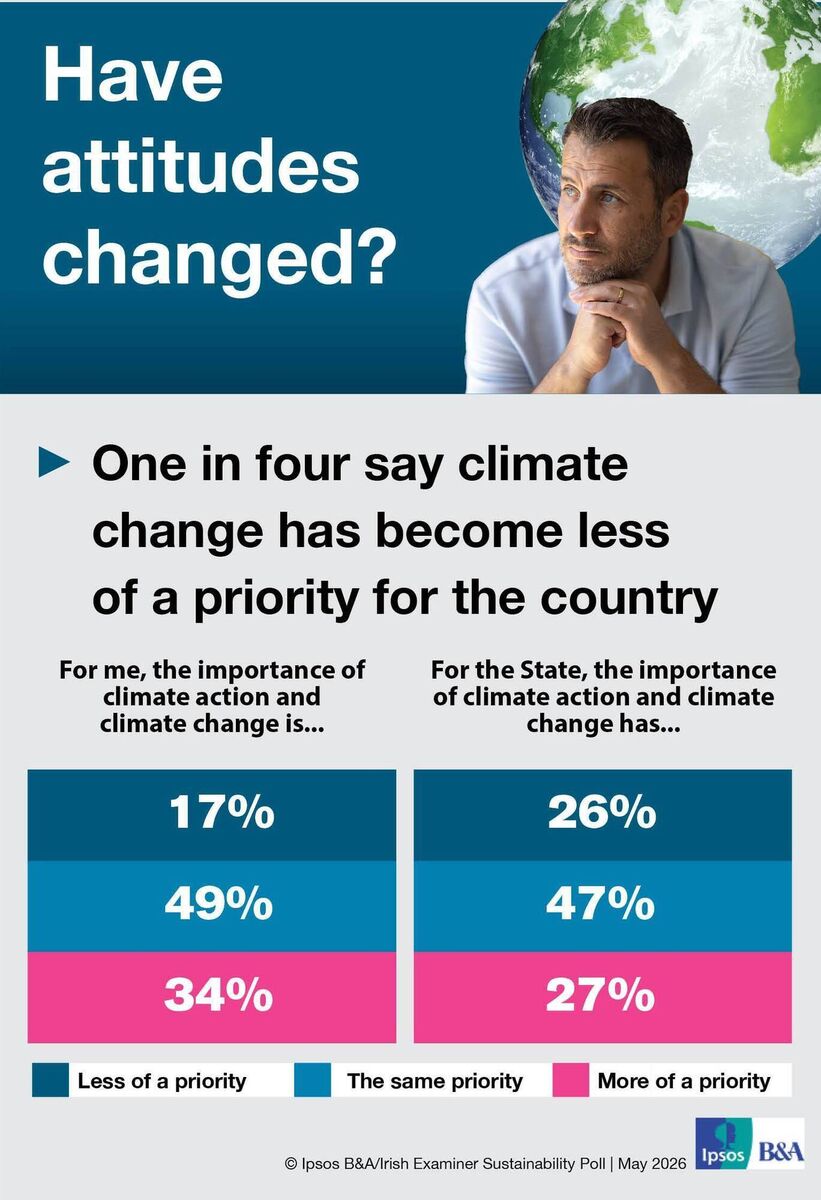
When asked about sustainable practices, farmers were less likely than the general population to take public transport, to travel less by petrol or diesel vehicle, and to protest or demonstrate.
And farmers were more likely to say retrofitting your home would help in combating climate change, but less likely to say second-hand shopping and eating less meat would be beneficial.
Some 35% of farmers said financial freedom prevents them from acting in a more environmentally conscious way, compared to 59% of all adults. Farmers are more likely to see government supports as a key enabler of sustainable action (39%, +14 points compared to the average).
However, they are less likely than the general public to believe that greater awareness of sustainable living or the availability of eco-friendly products will drive change.
When it comes to trusted sources of information, farmers are more likely than the general population to trust weather forecasters (51% compared with 37%).
Trust is lower for the Environmental Protection Agency (EPA) (38% compared with 53%), and particularly low for the Government, at just 12% compared with 30%.
For the population as a whole, scientists are the most trusted sources of climate information with 60% citing them as a trusted source.
Only 8% of people trust online influencers, while 3% trust social media.
Men were twice as likely to trust online influencers at 10% vs 5% for women.
Younger people were also six times more likely to trust influencers for climate content at 18% for 18- to 24-year-olds against 3% for over 65s.
In the past, researchers have highlighted the impact that influencers could have on debates and public awareness around climate change.
More than five years ago, Maynooth University researchers Máire Nic an Bhaird and Laoise Ní Chléirigh examined the role that influencers could play on the issue of climate knowledge.
“Imagine an influencer emphasising biodiversity protection instead of ostentatious balloon arches for birthday parties and gender reveals,” they said at the time.
“We cannot wait for government.
“We must realise our individual choices will make a difference, but our community choices are even more impactful.”
This poll from Ipsos B&A suggested friends and family were less trusted than the likes of scientists and weather forecasters, but the results do skew towards younger people placing more trust in family, friends, influencers, and social media.
Older people, on the other hand, had much higher rates of trust in weather forecasters and the EPA.
A study published last year from researchers at the University of Queensland in Australia and the Edelman Trust Institute in New York emphasised that, while attention is paid into what messages are persuasive when it comes to communicating to the public about climate change, who is delivering the message and how it is delivered is also important.
“In the face of accelerating climate risks, building public trust in climate information is both a scientific and societal imperative,” the researchers said.
“While scientists remain highly trusted among many, informal networks — particularly friends, family, and ‘people like me’ — play a central role.”
Read More
CLIMATE & SUSTAINABILITY HUB
CONNECT WITH US TODAY



Be the first to know the latest news and updates