King of the hills: Going wild about our old Irish goats
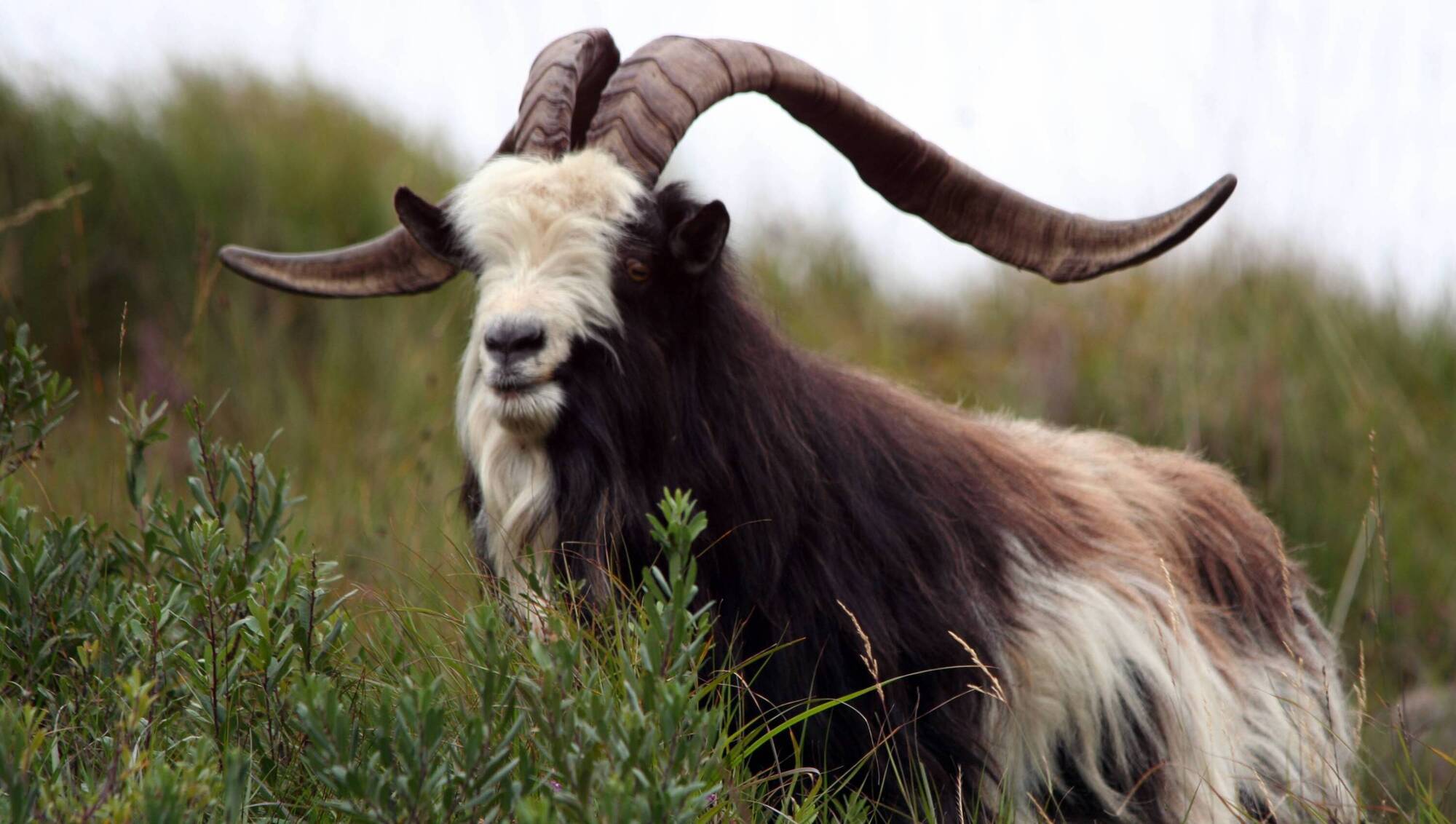
Despite its neglect, the Old Irish Goat survives in the wild near Mulranny, the Hill of Howth, and elsewhere around Ireland. Picture: Seán Carolan
We refer to our children as ‘kids’, but our attitude to goats is ambivalent. Muriel the Goat, in George Orwell’s Animal Farm, is a respectable citizen. She can read, but she’s deemed to be lower in the social pecking-order than the pigs. A captured goat is crowned during Puck Fair, but an Puc ar Buile is a tricky customer.
Nor is the goat love-hate relationship just an Irish thing. The Greek god Pan was half-man half- goat. Symbols of lechery and agents of Satan, goats were not to be trusted. At Yom Kippur, the Day of Atonement, the scapegoat takes on the sins of the community and carries them off into the wilderness.
Despite its unique talents, the goat is the poor relation of Irish livestock. Just 7,303 were recorded in a 2023 census here. Compare that with our eight million cattle and five million sheep. But, despite its neglect, the Old Irish Goat survives in the wild near Mulranny, the Hill of Howth, and elsewhere.
Researchers, led by Judith Findlater of Queen’s University Belfast, have analysed goat remains from two locations; six from the late Bronze Age Haughey’s Fort in County Armagh and two from late medieval Carrickfergus.
Goats and sheep are so closely related that telling their bones apart in ancient digs is a notorious problem. However, the Queen’s University team combined genetic data, protein analysis and archaeological techniques, to identify the bones unearthed as belonging to goats.
The two species have contrasting lifestyles. Sheep are grazers; they feed mostly in open terrain. Goats are browsers. Eating the leaves of bushes and trees, they have developed more varied and adventurous ways. Climbing may not seem to be an ungulate thing, but cloven hoofs have two toes which can grip like pincers. The can also spread out to maintain balance. Sure-footed, goats will venture safely onto scary cliff ledges. Seeing groups of them browsing fruit at the tops of Argan trees, eight to ten metres above the ground in Morocco, is an incongruous sight.
Goat digestive systems are equally adventurous. The tough plants, at which other farm animals turn up their noses, can’t defeat a goat’s stomach.
The Queen’s University research revealed ‘a deep signal of connection between the late Bronze Age Haughey’s Fort goat and the Old Irish Goat of today’, the researchers note.
Goats probably arrived in Ireland with the introduction of agriculture around 5,900 years ago. Ireland, back then, was a country of trees bushes and swamps. It must, therefore, have suited the rearing of goats; robust animals which will eat virtually anything. But these animals are adventurous, unpredictable and can be aggressive. Difficult to herd, they would have to be tethered, lest they wander off.
With the gradual removal of trees and bushes over the millennia, tillage and the grazing of cattle and sheep dislodged King Puck from his throne.
The Wild Irish Goat, a romantic outlaw from farmed civilisation, has managed not only to survive in the wild, but to maintain its identity for six thousand years. We should be proud of this honorary member of our wild fauna.
- Judith Findlater et al. Old Goats: 3,000 Years of Genetic Connectivity of the Domestic Goat in Ireland. Journal of Archaeological Science. 2026