Hot topic: The impacts of El Niño in a warmer world
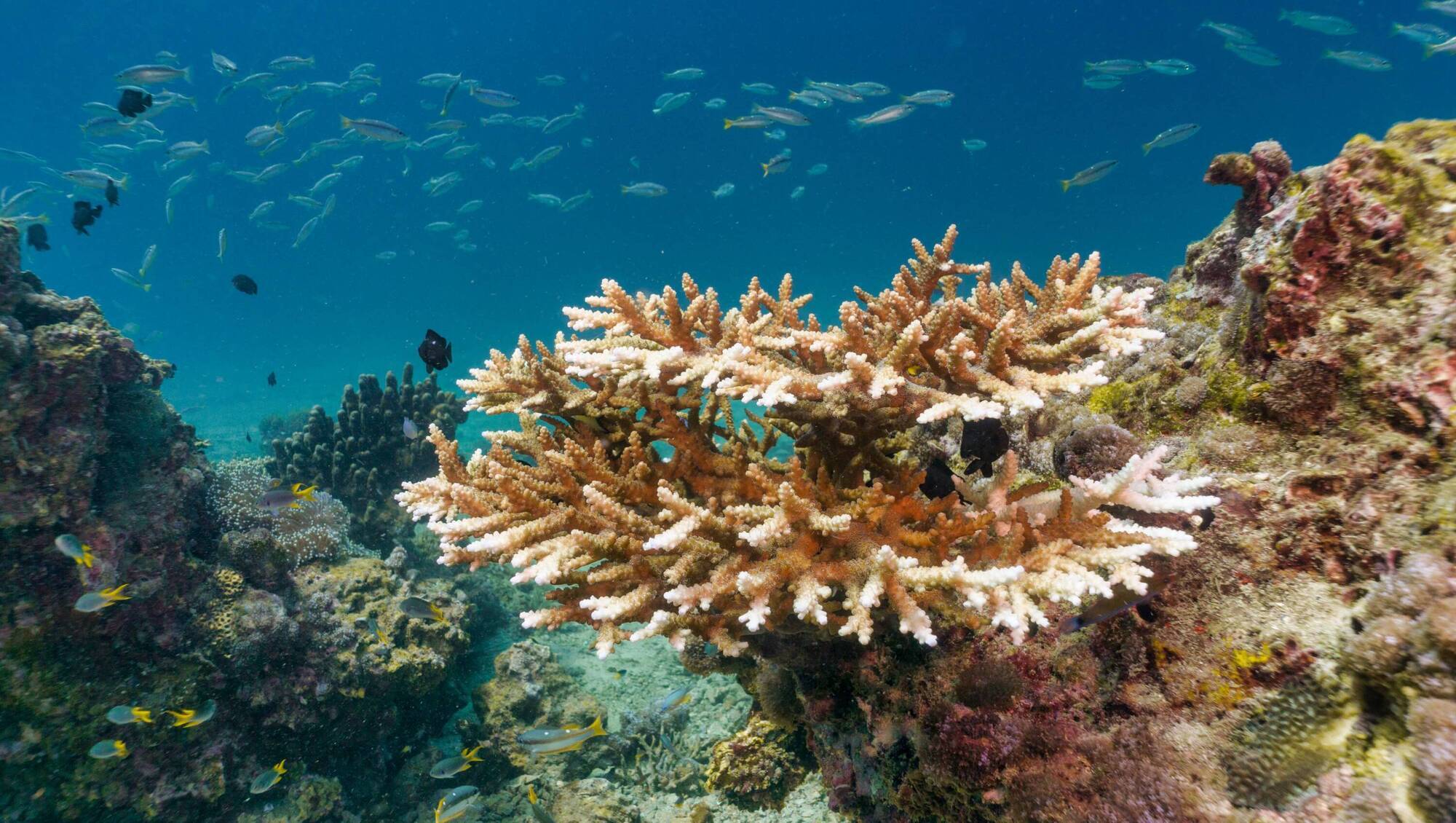
Staghorn coral in the Phi Phi Islands, in the Andaman Sea, Krabi, Thailand, showing early signs of coral bleaching as the tips turn white. El Niño can result in marine ecosystems altering as the base of the food chain changes. Coral reefs can bleach under enhanced thermal stress. Picture: iStock
The Pacific Ocean punches well above its weight in shaping global climate. Small changes in its temperature and winds can ripple outward, reshaping rainfall, intensifying extremes, and pushing global temperatures higher. This is the El Niño–Southern Oscillation (ENSO) in action and it’s a powerful climate cycle that flips between warm, cool, and neutral states. At the moment, it appears to be shifting again, and that shift matters.
The Pacific Ocean is currently in the late stages of a weak La Niña event. This system is weakening rapidly. Sea surface temperatures in the central and eastern equatorial Pacific are near or slightly below average. Climate scientists expect a transition to neutral conditions within the next month or two.
Neutral may sound calm, but it is often a transitional phase, and frequently the most unpredictable. Beneath the surface, heat is already building in the ocean, and trade winds are showing signs of weakening. These are the classic early signals that often precede El Niño. Forecasts indicate a growing chance that El Niño will emerge by June–August 2026 (currently around 62% probability) and could persist through the end of the year and beyond.
Of course, we are now entering the infamous spring predictability barrier, which is a fancy way of saying a period when ENSO forecasts are notoriously less reliable as the ocean-atmosphere coupling is weak. This means the outlook could still shift in the coming months. Even so, the Pacific is clearly stirring, and history shows that when it does, the effects are rarely subtle.
Under normal conditions, strong trade winds push warm surface waters westward toward Indonesia, allowing colder, nutrient-rich water to upwell (rise) off the coast of South America. It’s a stable system, more or less. Productive fisheries thrive. Rain falls where it is normally does. The atmosphere and ocean stay in step. El Niño disrupts that balance. The trade winds weaken and warm water moves back eastward across the Pacific. The cold upwelling off Peru collapses. Entire weather systems reorganise themselves in response.
The consequences are not abstract. They are immediate and unevenly distributed. Parts of South America can experience intense flooding, while Australia and Indonesia are pushed toward drought and wildfire risk. Marine ecosystems alter as the base of the food chain changes. Coral reefs can bleach under enhanced thermal stress. Fisheries, particularly in the eastern Pacific, are impacted. And hovering over all of this is an uncomfortable truth that El Niño years tend to push global temperatures higher. Not because they cause climate change, but because they amplify it, stacking natural variability on top of already warming conditions.
ENSO is not new. It has been part of Earth’s climate system for thousands of years, recorded in corals, lake sediments, and cave deposits across the tropics. But what those palaeoclimate archives also tell us is that ENSO is not fixed. It changes over long time periods. There is growing evidence that the frequency and intensity of strong El Niño events have increased in since the mid-20th century. Climate models suggest that in a warmer world, the most extreme El Niño events may become more common.
This is not just background variability anymore. It is variability interacting with a system already under strain. Warmer oceans, higher baseline temperatures, and altered atmospheric circulation mean that when El Niño arrives, it does so on a different playing field than it did even a century ago. In short, the stakes are higher.
But ENSO is not a villain in a climate story. It’s powerful. Long before climate models and satellite data, Polynesian navigators were reading the Pacific with extraordinary precision. They understood its rhythms. Its winds, swells, and seasonal shifts. Palaeoenvironmental evidence suggest that periods of increased El Niño-like conditions coincided with key phases of Polynesian expansion across the Pacific Ocean, particularly between about 1000 and 1500 years ago. During these times, weakened trade winds and altered ocean currents would have made eastward voyages, normally the most challenging direction, more achievable.
This matters. The Pacific is vast, and under typical conditions, its prevailing winds resist eastward travel. But during El Niño phases, that resistance eases. The ocean, in effect, becomes more navigable. It is entirely plausible that these climatic windows helped facilitate some of the most remarkable voyages in human history, enabling the settlement of remote islands such as Rapa Nui. Climate variability, in this context, was not a hazard. Instead, it was an opportunity, seized by people who knew how to read the ocean.
If El Niño does develop in the coming months, it will not arrive in isolation. It will layer itself onto an already warming climate system that has, in recent years, repeatedly broken temperature records. The result will likely be a temporary boost in global average temperatures, alongside a reshuffling of regional weather extremes. Some regions will face heightened flood risk, others prolonged drought. Marine ecosystems already stressed by warming oceans may experience additional pressure, from coral bleaching to shifts in fisheries.
This is not a distant or abstract phenomenon. It is a powerful reminder that Earth’s climate operates on multiple timescales at once: the slow, steady rise in baseline temperatures driven by greenhouse gases, intertwined with faster natural oscillations like ENSO that can amplify impacts and catch societies off guard.
Whether 2026 delivers a full-fledged El Niño, a weaker one, or an extended neutral phase, the broader direction matters. These events don’t just shape weather for a season; they test how well prepared we are for variability in a world that is already warmer and more volatile than it was even a decade ago. ENSO may be natural, but its consequences are increasingly shaped by a climate we have already altered.
CONNECT WITH US TODAY



Be the first to know the latest news and updates