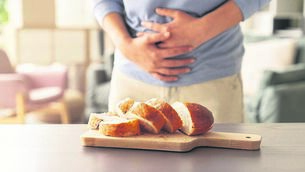
IT’S the time of year when we often reach for comfort foods - a slice of gingerbread loaf, a mince pie - but experts urge us to hold fire as they could affect how our bodies cope with stress.
In two recent studies from the University of Birmingham, researchers have discovered that eating high-fat foods when feeling frazzled triggers a cascade of unwanted health reactions.
Stress is known to cause cardiac changes in the body — our heart rate and blood pressure rise almost instantly, for example, when we feel under pressure.
“These responses are totally normal, and in healthy people, blood vessels dilate nicely, which reduces the pressure on the vessel walls,” says Rosalind Baynham, a PhD researcher and lead author of the new studies.
“In people at risk of heart disease, their blood vessels are not as elastic and so there’s an impairment in endothelial function, or how well their blood vessels dilate, during and following stress and that means blood isn’t getting where it needs to be, such as to the heart and brain.”
For the first part of their investigation, Baynham and her colleagues wanted to find out whether a moderate intake of fatty foods, similar to the amount many of us would eat when feeling stressed and anxious, affected vascular function in otherwise healthy, young individuals.
For the trial, participants were asked to consume two all-butter croissants containing around 56.5g of fat before completing an eight-minute maths stress task.
Results published in the journal Frontiers In Nutrition, showed that the two croissants caused a sharp and potentially harmful drop in the healthy elasticity of blood vessels in the participants who had no history of heart disease or other health issues.
And 90 minutes after the maths task, tests showed that artery elasticity was still not back to normal.
It isn’t just the arteries that suffer when we indulge.
For a second paper, published in the journal Nutrients, the team looked at how fatty snacks affected brain function following the stress-inducing number tests.
They found that after eating the fat-laden croissants, oxygen flow to the pre-frontal cortex part of the brain that regulates our thoughts, actions and emotions was reduced.
During and after the stress tests, the participants also reported plummeting mood, something they didn’t experience with the control meal.
And that switch in state of mind could make people feel more stressed than they were to start with.
While a fortunate few eat less when stressed, there’s evidence that many people’s brains are programmed to crave calories in the form of fat and sugar.
Neuroscientists at the Garvan Institute of Medical Research in Sydney recently showed in the journal Neuron that this combination of calorie-dense ‘comfort’ foods and stress triggers changes in the brain that increase cravings for even more sweet, highly palatable and fatty food.
“When we are stressed the part of the brain that is in charge of decision-making is not optimal, and we are often driven to eat foods that are higher in fat, salt and sugar — foods that feel pleasurable and comforting,” says Waterford-based dietician Aoife Hearne. “But the comfort we may feel is often only short-lived and whatever is driving your stress remains.”
Over time, the ‘reward’ and pleasure we get from eating comfort foods wanes, she says.
“We need more and more of these foods to get the same ‘hit’.”
When you consider that a regular bag of crisps contains 7.7g of fat, a Twix 12g, a blueberry muffin 14.6g, and a mince pie provides 9.9g, it is not surprising that the effect on our waistline — and health — can be significant when we overindulge.
The upshot is we often don’t feel better but worse. “We need to set up our homes, cars and offices so that real food is the easy or obvious choice to pick, says Hearne.
“Foods that are higher in fibre and have protein will help keep us feeling fuller for longer are great and a better snacking pattern contributes to a happy brain.”
What else makes stress worse?
Alcohol
Drinking small amounts of alcohol is believed to reduce the negative emotional effects of stress and anxiety.
However, more could backfire.
In a study published in the American Journal of Physiology, Heart and Circulatory Physiology, a small glass of either red wine or the same volume of other types of alcohol helped blood vessels to become more ‘relaxed’ or dilated, which reduced stress on the heart.
But a study at the University of Chicago suggested that while small amounts of alcohol might relieve stress and reduce the release of stress hormones such as cortisol, it also prolongs the feelings of tension produced by the stress and can trigger people to drink more in the mistaken belief it is helping them to calm down. One drink is always enough if stressed.
Salt
Results of a study by cardiologists, published last year in the journal Cardiovascular Research, suggested that a high-salt diet can send stress hormones soaring up to a worrying 75%.
“This study tells us that high salt in our food changes the way our brain handles stress,” said Matthew Bailey, professor of renal physiology at the University of Edinburgh’s Centre for Cardiovascular Science, lead author of the study.
Sugar
A team of scientists reviewed 31 published studies involving almost 1,300 adults to determine whether snacking on sugary foods will help you feel better.
The conclusion of their paper in the journal Neuroscience & Biobehavioral Reviews was that sugar has no positive effect on mood and consuming lots of it can worsen your stress rather than relieve it.
“If anything, sugar will probably make you feel worse,” they wrote after identifying that sugar-eaters felt more tired and less energetic.

Cancel anytime
CONNECT WITH US TODAY
Be the first to know the latest news and updates