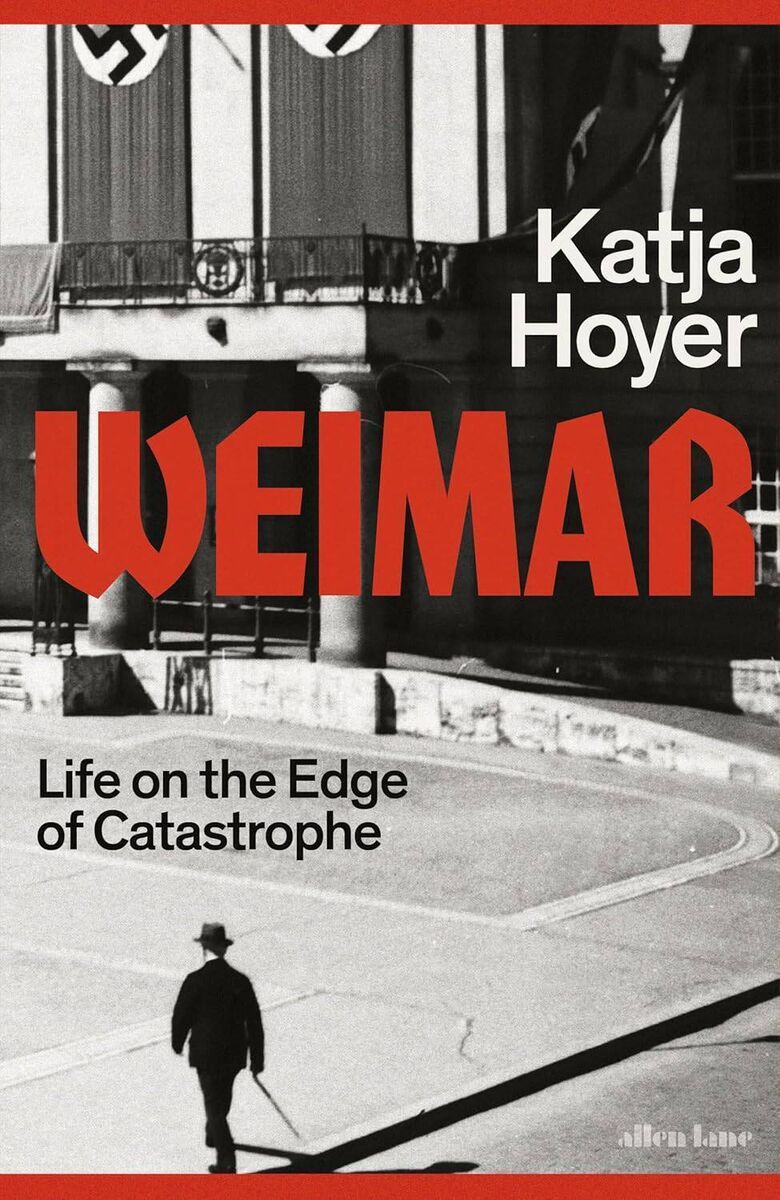
Book review: How evil quickly erodes society

This is an important book for anyone who, like Churchill, recognises that of all the systems we’ve tried, democracy is by far the best
Katja Hoyer’s call to arms is full of troubling anecdotes.

Katja Hoyer’s call to arms is full of troubling anecdotes.

  • Weimar: Life on the Edge of Catastrophe 
  • Katja Hoyer 
  • Allen Lane, €37.50 

This clarion call comes just as Europe and its once reliable ally across the Atlantic flirt openly with ideas that always lead to autocracy and terror.

In her engaging telling, Katja Hoyer, like any worthwhile historian must, vindicates John Stuart Mills’ warning from 1867: 

“Bad men need nothing more to compass their ends, than that good men should look on and do nothing.”

That is an accurate, well-thumbed adage, but Hoyer’s fresh exposition examines a cultured community in the central German town of Weimar between the world wars. 

It is, or was, easily recognisable as modern, enlightened, and European, entirely comparable with its contemporaries in our then nascent Republic.

The book remembers the lives, the hopes, and horrors, of some 35,000 residents of the modest Thuringian town that, because of Hitler’s understanding of the power of image, impression, and reassurance, gave its name to a new German republic.

That Berlin was then an explosion waiting to happen was a factor — even tyranny needs stability. 

Weimar’s very tweeness, its bourgeois leanings, its golf-club ambitions made it a nursery for one of the darkest implosions in human history.

Because it venerated poets — Schiller and Goethe — who once lived there; because it celebrated its links with Bach and, briefly, hosted one of modern Europe’s perception-changing cultural movements, Walter Gropius’ Bauhaus, it had to heft to give the Nazis the cover they needed to generate the momentum that would ravage Europe.

Bauhaus, its staff and students were expelled from the town because of “depravities” by those who would build murder factories right across the continent. 

It was another irony beyond irony that Bauhaus graduate Franz Ehrlich survived Buchenwald concentration camp, built just outside Weimar, because his Bauhaus-based design of the motto over Buchenwald’s entrance impressed his SS jailers. 

His rendering of Jedem Das Seine — To Each His Own — was used as a template at many of the Holocaust’s death factories.

It was utterly beyond irony that Weimar’s municipal crematorium was quickly overwhelmed by the flow of corpses from the camp. 

So too was the decision to build bigger, more efficient crematoria because Buchenwald corpses were so emaciated and brutalised that it was almost impossible to burn them. 

This nullifies the ‘we didn’t know’ argument offered by so many Germans.

Hoyer’s magnificent call to arms — to see it as anything else is to miss the point — is full of anecdotes, one more troubling than the other. 

However, there is one very positive story, the advance of medicine that has made Illnesses fatal not so long ago little more than troublesome today.

Her take-home message is how real evil can very quickly destroy a society; how quickly neighbours betray neighbours if a demagogue exploits discontent. 

The book’s closing sentence begs the biggest question. Hoyer closes with: “It is these dynamics that we may find lessons to safeguard democracy and freedom in our own time.”

That raises an altogether grim prospect: Have our liberal, middle of the road, tolerant democrats squandered the kind of credibility and power needed to avert the next Weimar? 

If their inept and dangerous response to climate change is anything to go by, the answer can only lead to even more sleepless nights.

This is an important book for anyone who, like Churchill, recognises that of all the systems we’ve tried, democracy is by far the best.

BOOKS & MORE

Check out our Books Hub where you will find the latest news, reviews, features, opinions and analysis on all things books from the Irish Examiner's team of specialist writers, columnists and contributors.


More in this section

Scene & Heard

Newsletter

From music and film to books and visual art, explore the best of culture in Munster and beyond. Selected by our Arts Editor and delivered weekly.

Cookie Policy Privacy Policy Brand Safety FAQ Help Contact Us Terms and Conditions

© Examiner Echo Group Limited