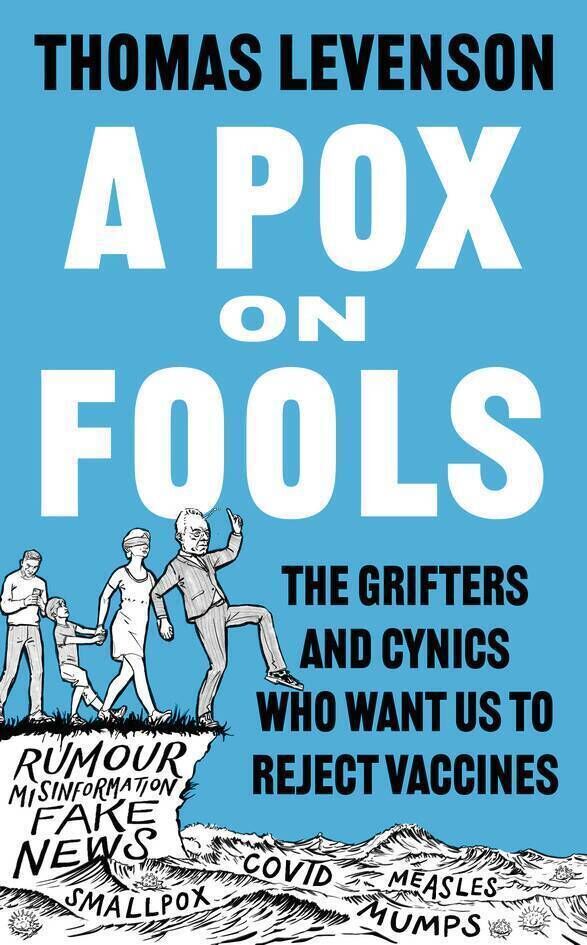
Book review: Vaccines and the idiocy epidemic

Thomas Levenson gives us a fascinating potted history of vaccination, and points out that anti-vax arguments are in fact 18th century objections repurposed for the modern age
Thomas Levenson mounts an eloquent defence of vaccine theory, and cheerfully debunks the antics of self-appointed experts such as Robert F Kennedy Jr, the US secretary of health.

Thomas Levenson mounts an eloquent defence of vaccine theory, and cheerfully debunks the antics of self-appointed experts such as Robert F Kennedy Jr, the US secretary of health.

  • A Pox on Fools 
  • Thomas Levenson 
  • Head of Zeus, €17.99 

Vaccination was one of the great scientific miracles of the 20th century. 

Beginning in the early 1900s, and gathering pace after the Second World War, state immunisation programmes across the Western world and beyond ended the march of killer viruses that had taken the lives of tens of millions, most especially children. 

Measles, mumps, typhoid, polio, rubella — one by one these illnesses were subdued by mass vaccination.

These days though, vaccines have many enemies. 

Starting in the late 1990s with a scaremongering campaign over the MMR jab, modern anti-vax scepticism has become a sort of movement, obsessed with personal liberty and virulently opposed to state management of health. 

The covid pandemic turbocharged this defiantly fact-averse belief system, which has since found its way into the upper echelons of the American government.

In his book A Pox on Fools, the writer and documentarian Thomas Levenson mounts an eloquent defence of vaccine theory, and cheerfully debunks the antics of self-appointed experts such as Robert F Kennedy Jr, the US secretary of health.

Levenson describes vaccines as “a secular miracle”, an “unmatched triumph of human inquiry and technical skill — over death itself”.

His claims are large, but verified by science, unlike the Vesuvian spoutings of Kennedy, who in the space of two years has gutted American vaccine policies, and “made microbes great again”. 

Measles epidemics have revived, killing American children, and a similar scenario is unfolding in Britain.

In the course of this short but lively book, Levenson gives us a fascinating potted history of vaccination, and points out that anti-vax arguments are in fact 18th century objections repurposed for the modern age. 

And as a case in point, he considers the historical trajectory of smallpox, once the source of killer plagues.

Smallpox vaccinations in England in the 1720s

The first recorded smallpox vaccinations were carried out in England in the 1720s, and involved a process discovered in Turkey, whereby healthy people would be injected with a strain of smallpox harvested from infected cows, thereby provoking an immune response. 

At that point, inoculation was risky: There were side-effects, death was not uncommon. 

But carried out on a wide scale, the vaccines worked, and by the end of the 18th century, smallpox was rapidly diminishing.

Even in the face of this unprecedented success, outrage was instant, and a wave of criticism castigated early vaccine programmes as “ungodly”, “blasphemous”, and “wicked”. 

Diseases came from God, and only he should decide who lived or died: Injecting people with extraneous cow matter was obscene; and “a virtuous life” was the best way to combat illness.

Anti-vax pioneers sprung up across Europe and the US. 

Walt Whitman, a great poet but a bit of a twit, equated vaccines with “steamboats … gunpowder and spinning jennies” as unnatural inventions that left the people less “peaceable and happy”.

Many of these florid arguments have been repurposed by modern anti-vaxxers, including RFK Jr. 

But as Levenson pithily puts it, “polio doesn’t care if your diet is organic or vegan”. 

Vaccines work, are incredibly effective, and people who pretend otherwise are often doing so for a reason. 

RFK Jr has made millions peddling absurd “health advice”, and gained the status he always craved.

He came to prominence during the pandemic, when he hysterically pointed out that “none of us can run, none of us can hide” from the covid jab, which he described as “the deadliest vaccine ever made”. 

“Even in Hitler’s Germany,” he continued, “you could hide in an attic like Anne Frank did.” 

Yes, and Frank ended up in Bergen-Belsen and died of typhus, a dreadful disease for which there is now a vaccine.

Unlike the witterings of RFK Jr, A Pox on Fools is necessarily full of science, but informs without ever becoming dull, and is a lively, logical, well-written, and impeccably researched book.

The perfect gift for all the anti-vaxxers in your life.

x

BOOKS & MORE

Check out our Books Hub where you will find the latest news, reviews, features, opinions and analysis on all things books from the Irish Examiner's team of specialist writers, columnists and contributors.


More in this section

Scene & Heard

Newsletter

From music and film to books and visual art, explore the best of culture in Munster and beyond. Selected by our Arts Editor and delivered weekly.

Cookie Policy Privacy Policy Brand Safety FAQ Help Contact Us Terms and Conditions

© Examiner Echo Group Limited