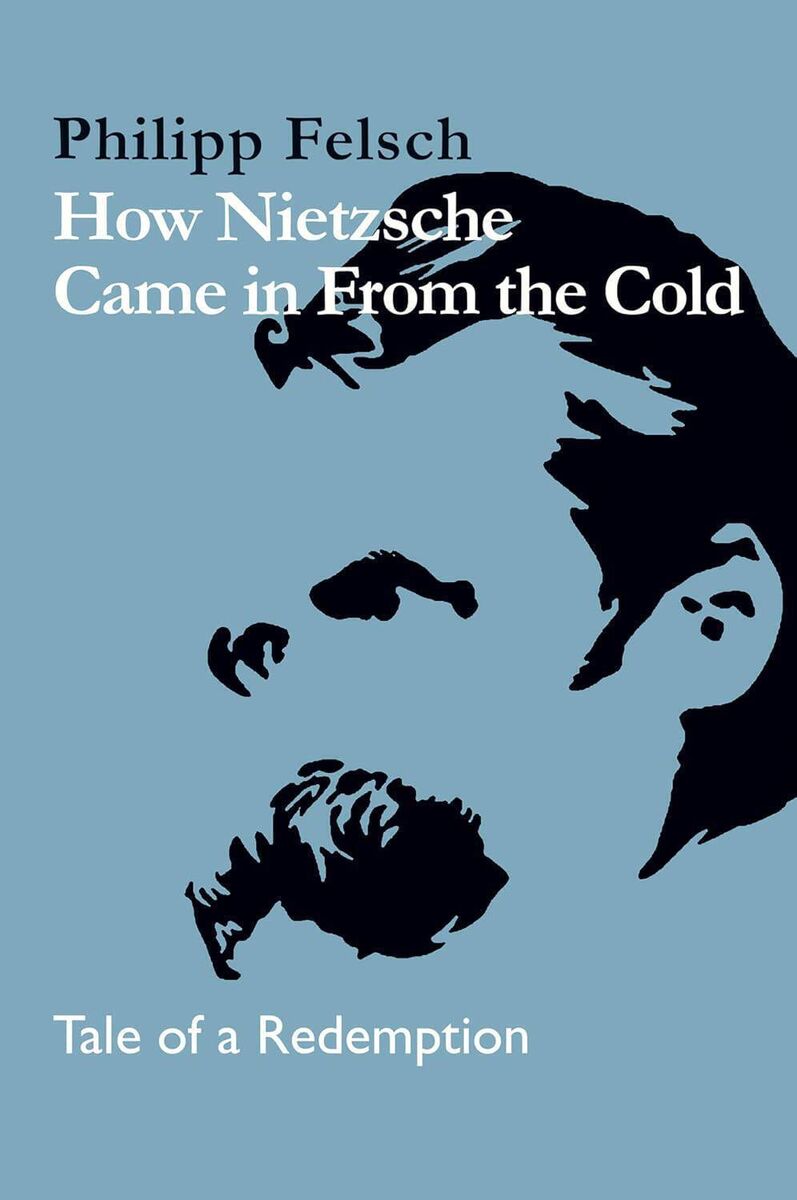
Book review: How philosopher who inspired Hitler and Mussolini came in from the cold

The story of Colli and Montinari’s efforts to produce a new, critical edition of Nietzsche’s writings, using the material deposited in Weimar, is a thrilling, many-sided piece of political and scholarly history
Book review: How philosopher who inspired Hitler and Mussolini came in from the cold

Philipp Felsch picture: Jan Single author of of How Nietzsche Came in From the Cold Professor of Cultural History at Humboldt University, Berlin

  • How Nietzsche Came in From the Cold: Tale of a Redemption 
  • Philipp Felsch 
  • Polity, £25

IN 1943, for Mussolini’s 60th birthday, Hitler sent him a complete edition of the works of the German 19th-century philosopher Friedrich Nietzsche, bound in blue pigskin.

At the outset of his political career, Mussolini had learnt German specifically in order to read Nietzsche in the original; and had used Nietzsche’s maxim ‘live dangerously’ as a slogan. In 1946, at the Nuremberg trials, Francois de Menthon, who was the lead French prosecutor, identified Nietzsche as a forebear of the Nazis through his “vision of domination over the masses by absolute rulers”.

Ironically, after the war, an enormous archive of 10,000 barely legible pages of Nietzsche’s ‘nachlass’, writings that remained unpublished when mental collapse ended his productive life in 1889, ended up in storage in Weimar: inside communist East Germany, therefore, where he was officially blacklisted as an enemy of the working class.

“Not to regard the man as quotable”, wrote philosopher Wolfgang Harich, “ought to rank among the basic rules of mental hygiene”. Yet some continued to find this same author immensely quotable. Nietzsche was lionised by the new wave of radical French thinkers of the 1960s, including Michel Foucault, to whom Nietzsche’s scepticism about the existence of truth, about the authority of author and text, was manna from a non-existent heaven. He was their ally in the assault from the left on all forms of cultural meaning-making.

The very titles of Nietzsche’s books ring down the years since he first rattled Europe with his ideas: Thus Spake Zarathustra; Human, All Too Human; The Will to Power; and others. But they were clouded in suspicions about how much the texts actually reflected Nietzsche’s intentions, on the one hand, and, on the other, the interferences and adulterations committed by his sister, and his carer in his desperate final years, Elisabeth Forster-Nietzsche — changes which supposedly made him congenial to Mussolini and Hitler.

The scholarly grunt work in the ‘nachlass’, necessary for rehabilitating Nietzsche as a major European philosopher, was carried out by two relatively obscure, anti-fascist Italians, Giorgio Colli and Mazzino Montinari.

In How Nietzsche Came in From the Cold, Philipp Felsch, professor of cultural history at Humboldt University in Berlin, tells their story superbly, opening in mid-Second World War Lucca, when Colli, then a young secondary school philosophy teacher, was gathering around him his ‘chosen few’, the brightest of his pupils, those capable of sharing in his intense Graecophilia.

Among them was Montinari who, after the war, would go on to study at the elite Scuola Normale Superiore University in Pisa. There, one could experience the “lightness and joy of being communist” in the years before events such as the crushing of the Hungarian uprising of 1956 meant that few could any longer ignore the dark heart of the USSR.

Montinari became an active member of the Italian Communist Party and was a founding director of the Centro Thomas Mann in Rome. He had translated excerpts of Mann’s correspondence with communist authors such as Gyorgy Lukacs for party magazine, Il Contemporaneo.

The story of Colli and Montinari’s efforts to produce a new, critical edition of Nietzsche’s writings, using the material deposited in Weimar, is a thrilling, many-sided piece of political and scholarly history, engrossing not least for its evocation of the intellectual battleground that opened up between the ‘spoilsport’ philologists (‘extinguishing themselves in the presence of the text’) and norm-allergic, post-modern, mainly French philosophers who would not write about truth without air quoting it. 

Just as fascinating are passages on the long-term influence of Antonio Gramsci, who elevated patience to the rank of cardinal virtue among revolutionaries: “Pessimism of reason, optimism of will” was his morale-boosting mantra.

Finally, given that this is a book ultimately about getting the right words onto the page, it would be remiss not to mention Daniel Bowles, responsible for the translation of Philipp Felsch’s original text. It reads splendidly.

BOOKS & MORE

Check out our Books Hub where you will find the latest news, reviews, features, opinions and analysis on all things books from the Irish Examiner's team of specialist writers, columnists and contributors.
More in this section

Scene & Heard

Newsletter

Music, film art, culture, books and more from Munster and beyond.......curated weekly by the Irish Examiner Arts Editor.

Cookie Policy Privacy Policy Brand Safety FAQ Help Contact Us Terms and Conditions

© Examiner Echo Group Limited