Signpost: With calving complete, focus shifts to breeding and silage in Youghal
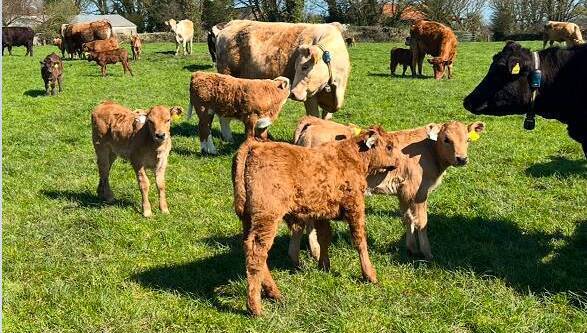
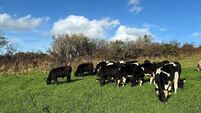
Calves out grazing on Eamonn and Donnchadh McCarthy's farm.
The spring calving herd has finished calving and is now out on grass full time. We completed a grass walk on Wednesday, April 2, and the farm cover was 700kgdm/ha. The replacement maiden heifers had been out on grass since early February but were housed in the last week in March in order to maintain the farm cover above 600kg DM/ha.
The maiden heifers will be returned outdoors to grass once growth rates improve, hopefully in approximately a week's time, as the predicted grass growth for the coming week on Pasturebase is over 40kgdm/ha per day for our region. The first fields grazed had a cover of 1100kgdm/ha on the day of measuring.
The field will be reseeded by direct drilling with minimal cultivation taking place. Silage ground has been closed off and has received 80–90 units/acre of chemical nitrogen in the form of protected urea and 14 units/acre of sulphur.
The silage ground also received approximately 2,500 gallons/acre of cattle slurry. The entire silage ground has been grazed with cattle, which should improve the DMD% (dry matter digestibility %) of the subsequent silage.
The calving season for the spring herd has finished. 37 calves were born alive. We lost one calf and had one set of twin Limousin bull calves. The cows calved over five weeks and five days. The last cow calved on March 25. Our attention is now turning to the breeding season.
The breeding season for the spring-calving herds will commence on May 1, allowing for calving to commence around February 10, 2026. The maiden heifers have the automated heat detection collars fitted to them for over a month at this stage.
The heifers averaged 298kg liveweight on January 3. At that stage, they had 117 days to gain 100kg in order to hit our target bulling weight for these animals (400kg – 60% of mature herd weight 650kg). The heifers needed to gain 0.87kg/day; we find turning the heifers out to grass early results in weight gains of over 1kg/day.
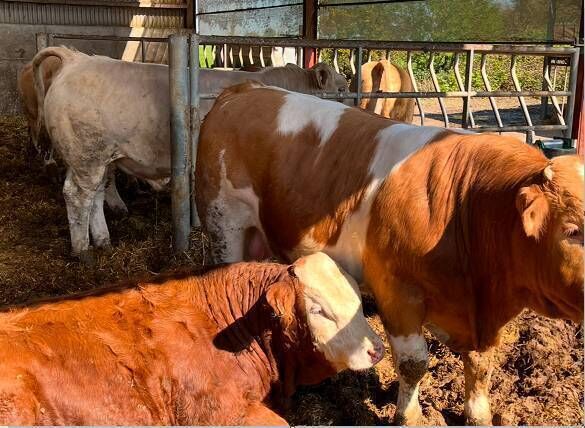
In preparation for the breeding season, AI sires have been selected for the herd. The Aberdeen Angus bull AA9860 will be used on the heifers. This bull is relatively easy calving and has a replacement index of €182. He is also high for carcass weight (20.5kg) and has a milk PTA of over 11kg.
The cows selected for breeding replacements will be inseminated to Erebos (LM6172) and Shannon Stan (LM9379). Both of these bulls have a high PTA for milk kgs and have a replacement index of €181 and €209, respectively. Both of these bulls have been used in the past on the farm, and we are very happy with their progeny.
We will require approximately eight heifers as replacements for the spring herd, so we will need to use approximately 32 straws of replacement type bulls before we move onto terminal sires. We have found in the past that it takes approximately four conventional AI straws to get a heifer calved into the herd.
We have begun weaning calves from the autumn herd. We used nose paddles to help break the cow–calf bond. Each week, we wean approximately five to six calves. We have commenced weaning the heifer calves, and once they are weaned, the bulls will then be weaned for finishing as under 16-month young bull beef.
We are also hoping to erect a new roofed Easi-Feed unit this year. We are currently awaiting approval in order to avail of a TAMS Grant. The shed will facilitate easier handling of animals over the winter period and reduce labour. The shed will be a mono-pitched roof type shed. We are hoping to install rubber mats on the slats for improved animal comfort.
- Teagasc advisor: James Mullane.