AI-powered laser weeder now used on Irish farm
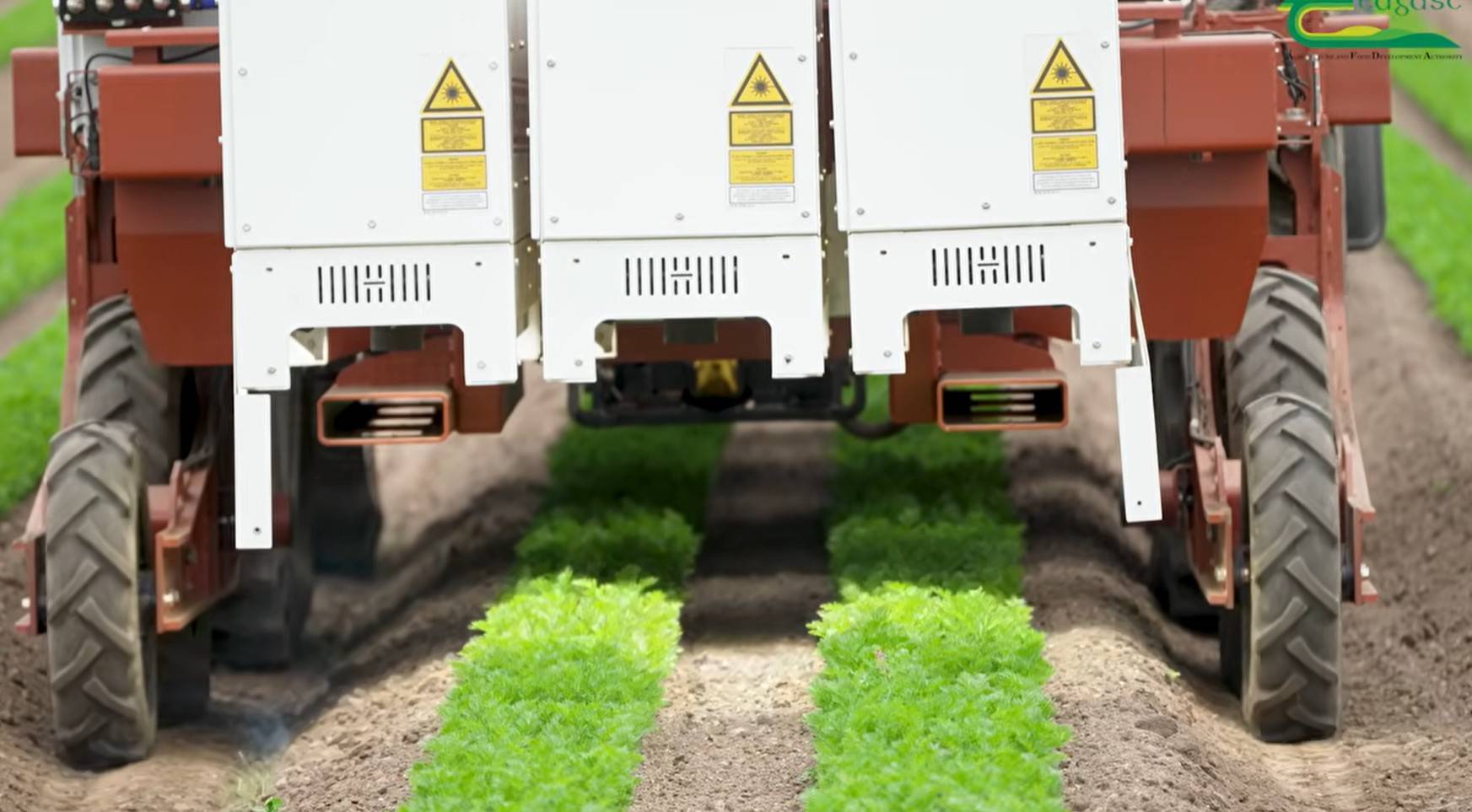
The laser weeder on Philip Draper's Coolnagrower Organic Produce farm.
Philip Draper of Coolnagrower Organic Produce Ltd is the first horticulture grower in Ireland to invest in a state-of-the-art AI-powered laser weeder for tackling one of the biggest challenges and highest production costs in organic vegetable production, namely weed management.
He spoke with William Deasy, Specialised Vegetable Advisor with Teagasc, on a recent Teagasc video.
“The main reason we were looking at a laser weeder was to cut down on manual labour. Manual labour is becoming hard to source and increasingly more expensive. The nature of this business is that we're highly dependent on the weather. Even in a wet season, this machine can work, which is very important, especially in Ireland”, Philip said.
Philip farms just outside Birr, Co Offaly. He studied commercial horticulture in Kildalton Agricultural College. “When I finished there, I started farming in 1991. Organics would have been very small back then in the early 90s, and everything was done pretty manually. As the market increased, we increased our acreage. The main crops that we grow are carrots, parsnips, beetroot and potatoes. Our main customers are SuperValu and Tesco, and we also supply a number of smaller outlets including farmers' markets and local shops”, Philip explained.
“Using artificial intelligence, the laser weeder identifies the weed and fires the laser at the weed to burn it out. It is very accurate. It's able to hit weeds that are very close to the carrot. You can set the machine to follow the band of the carrots, which will just target in and around the carrots, and then you can say you're going to mechanically hoe the rest of the bed. If the weather is bad, and you know you're not going to get out to mechanically hoe, you can set the machine to do the full bed”, Philip explained.
“It's very important to hit the weeds at the small stage. If the weed gets a bit bigger, that means the machine has to go slower. You have to have your zones staggered, to target the weeds when they're at the ideal stage, the small stage. It has meant that we've had to work long hours when the weed is at the right stage, rather than letting the weed get too strong. It is taking us six hours for one acre, and we've had to give it three passes. So on a 24-hour shift, we were doing four acres a day.
“The bed is left undisturbed, it's targeting the weeds that are showing”, he said. “Inevitably, there's always going to be weeds at different stages of growth, and that's why it takes three passes, and generally by the third pass, it is faster.
“The main benefit is we haven't had to employ a manual weeding crew to come in and do the weeding. Another major advantage is the crop is clean now at an earlier stage than I've ever had it before. By having this machine, it will allow us now to start bringing our zones a little bit earlier and to extend the market at the end of the year”, Philip explained.
Coolnagrower Organic Produce Ltd was able to draw down a grant to help with the purchase of the laser weeder. “We applied for grant aid with the Department of Agriculture under the Commercial Horticulture Scheme, and thankfully we were approved for grant aid, which was a huge help, which allowed us to make the investment in this technology”, Philip said.
“The biggest thing that this has brought to the farm now, it has taken the stress out of the worry that you're going to have another couple of wet years and not be able to manage weeds. In those bad years, my harvest didn't start for two months later than normal.
“So now I feel I'll be able to supply my customers reliably from the time I should be starting, because I now have a method of controlling the weeds, even in a difficult growing season.
“When you're making an investment of this level, you're not just thinking of the next five years down the line. You're looking at the business where it's going to be in the next 20 years' time. So certainly this is going to secure the future of the business as well. It's making the whole thing work more sustainably”, Philip said.