Collaboration is driving Ireland’s next phase of medtech growth
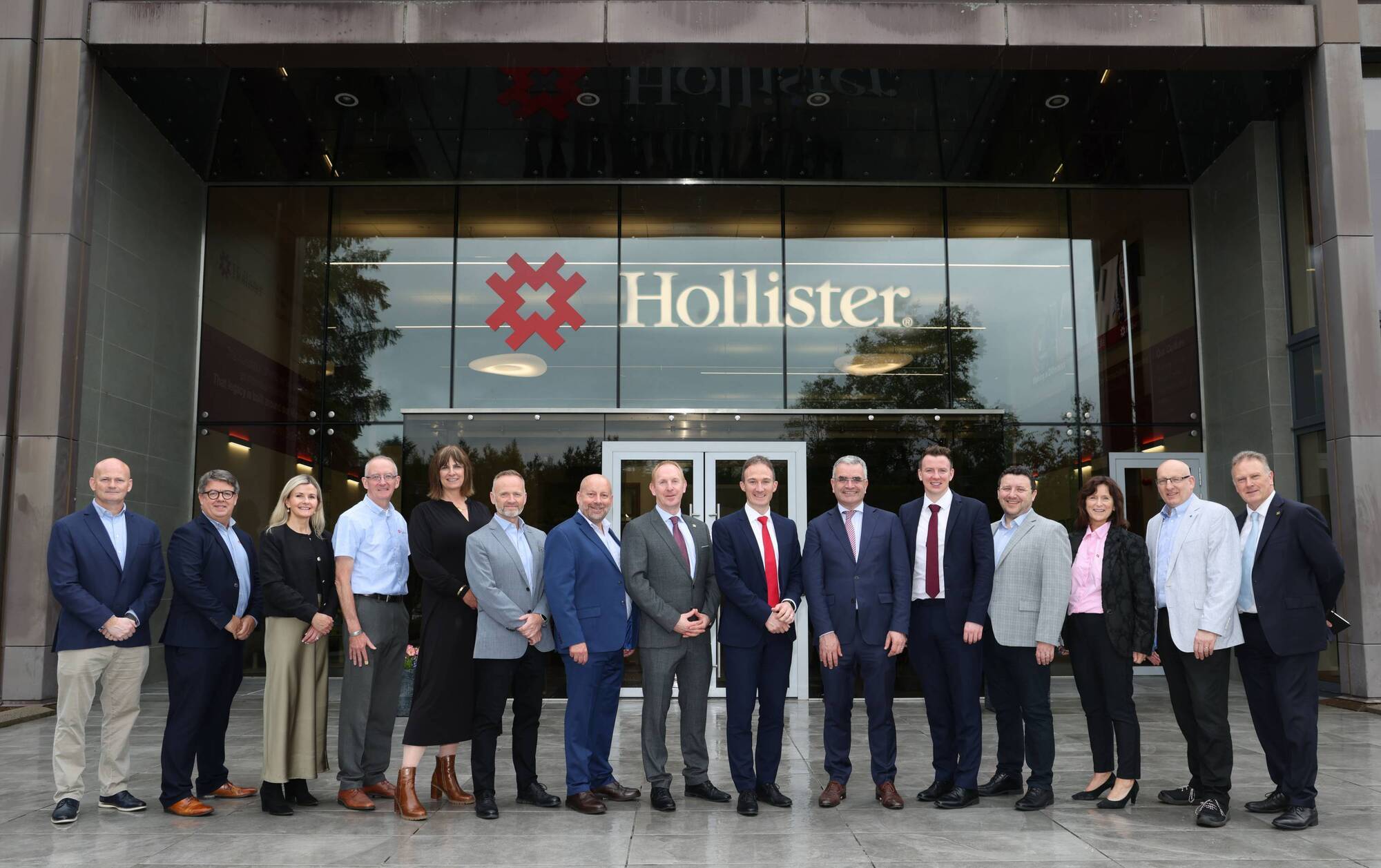
IDA Ireland with executives from Hollister, a global leader in ostomy, continence, wound care and critical care products, announcing an €80m R&D investment and a digital transformation project that will create approximately 50 new jobs in Ballina, Co Mayo. Pictured are: Shane Caher, Hollister, Carlos Horkan, Hollister, Lorraine McDermott, Hollister, Connie Walsh, IDA Ireland, Minister of State, Alan Dillon, Maureen Timlin, IDA Ireland, Minister for Social Protection, Dara Calleary, John Nugent, IDA Ireland, Michael Lohan, CEO of IDA Ireland, Senator Mark Duffy, and Seamus Fitzpatrick, Hollister. Photo: Aengus McMahon
John Nugent describes his role at IDA Ireland as being like a "fur-lined mousetrap". It is the sort of job that continually presents new challenges and opportunities, making it difficult to step away from. After more than three decades with the agency, his enthusiasm for Ireland's life sciences sector remains undiminished.
As department manager for Life Sciences, Nugent works with many of the world's leading medical technology companies. His background in chemistry, environmental science and business management gives him both a technical understanding and a commercial perspective, but it is his belief in collaboration that underpins his view of why Ireland continues to attract global investment.
When asked what makes Ireland's medtech sector stand out, he does not begin by talking about automation, artificial intelligence or manufacturing. Instead, he talks about the ecosystem that has developed over decades.
"It is the way it comes together and the way it works together," he says. "It is the most collaborative sector in terms of the interplay between multinationals and SMEs, industry and academia, and government. Patients are at the heart of everything."
For Nugent, that collaborative approach is Ireland's greatest competitive advantage. It extends beyond individual companies to include research centres, universities, regulators and government agencies, all contributing to an environment where innovation can flourish while maintaining the high standards expected of the healthcare sector.
The patient remains the common focus. While companies naturally compete commercially, everyone ultimately understands the purpose behind the work. Every family has experienced illness, he observes, and that shared understanding encourages organisations to work together to develop better healthcare solutions. Regulators also play an essential role, ensuring quality, safety and efficacy while creating an environment that still allows innovation to progress.
Ireland's reputation as a manufacturing location is well established, but Nugent believes the country's strengths have evolved considerably. Manufacturing remains the foundation, yet it is no longer the only reason companies invest here.
The major multinational companies that established manufacturing operations several decades ago are increasingly locating research, software development, product improvement and sustainability programmes alongside their production facilities. As new technologies emerge, Ireland is competing not simply as a place to manufacture products but as a location where products are developed, refined and supported throughout their lifecycle.
That evolution reflects wider changes across the industry. Digital technologies are becoming integral to manufacturing, creating opportunities to improve efficiency, product quality and sustainability. Automated production systems generate significant volumes of data, allowing companies to understand their operations in far greater detail than was previously possible.
For Nugent, the value lies not in collecting data for its own sake but in using it to make better decisions. Manufacturers can monitor production in real time, anticipate maintenance requirements, improve supply chains and understand where improvements can be made. Increasingly, digital manufacturing also allows companies to measure environmental performance and identify opportunities to reduce carbon emissions throughout the production process.
Artificial intelligence is becoming part of that process, although Nugent is careful not to overstate its role. Rather than viewing AI as a replacement for people, he sees it as another tool that helps manufacturers analyse increasingly complex data sets and improve operational performance.
One example is product inspection. Medical devices require exceptionally high quality standards and even small cosmetic defects can lead to products being rejected. AI-powered vision systems can identify imperfections quickly and consistently, reducing human error while also helping manufacturers trace the origin of faults within the production process. The result is improved quality, greater efficiency and less waste.
The same philosophy applies to automation more broadly. While manufacturing processes have become increasingly automated, Nugent does not believe this has simply displaced workers. Instead, many roles have evolved. Employees who once carried out repetitive production tasks are increasingly working in technical, analytical and planning roles that support highly automated manufacturing environments.
Maintaining that transition requires continued investment in skills. As manufacturing becomes more digital, companies need expertise in software, cybersecurity, data analytics and systems integration alongside traditional engineering disciplines. Ireland's ability to provide that talent will play an important role in sustaining future investment.
Supporting companies through that transition has also changed the role of IDA Ireland. Nugent says the organisation's relationship with client companies has become much more strategic. While financial supports remain important when companies first establish operations, the emphasis today is on helping businesses identify future opportunities, assess their capabilities and develop long-term plans around digital manufacturing, sustainability and innovation.
That approach reflects the agency's wider strategy of strengthening long-term investment while helping companies remain internationally competitive. Ireland may have built an exceptional reputation in life sciences over several decades, but Nugent is conscious that global competition continues to intensify.
He points to the increasing convergence of healthcare, software, data management and digital technologies as one of the defining trends shaping the sector. Future investment decisions will be influenced not only by manufacturing capability but by a country's ability to support research, software development, connected healthcare and advanced data management. Ireland, he believes, is well placed because those capabilities already exist across multiple sectors of the economy.
That is why collaboration remains central to his thinking. The relationships between multinational companies, indigenous businesses, universities, research institutes and government have taken decades to develop, but they continue to give Ireland an advantage as the sector evolves.
Industry 4.0 is often presented as a story about technology. Nugent sees it rather differently. Technology will continue to change manufacturing, but the country's long-term success will depend on the strength of the partnerships that support innovation, develop talent and ensure that Ireland remains an attractive location for investment.
For him, that is what makes the job so compelling. Every new technological advance creates another challenge to solve, another opportunity to strengthen the ecosystem and another reason why Ireland continues to compete successfully on the global stage.

CONNECT WITH US TODAY



Be the first to know the latest news and updates