How continuous learning is giving Irish manufacturing a competitive advantage
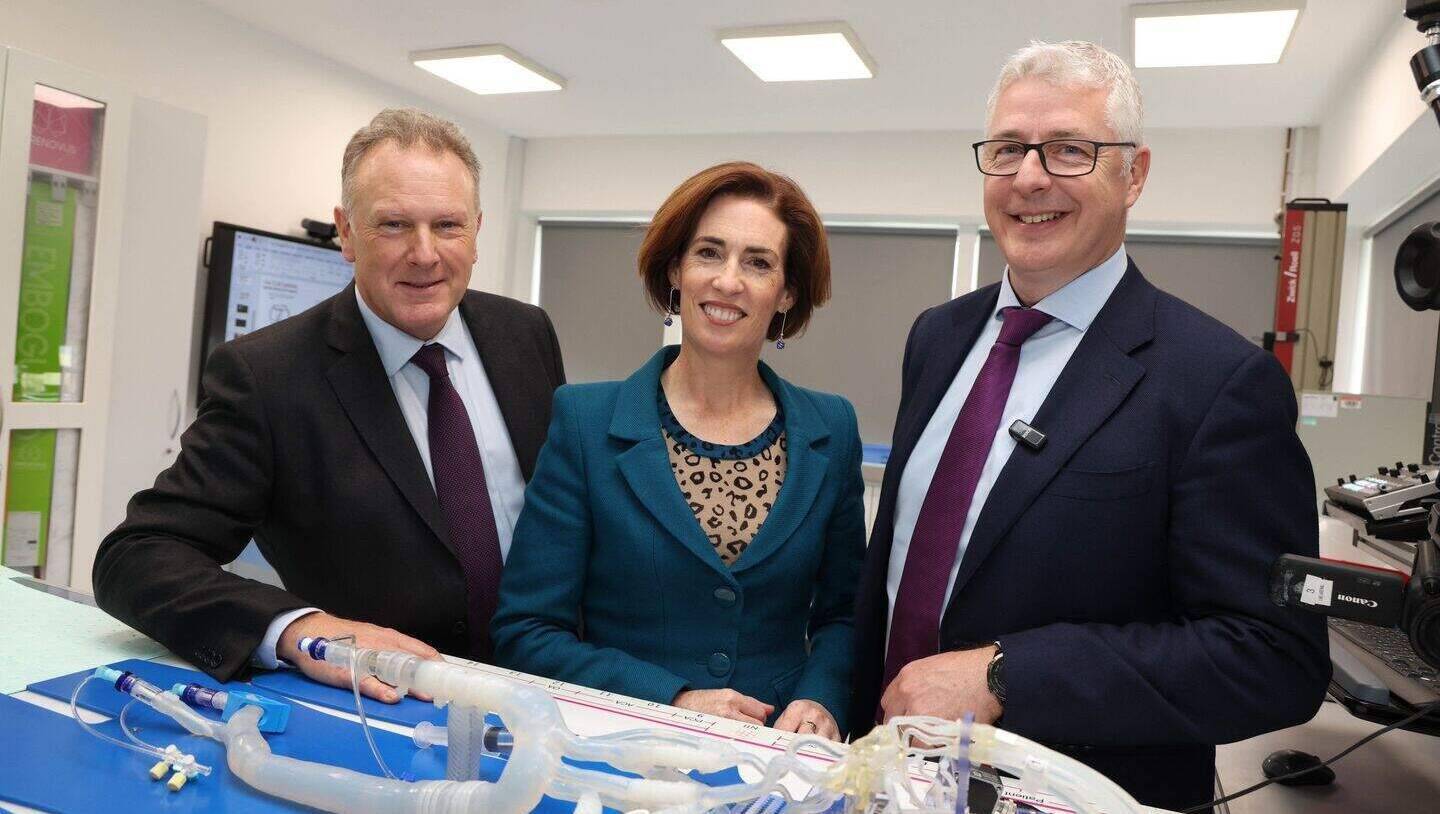
Johnson & Johnson MedTech, announcing the expansion of its Galway facility. This move is closely aligned to its ‘Adapt Intelligently’ strategy, using cutting-edge innovation to progress stroke care. Pictured are: John Nugent, IDA Ireland, Minister for Education and Youth of Ireland Hildegarde Naughton, and Michael Gilvarry, head of R&D for Johnson & Johnson Medtech Neurovascular and general manager of the Galway site.
For years, discussions around manufacturing have focused on automation and the fear that technology would replace jobs. John Nugent sees a different picture emerging.
The challenge facing Ireland's manufacturing sector is not simply attracting talent but ensuring that people continue to develop new skills throughout their careers. As digital technologies become embedded across production, research and supply chains, continuous learning is becoming one of the country's greatest competitive advantages.
"There is constant upskilling," says Nugent, department manager for Life Sciences at IDA Ireland. "It's all the time."
That approach reflects the changing nature of advanced manufacturing. The sector continues to recruit engineers, scientists and production specialists, but demand is also growing for expertise in software engineering, artificial intelligence, cybersecurity and data science. These are skills sought by almost every industry, making competition for talent increasingly global.
"The evidence suggests companies are not struggling to recruit people," Nugent says. "It varies depending on the skills you are looking for."
Specialists in AI and software engineering remain in particularly high demand because every sector is competing for the same expertise.
Ireland's ability to attract international talent has helped strengthen that position. Around one in five employees working in IDA-supported companies was born outside Ireland, bringing experience, diversity and specialist knowledge into the country's industrial base. Rather than seeing this as a challenge, Nugent believes it reflects the attractiveness of Ireland as a location for internationally mobile talent.
At the same time, investment in the existing workforce has accelerated. Upskilling has become a strategic priority, both for companies introducing new technologies and for agencies supporting long-term industrial development.
IDA Ireland had originally set a target of training 40,000 people during the lifetime of its current strategy. According to Nugent, progress has already exceeded expectations, with more than 30,000 people trained in the past year alone. The scale of demand has been so significant that he would not be surprised to see the target increased as the strategy develops.
Research and innovation are following a similar trajectory. Nugent notes that investment commitments in research and development have also moved ahead of target, reflecting growing confidence among international companies in Ireland's innovation ecosystem. Rather than separating manufacturing from research, companies increasingly see them as complementary activities supported by the same highly skilled workforce.
That demand for skills is supported by a network of specialist organisations working alongside industry. The Irish Medtech Skillnet has become an important partner for companies planning workforce development, while Digital Manufacturing Ireland focuses on helping businesses understand the skills needed for increasingly digital production environments. Irish Manufacturing Research also plays an important role, particularly in automation and advanced manufacturing technologies.
For Nugent, these organisations are not simply training providers; they are part of the wider ecosystem that has allowed Ireland to remain competitive as manufacturing evolves.
Digital technologies continue to reshape every stage of production, from automation and quality control to logistics and supply chain management. Artificial intelligence is expected to have the greatest impact over the next five years, particularly in manufacturing processes where it can analyse large volumes of operational data, improve efficiency and support better decision-making.
That technological shift is changing the profile of the manufacturing workforce. As routine tasks become increasingly automated, demand is growing for people who can manage digital systems, analyse data and integrate new technologies into existing operations. The result is a manufacturing sector where technical knowledge, adaptability and continuous learning have become as important as traditional engineering expertise.
Nugent believes Ireland is well placed to meet that challenge because the country has spent decades building partnerships between industry, higher education and research. Those relationships make it easier to identify emerging skills requirements and respond quickly as technologies develop.
Looking ahead, he expects innovation to remain the defining characteristic of Irish manufacturing. Companies considering investment increasingly want more than production capacity; they are looking for an ecosystem capable of supporting research, technology development and highly skilled people.
"The future is here," he says simply.
For Ireland's manufacturing sector, that future will depend as much on people as on technology. While automation and artificial intelligence continue to transform production, the country's long-term competitiveness will rest on its ability to keep developing the skills needed for the next generation of innovation.

CONNECT WITH US TODAY



Be the first to know the latest news and updates