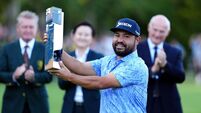
Schwartzel leaves the field green with envy

CHARL SCHWARTZEL should have known it was going to be a very good day at the very first hole.

After spraying his second shot far right of the green, he pulled out a six-iron, chipped the ball off a patch of trampled-down grass, and watched it roll and roll and roll — right in the cup for an improbable birdie.

Think that was unexpected? The South African was just getting warmed up. He drilled his tee shot at number three into the middle of the fairway, then holed out with a wedge from 114 yards for eagle.

It didn’t even compare to the finish, though.

Schwartzel became the first champion in Masters history to close with four straight birdies, the capper to a final round like no other at Augusta National.

Tiger Woods charged. Rory McIlroy collapsed. And just about everyone else seemed to have a chance to win on the back nine.

“There’s so many roars that go on around Augusta,” Schwartzel said. “It echoes through those trees. There’s always a roar. Every single hole you walk down, someone has done something.”

Especially on this day.

At one point or another, eight different players had at least a share of the lead. The list included Woods, making a fist-pumping, swaggering charge up the board. And Adam Scott, deftly carving up the greens with that long putter of his. And Jason Day, a Masters rookie who played like he owns the place. And Geoff Ogilvy, ripping off five birdies in a row on the back side. And Luke Donald, hitting the flag stick with a shot off one leg, then chipping in from the front of the green with his final swing.

The top six finishers each posted scores in the 60s on a steamy spring day.

The hottest one of all was a 26-year-old carrying on South Africa’s proud golf tradition, winning on the 50th anniversary of countryman Gary Player becoming the first international winner at the Masters.

One by one, all the challengers for the Green Jacket fell aside as Schwartzel birdied 15 … and 16 … and 17 … and, finally, 18 — even though all he needed at that point was an easy little two-putt to win.

“You know, I always thought if there was one (major) that I would win, it would be this one,” Schwartzel said. “This is the sort of golf course that suits my eye.”

He was sure dialled in on those last four holes.

His six-under 66, was the best closing round at the Masters in 22 years. Schwartzel finished two strokes ahead of Scott and Day, a pair of Aussies who valiantly tried to be the first player from Down Under to win at Augusta.

Schwartzel had played in only one previous Masters — he tied for 30th a year ago — but he got a very helpful tutorial from a guy who’s won more Green Jackets than anyone.

After finagling a lunch with six-time winner Jack Nicklaus at a charity function, he deftly broke the ice with one of their shared interests beyond the golf course.

“I’ve never met Jack. I was really excited,” Schwartzel recalled. The talk soon turned to Augusta National. And, boy, did the Golden Bear open up. I’m thinking it’s going to be just a vaguely quick little thing, and he actually took the time to take me through all 18 holes,” Schwartzel said. “The way he used to think around Augusta. The way he used to play it, which flags he used to attack.”

Schwartzel sure put those lessons to good use on Sunday. It was the sort of finishing kick that Nicklaus turned in a quarter-century ago for the last of his Masters wins.

For a while, Woods was the one rekindling memories of ‘86. Mired in the longest winless streak of his career and still tarnished by an embarrassing sex scandal, he ripped through the front nine with a five-under 31 that erased his daunting seven-shot deficit coming into the round.

Woods got through the 10th and the always-troublesome 11th with pars, setting himself to really attack the course through the heart of Amen Corner.

Instead, the course bit back. After a long delay waiting to putt at the 12th, Woods missed a short one and took bogey. At the next hole, he wasted a perfect tee shot along the creek line and settled for par on a hole that played easier than any other.

THE real backbreaker,though, came at the last ofthe par-fives. Woods gave himself a perfect look at the 15th with a tee shot to the top of the ridge, then jammed his approach within five feet of the cup for an eagle try that would’ve given him the outright lead.

The putt lipped out. He settled for birdie. And everyone sensed that Woods, playing several groups ahead of the other contenders, had squandered his final chance.

At least he didn’t finish like McIlroy. The seemingly unflappable 21-year-old was leading through each of the first three days, and went into the final round with a four-stroke edge on the field. Even after a shaky front nine, the youngster made the turn still one shot ahead.

Then he fell apart. McIlroy yanked his tee shot at the 10th into the trees left of the fairway, the ball ricocheting to a spot between two of the club’s famous cabins. He pitched out through the fairway, knocked his next shot over by the scoreboard left of the green, hit another tree trying to get on and wound up with a triple-bogey seven.

Three-putts at the next two holes finished him off, though his misery lasted right to the end. He drove into a creek, missed two more short putts and signed for an 80 — the worst final round by a 54-hole Masters leader since Ken Venturi in 1956.

“I just hit a poor tee shot on 10 and it unravelled from there,” McIlroy said. “I just sort of lost it … and I couldn’t get it back.”

x

More in this section

Sport

Newsletter

Sign up to our daily sports bulletin, delivered straight to your inbox at 5pm. Subscribers also receive an exclusive email from our sports desk editors every Friday evening looking forward to the weekend's sporting action.

Cookie Policy Privacy Policy Brand Safety FAQ Help Contact Us Terms and Conditions

© Examiner Echo Group Limited