Cork family faces €3,000-a-month transport bill to get daughter to HSE-funded disability training
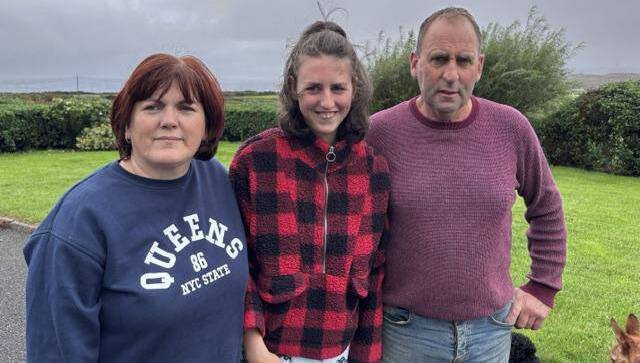
Megan O'Sullivan (centre), who has an extremely rare gene defect, with her mother Teresa (left) and father Donald (right).
Teresa O’Sullivan has every reason to be grateful for her daughter’s placement at a facility where she can receive training to help her do basic things.
Megan is one of the only a few hundred people in medical history ever recorded to have a faulty TUBB2B gene that affects the development of a person’s brain. She needs help to do things like make a sandwich or count money.
While outwardly, the 19-year-old may appear like any other teenager, she suffers from an extremely rare neurological disorder that can manifest itself in — among other things — cognitive impairment, balance and co-ordination issues, visual impairment, global development delay, and deep-rooted fear of things most take for granted, like walking down a street on her own.
To be able to cope with something as ordinary as a ride on a bus or that walk down a street, she needs what is known as travel training. In her case, that could take up to two years.
Whatever happiness that Teresa has that her daughter has her placement, it is, however, tinged with the frustration of her not actually being able to get there. Her Allihies home on the western tip of Cork’s Beara Peninsula is more than an hour’s drive away from Bantry, where the disability support service organisation CoAction is based.
Its St Goban’s facility in the town is one of a number of support services it runs for over 190 adults and more than 800 children, providing a wide range of services including day services, home support and multidisciplinary services for children with complex needs. It is the lead agency for the West Cork Children’s Disability Network Team under Progressing Disability Services for Children and Young People.
The course on which Megan has a placement is one of just 10 available in Bantry and is a three-year rehabilitative training (RT) programme funded by HSE South West Disability Day Services. Over 4,000 adults are supported by day services through 12 agencies, like CoAction, operating in 150 locations across Cork city and county.
Megan can’t get to St Goban’s because the State won’t fund, or even help fund, the transport to get her to the rehabilitation training she needs to help her become more independent. While public transport is available, Megan is unable to use it because, while she has yet to be able to cope with travelling on her own by bus, she faces a 15-20 minute walk from the bus stop to her rehabilitative training sessions at CoAction.
That route takes her along a busy road with multiple junctions and while most people would not have a problem with such a journey, she would find encountering so many people and moving vehicles terrifying. The alternative, of spending around €3,000-a-month on a taxi, is not one her parents can afford.
Teresa and her husband Donald, a farmer, have been told that due to the large number of referrals the HSE South West Disability Day Services team receives and the “increasingly complex” nature of those referrals, it is becoming increasingly difficult to ensure people who need placements get them.
The O’Sullivan family have also been told the provision of transport is not part of core services funded by the HSE and public transport is generally used in all circumstances. This is, they say, so people with a disability have access to what they have described as “the normal range” of services.
The HSE has also said that while some transport supports are provided by the HSE or funded agencies, these are only funded on a “case-by-case” basis.
However, as the family has since learned, under Pillar 5 of the National Human Rights Strategy for Disabled People 2025-2030, the Department of Transport has — along with a variety of stakeholders, including the HSE — made a commitment to take a “whole-of-journey” approach to provide disabled people with enhanced personal mobility options.
Inclusion Ireland has also stated that under Article 25 of the United Nations Convention on the Rights of Persons with Disabilities (UNCRPD) people have the right to the enjoyment of the highest attainable standard of health “without discrimination on the basis of disability”.
Additionally, article 26 states that Ireland should support people with disabilities to “attain and maintain maximum independence, full physical, mental, social and vocational ability, and full inclusion and participation in all aspects of life”.
Megan should have started at St Goban’s two weeks ago, but is now instead going to be placed in the care of a disabilities hub in Castletownbere.
Teresa said: “Myself and my husband are very, very grateful that Megan has the placement she has. Without that placement, she wouldn’t get the rehabilitative training she needs, so we cannot stress how grateful we are.
“But we are also very frustrated by the fact that while the HSE has agreed to fund that placement, Megan can’t actually avail of it.
“We assumed that her actually being able to get to the placement in the first place would have been taken on board. We would fund her private transport if we could but we can’t. We would happily help cover the cost if the HSE were to even suggest a package of supported travel, but there has been no suggestion.
“Both myself and my husband work fulltime and if either of us gave up our jobs or cut back our hours, we just wouldn’t be able to afford to cover the day-to-day costs of running a home and the through-the-roof diesel costs on a reduced income.”
She added: “The tragic irony about all this is that the longer Megan waits to be able to access the service she needs, the longer she remains almost entirely dependent on myself and her father.
“She needs to learn to be more independent for her own sake but also surely the HSE and the Government can see that adult children like her can be less of a — for want of a better word — burden on services.”
When told that the HSE has advised the , in response to questions about transport for adults with disabilities, that responsibility for the provision of accessible public transport rests with the National Transport Authority, she replied: “Nobody told us this.
“We will now have to write to them, but we had always understood that the Government had adopted a ‘whole-of-journey’ approach as far as mobility issues were concerned.”
The HSE was asked how long it has been exploring arrangements with Local Link.
It was also asked if — given that HSE in general, and South West Day Services in particular, have made a commitment to take a “whole-of-journey” approach to provide disabled people with enhanced personal mobility options — the HSE South West has asked for or been allocated any extra funding to pay for transport services for any vulnerable adults in Cork or Kerry.
The also asked the HSE why, given the HSE’s Pillar 5 commitment and Ireland’s UNCRPD obligations, all vulnerable adults over 18 are not enough of a priority for them to get HSE funding to attend HSE-funded services in the HSE South West catchment area.
A spokesperson replied: “Responsibility for the provision of accessible public transport rests with the National Transport Authority and public transport operators.
"Transport to adult disability day services is not a core funded element of the day service programme and HSE South West does not receive a funding allocation to provide transport for day service attendees.
“While in some circumstances transport support may be provided by the HSE or funded service providers on a discretionary basis, this is exclusively dependent on local resources, capacity and individual circumstances. These arrangements are not universally available.”
Megan’s local TD, Independent Ireland’s Michael Collins, said he routinely raises the issue of transport for young adults in rural areas who can’t access HSE services in towns.
“I have sympathy for pressures the HSE is under but the disconnect between the provision of services and access to them for anybody over 18 years old just beggars belief,” he said.
He added: “The HSE is nearly two years into its commitment under Pillar 5 of the National Human Rights Strategy for Disabled People 2025-2030.
“In launching it last year, the Taoiseach said he and his government has a duty to acknowledge what he called ‘the totality of the lived experience of disabled people’ and to provide what he also called ‘joined-up, person-centred services’ that meet their needs.
“There is nothing joined up about what has happened in Megan’s case, and I would urge everybody involved to step up to their obligations in her case and so many others like it."
He said the HSE spends millions every year on taxis or other transport for a select range of other people whose services the HSE funds.
“It really is a slap in the face for parents to, in effect, be told their child is not enough of a priority for transport provision because they made the mistake of turning 18. If the Government really is as serious as it says it is, then it needs to make sure the Megan O’Sullivans of this world can actually physically get to the services they need.”
CoAction West Cork CEO Jillian Connolly said: “CoAction do support individuals to access public transport, where possible, including the development of necessary skills to travel independently. Unfortunately, it is widely reported that, even where public transport is available, it is not the appropriate support for many individuals' needs.
“As a result, individuals have a reliance on their primary support network to enable social inclusion including access to day services, impacting on the wider family unit.
“Bespoke transport arrangements may be provided to individuals through individualised agreements with the HSE or the reconfiguration of existing resources. However, these arrangements are in place for a minority of individuals.”
CONNECT WITH US TODAY



Be the first to know the latest news and updates