Tommy Martin: Scotland needs Hearts but you don't always get what you deserve
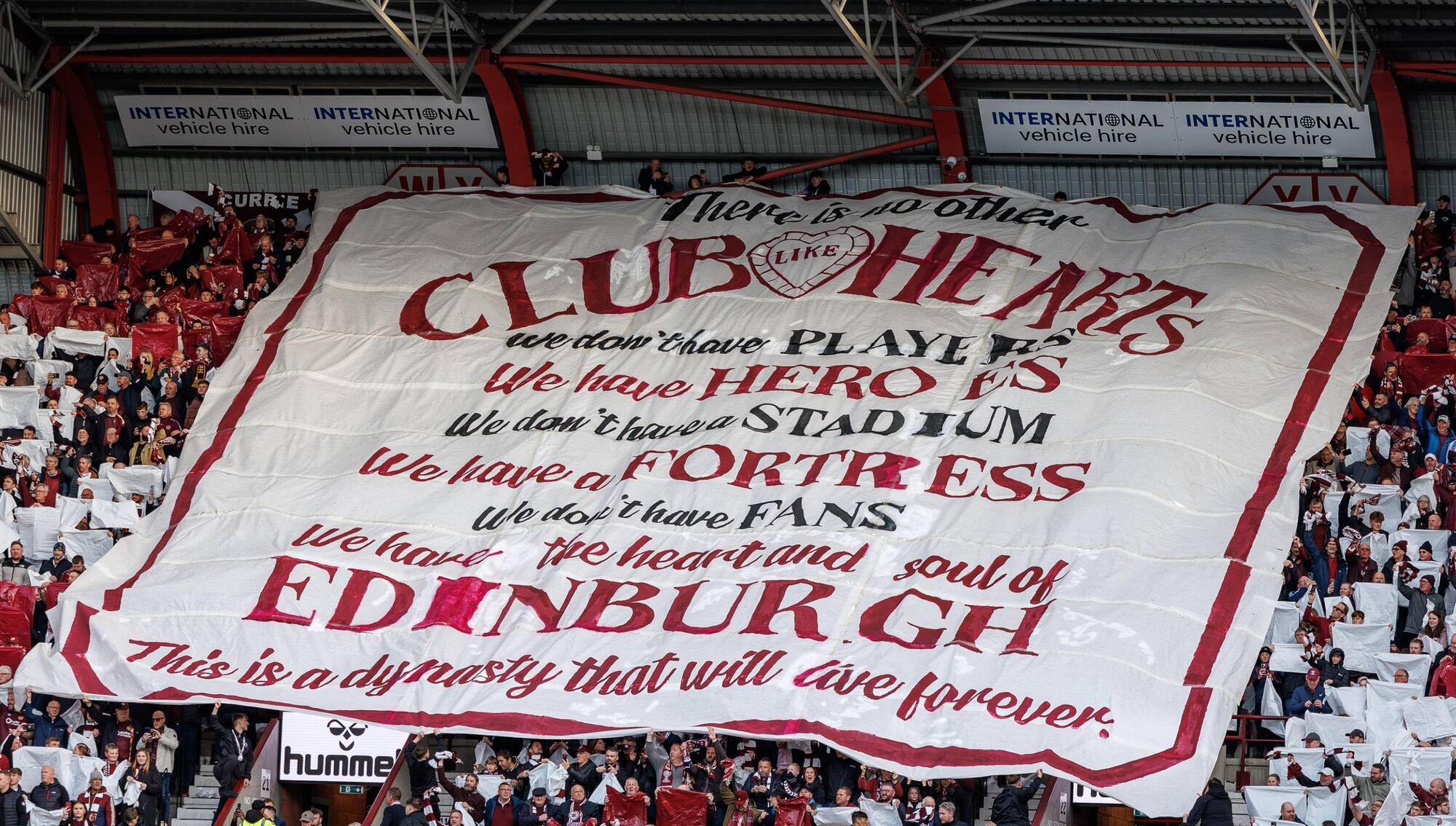
CLEAR EYES, FULL HEARTS: Hearts banner ahead of kick off during the week. Pic: WM Sport Media/Getty Images)
As someone who has been watching Scottish football for 40 years, I’ve noticed that people love telling you that they don’t watch Scottish football.
They do this because it makes them feel smart and sophisticated, things people like to think of themselves as being. In their minds, Scottish football is both crap and entirely sustained by the age-old sectarian blood feud between Celtic and Rangers, meaning that watching it makes you either an idiot or a bigot, neither of which are things people like to think of themselves as being.
Enter the 2025/26 Scottish Premiership season. Squeeze up ye idiots and bigots!
By a gripping confluence of crazily interweaving narratives, the title race that climaxes at Celtic Park has dragged Scottish football out of decades of dwindling relevance and put it front and centre in the great town square of football chatter.
What a ride it has been. From the histrionic departure of Brendan Rodgers as Celtic manager, to the Tony Bloom-powered surge of Hearts as title pretenders to the brief and disastrous reigns of Russell Martin and Wilfried Nancy at Rangers and Celtic respectively, to the unlikely romance of septuagenarian Martin O’Neill’s twin interim spells at Parkhead, to the global outrage at the VAR intervention on Wednesday night that awarded Celtic the penalty that set up the do-or-die, final day showdown between the two remaining contenders. Phew!
After all that, just one point separates the leaders Hearts and Celtic in second place. Now Celtic must do what they have failed to do on three separate occasions this season and beat Hearts, something which absolutely no one other than their own supporters and those of Hearts’ Edinburgh rivals Hibernian wants them to do.
For while Celtic and Rangers have played their part in the compelling narrative of the season with their blundering acts of managerial self-sabotage, the Jam Tarts of Tynecastle are clearly the heroes of the tale – one that is four decades in the telling.
Being, I like to think, neither an idiot nor a bigot, I have watched Scottish football all these years mainly because every childhood Saturday afternoon my Glaswegian father would take a paint and sawdust-stained Panasonic radio out of his joinery workshed and plonk it in the only corner of house in which you could pick up a faint, medium wave signal from BBC Radio Scotland. So, to be accurate, I was listening to Scottish football long before I watched it.
The first season I became interested in the irritating waves of squally interference mixed with the odd excitable Scottish interjection was the 1985-86 campaign, coincidentally the last time Hearts led the league heading into its final day. That was in the first flush of childhood obsession: Mexico ’86 was just weeks away and I consumed any football greedily, even through the harsh sonic landscape of BBC medium wave.
My father was 6 or 7 years removed from Glasgow at this stage, but because we struggle to perceive our parents as having an emotional hinterland beyond being the dispensers of discipline and sustenance, it is only now that I realise how much a connection to his old life that battered Panasonic radio must have been.
Donegal was not short of other relocated Glaswegians and Celtic-related chat, but as far as being removed from the bustle and verbal cut-and-thrust of actual Glasgow, you may as well have been in Arizona. The stories he told were of great games at Parkhead and Hampden and Ibrox, going to matches with his own father after a belly full of pie and peas, later on catching the tram after work to watch the Lisbon Lions, shimmying up the concrete steps through the throng to take the usual spot on the sprawling terraces to see Jock Stein’s all-conquering heroes take on the cream of Europe.
Now all that emotion and memory was squeezed into a small black box pumping out patchy waves of noise on a Saturday afternoon. We were a few years away from Sky TV broadcasting live Scottish football, but to my mind, few widescreen HD match-viewing experiences in later years were any more evocative than those days huddled around the Panasonic radio, and none more memorable than the day Celtic stole the league from Hearts in the final moments of the season 40 years ago.
That was the last Scottish season that boasted a defending champion other than Celtic or Rangers. Alex Ferguson’s Aberdeen had just won back-to-back titles and, throwing in Dundee United’s 1982-83 success, that meant that the four previous editions of the Scottish Premier Division had three different winners, none of whom were Rangers.
All Hearts had to do to add their name to the list was avoid defeat away to Dundee, while Celtic had to beat St Mirren away and overturn a goal-difference deficit of four. We tuned to 810 medium wave in hope rather than expectation.
A Celtic team inspired by Brian McClair, Mo Johnston, Paul McStay and Danny McGrain did their bit, winning 5-0, but in Dundee things didn’t seem to be going our way. Hearts were in the process of seeing out a 0-0 draw when Dundee threw on substitute Albert Kidd, a hitherto unheralded striker who was about to become a Celtic legend.
The BBC commentary dropped in and out between the waves of hiss and crackle and the game at Dens Park edged towards the final stages. Then with 83 minutes gone, a moment of clarity. Just a moment.
“It’s a goal! Kidd has scored!” And then the voice trailed off behind the squall.
Kidd has scored. But which Kidd? You see, Hearts’ captain was a right-back called Walter Kidd. Had Walter raided up the wing and got himself on the end of a loose ball in the box to seal the deal for Hearts?
No, he hadn’t. The voice came through again and told us it was Albert who had scored and, not only that, he would score again four minutes later and that was that. Hundreds of miles away from Dens Park, we jumped around the Panasonic radio in celebration not knowing or caring that Scottish football was about to enter four decades of grim duopoly or that Hearts would not be back in that position for the same amount of time.
I don’t know if it was as good for my father as being at St Mirren’s Love Street ground hearing it out of a transistor radio surrounded by thousands of other Celtic fans but it was good enough for me.
Grudgingly, I can admit that Hearts winning the league would be the best thing to happen to Scottish football since the days Fergie was king in the north. Anything other than a Hearts title would be a bum note for the neutrals who have been captivated by a league they normally wouldn’t give the time of day.
Even as a Celtic fan, there’s an argument that it’s better for Hearts to come out on top. It would be the kick in the backside the club need after too long thinking they can dominate Scotland in second gear. Their smart recruitment, benefitting from investment from Brighton owner Bloom and his Jamestown Analytics recruitment model, has embarrassed the stumbling Glasgow giants who have spent millions more. The emergence of a genuine third force would only help maintain the interest this season’s extraordinary, multi-layered narrative has generated in the Scottish game.
Most of all, they probably deserve it. But I never claimed to be smart and sophisticated. And you don’t always get what you deserve – just ask Albert Kidd.