Tommy Martin: Why League of Ireland players have freedom to speak loudest in game of political football
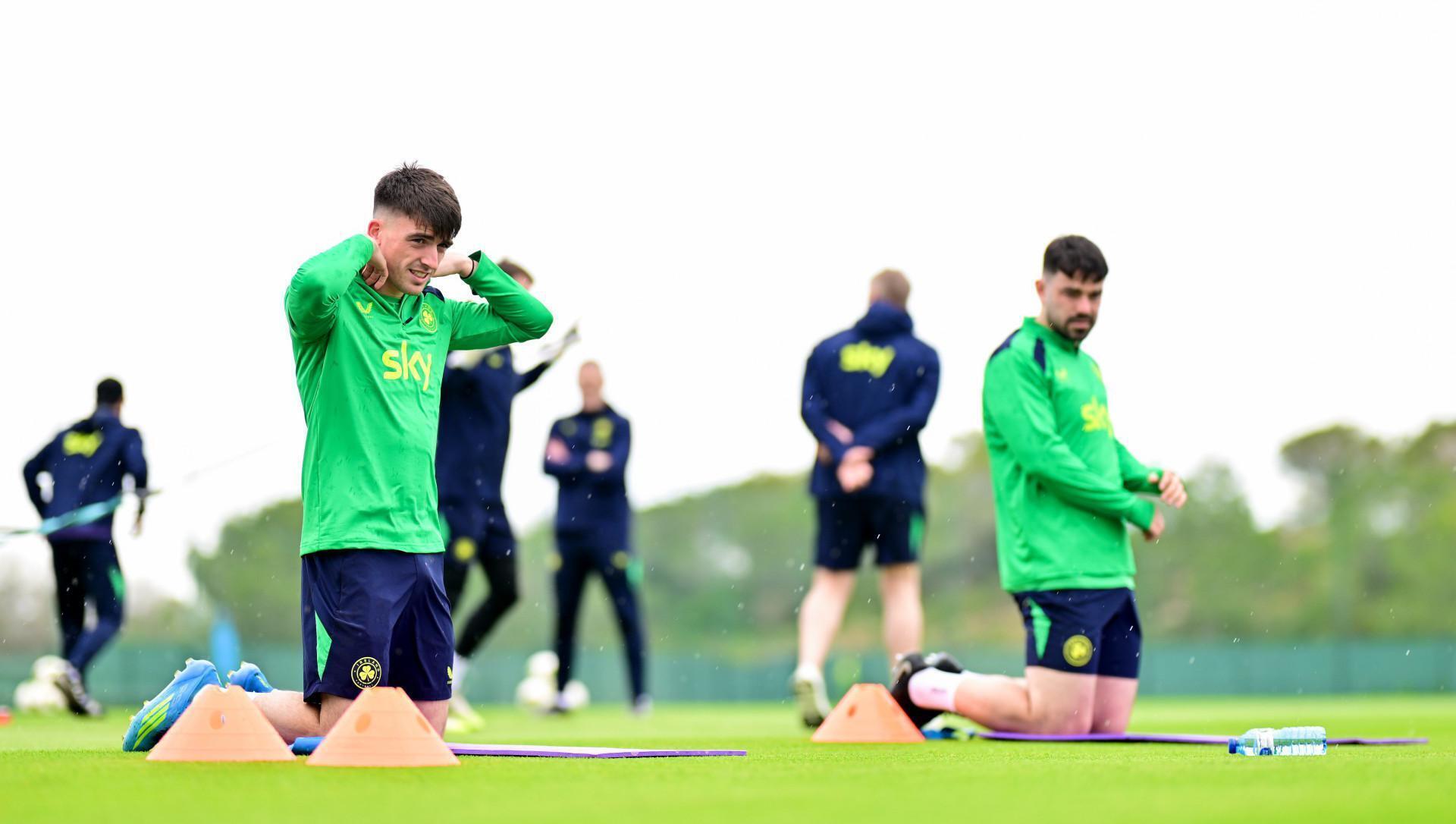
Andrew Moran and Eiran Cashin, right, during a Republic of Ireland training session at La Finca Resort in Alicante on Friday. Pic: Silvestre Szpylma/Sportsfile
It hasn’t gone away you know.
When the whole Israel Nations League thing broke in February it seemed like it would hang over Irish football like a bad smell, spoiling what we then hoped would be a summer of non-stop World Cup vibes.

But then Prague came along and everyone got up on their giddy goat. Wall-to-wall discussion of Heimir’s tactical plan, Troy Parrott-watch reaching Truman Show levels and Temu snowed under with orders for Czechia jerseys from Irish fans with hooky home section tickets. Everyone was there, it seemed, even Liveline. Would never happen on Joe’s watch.
Such was the mood of national merriment in the buildup to the Czechia game, as far as we can tell, no member of the Republic of Ireland squad was asked about their thoughts on the Israel game during their press obligations.
Presumably to do so would have risked the journalist in question being deemed Captain Buzzkill by an entire nation, and understandably the players in question might have had their heads elsewhere ahead of the most important match of their international careers. Interesting, nonetheless.
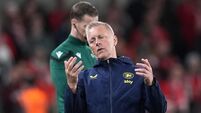
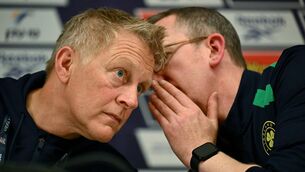
For those who were not paying attention, we didn’t qualify for the World Cup, but neither has the football discourse returned to the thorny Israel issue to any serious extent. Six weeks on from Prague and the chatter was about Heimir Hallgrimsson’s squad for a lower-than-low-key get-together in Murcia which culminates in a friendly against Grenada – the country, I think, not the Manchester-based ITV franchise.
The FAI’s new director of football, John Martin, was up in front of the media on Wednesday and all the headlines were about the usual bits and bobs like structures and finances and pinching players from the North.
Maybe it was disaster fatigue or maybe it was the fickle whirring of the news cycle or maybe the sweet sorrow of Prague had left a mood of such listless melancholy that no one had the stomach for a heavy dose of verbal wrasslin’ about Israel.
But then came this week’s Stop The Game letter, the latest gambit on behalf of the Irish Sport for Palestine movement, appealing to the FAI to refuse to fulfil the fixture slated for the Aviva Stadium on October 4th.
As with the campaign’s previous statements, the letter came signed by all manner of big names, and not just from the world of sport. As well as the likes of Brian Kerr and Roddy Collins, there was a sprinkling of stardust from the world of music, a fantasy festival lineup ranging from Christy Moore to Kneecap via Fontaines DC and all points between.
One senses the hand of another signatory, Bohemians chief commercial officer and Kneecap manager Daniel Lambert, a great man to pull off a winning collaboration. Knowing the two men in question, you suspect that for Kerr and Roddy, sharing a billing with the likes of Bobby Gillespie and Paul Weller might well be as good as it gets.
Leading the charge, however, was the Professional Footballers’ Association of Ireland chairman, Shamrock Rovers captain Pico Lopes. "We have to stop the game. As players and fans, our natural instinct is always to get out there and compete, but this is a moment where we need to look at the bigger picture,” Lopes wrote.
“We can't ignore the humanitarian catastrophe in Palestine; the sheer loss of life there has to take precedence over any sporting consideration. Ireland has an opportunity here to lead—to be a pioneer and do what others won't. We need to be brave enough to say enough is enough. We can’t just stand by. Please, stop the game."
Lopes was backed up by other current League of Ireland players, including Dawson Devoy, Joe Redmond and Padraig Amond, the captains of Bohemians, St. Patrick’s Athletic and Waterford respectively, as well as several players from the Women’s League of Ireland.
What is notable is that these are current, active footballers taking a leading role in what, despite the recent lull, is likely to be an increasingly gnarly issue in the leadup to the game. Current, active footballers in the League of Ireland, that is.
As of yet, no member of the Republic of Ireland squad has put their head above the parapet on this one. Fair enough, many say. They are the ones who will be asked to give something up here, unlike the rest of us shouting from the sidelines. And it is not up to them to make right what has been done wrong by those running the sport they play.
But their absence tells us a lot about the reality of protest and where its limits are. It’s not just caps, a modest appearance fee and Nations League points that would be at risk for members of the Ireland squad were they to take a stand and refuse to play the game.
Most operate professionally in the United Kingdom, an environment far less broadly sympathetic to the Palestinian cause than Ireland, in an industry dominated by complicated foreign ownership models and a more complex cultural and media landscape. One where, frankly, they could get expect to get battered by some parties for their stance. For evidence, take James McClean, prominent supporter of Irish Sport for Palestine and longtime poppy-refusenik.
And they get paid a lot of money to play football, not to take courageous political stances that might reflect badly on the Wall Street hedge fund that owns several of their toes as well as a chunk of Gaza-bashing listed weapons tech. You might think this is wrong, but would you take a political stance that risked your livelihood?
In this way, League of Ireland players have a sort of freedom that their wealthier colleagues across the water don’t share. It’s hard to believe that at least a handful of current Ireland players don’t share the views expressed in the Stop The Game letter and feel hugely conflicted by the prospect of lining out against a nation accused of perpetrating the crimes Israel has.
In contrast, the domestic league is often portrayed as the sporting wing of conscientious Ireland, with its communitarian spirit, working class heroes and fondness for indie band jersey collabs. Not that most fanbases wouldn’t welcome a shady Sheikh with a few spare billion. But it would be most unusual for a personality in the League to come out as a neoliberal, hang ‘em high, immigrant-bashing, right-wing talking head.
The only League of Ireland figure who has suffered for taking a stance on Israel is the former co-chairperson of Drogheda United, Joanna Byrne, who was relieved of her duties by the club’s US based owners, Trivela Group. They say it was because of general discomfort at her dual role as a Sinn Féin TD, but her removal came right after she called for the FAI to refuse to play Israel.
Here may be a reminder of what happens when capital meets conscience. Money can set you free but it can also be a cage. I’m sure many League of Ireland players would prefer to trade places and reap the benefits of an ecosystem that, in Eamon Dunphy’s famous words, apocryphally saw Glenn Whelan drive two Ferraris.
But until such time, the freedom to speak their minds is still worth something.