Colin Sheridan: How Everest turned from the world’s tallest mountain into peak posturing
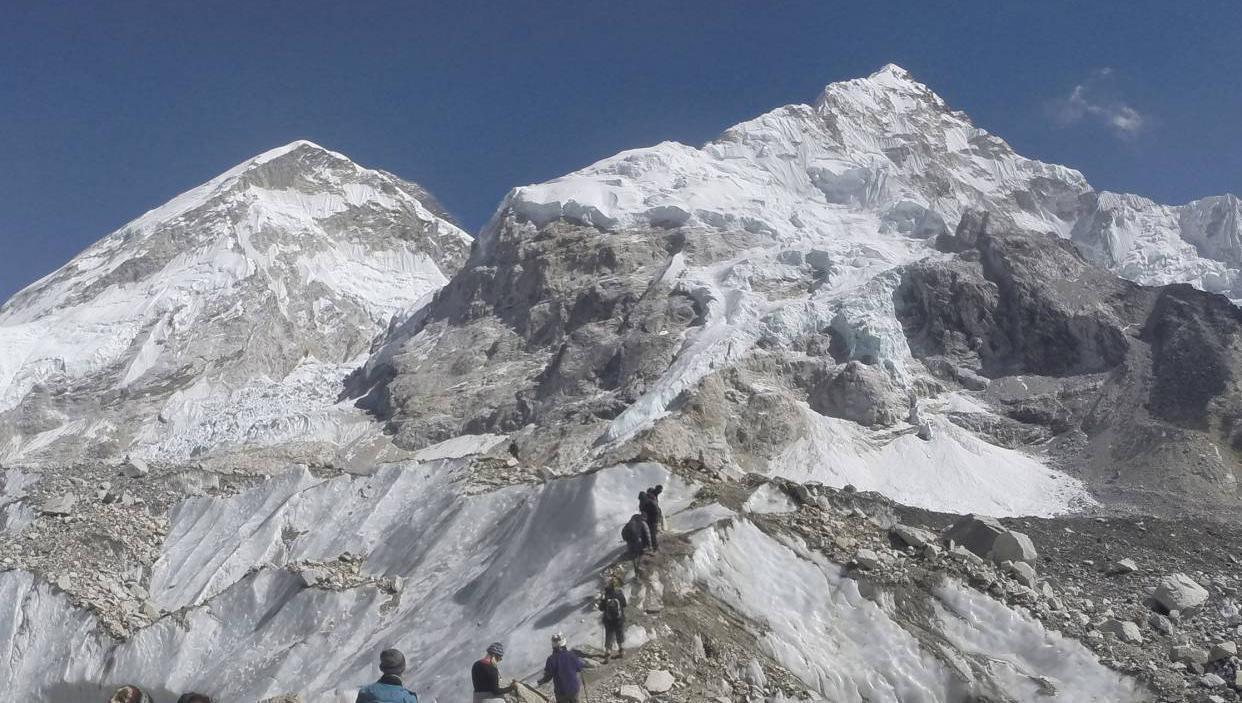
ALL IN: International trekkers pass through a glacier at the Mount Everest base camp, Nepal. Pic: AP Photo/Tashi Sherpa, file

Thirty years ago, yesterday, Mount Everest delivered one of the starkest warnings of the modern climbing era. On May 10, 1996, eight climbers died in a storm high above the world, a tragedy immortalised in Jon Krakauer’s , a book that should have punctured the romance around Everest forever. Because this was the day the mountain became a mirror.
Krakauer went to Everest as a journalist for magazine, intending to write about the commercialisation of climbing. By the time he came home, traumatised and grief-stricken, he had become the chronicler of a disaster that exposed something much darker than poor weather or human error. He exposed vanity. He thought by doing so he would call time on the Instead, it somehow sold the dream even harder.
Everest had become a place where wealthy amateurs could purchase proximity to greatness. It was no longer simply mountaineering. It had become aspiration packaged as achievement.
The deadliest thing on Everest was no longer the mountain itself. It was the human desire to stand on top of it.
Krakauer’s account stripped away the mythology around the summit. Clients with limited high-altitude experience were paying fortunes to be guided upward by Sherpas carrying oxygen, ropes, tents, food, and often the emotional burden of keeping frightened people alive. Guides, under commercial pressure, pushed beyond turnaround times that had previously been considered sacred. Pride overruled prudence. Exhaustion blurred judgment. The summit became more important than survival.
Everest was once the final frontier of elite alpinism. By the mid-1990s it had become something else entirely: a luxury endurance event for the ambitious rich. And in the years since Into Thin Air, that transformation has only accelerated.
Krakauer himself admitted recently that he believed the book might discourage people from climbing Everest. The opposite happened. When he reached the summit in 1996, he was roughly the 600th person ever to do so. Since then, more than 13,000 ascents have been recorded.
What was once exploration has now become industry.
The modern Everest season often looks less like an expedition and more like airport security queues at altitude. Climbers shuffle in traffic jams near the Hillary Step waiting for selfies and summit photos while oxygen drains from tanks and frostbite creeps silently through boots. The photographs are grotesque. Brightly coloured down suits lined up beneath death. A mountain - once the measure of man’s punyness - is now reduced to content.
And yet, perhaps Everest merely exaggerates something that already exists in sport. The pursuit of prestige has always had the power to make intelligent people irrational.
Cyclists pumped themselves full of chemicals chasing impossible standards. Baseball has had an entire era named after steroids. Boxers stayed in the ring too long because they could not bear ordinary life after glory. Gaelic footballers and hurlers routinely mortgage careers, relationships, and bodies for medals that ultimately fit in the palm of a hand. Sport rewards obsession, and, from the safety of the couch, that is often what makes it so tragically beautiful.
But Everest reveals what obsession looks like once stripped of all disguises. Nobody climbs Everest accidentally. Nobody wanders casually into the death zone. The mountain acts like a truth serum. Every insecurity, every ego, every craving for validation gets exposed at 8,000 metres. That is why the story still fascinates three decades later. Into Thin Air was never really about mountaineering. It was about human beings trying to outrun insignificance.
The Greek myth of Icarus feels unavoidable whenever Everest enters discussion. Men and women flying too close to the sun simply because they can. But the old telling of Icarus misses something important. He did not fall because he was immoral. He fell because he was seduced. Everest seduces in exactly the same way. It whispers that standing on top of the world might finally settle something restless inside you. The tragedy is that - like most sporting peaks - it rarely does.
One of the most uncomfortable truths to emerge from the Everest industry has been the treatment of Sherpas, whose labour and risk make modern summit attempts possible. The mythology of heroic Western endurance often depended on invisible Himalayan workers fixing ropes through icefalls, carrying impossible loads, and repeatedly risking their lives for clients who would later collect the applause. Krakauer’s book helped expose that imbalance to a mainstream audience. Subsequent disasters only reinforced it.
Even now, controversies continue around Everest tourism and exploitation. Reports in recent years have detailed everything from overcrowding to questionable rescue practices and commercial shortcuts. Yet people keep coming. Because Everest long ago stopped being the world’s tallest mountain, it is a status symbol. The summit photo has become a modern certificate of exceptionalism. Look at me. I endured! Look at me. I conquered!
Except nobody conquers Everest. The mountain merely allows certain people temporary passage. And perhaps that is why Krakauer’s book still matters. It remains one of the rare sporting texts willing to challenge the cult of achievement itself.
Modern culture constantly tells us to climb higher, optimise harder, push further, dominate discomfort, crush limits. Everest is the logical endpoint of that philosophy. A place where ambition literally suffocates people. Thirty years on, Into Thin Air endures because it understood something larger than mountaineering.
It understood that the greatest danger in elite sport, and maybe in life itself, is confusing accomplishment with meaning. At some point, every competitor has to ask the same question Everest forces upon climbers near the summit: How much of yourself are you willing to sacrifice just to say you got there?
On Friday night at a sold-out 3Arena in Dublin, Roy Keane played the old hits. For many in attendance, that was probably more than enough. If you pay to see Neil Young, you want After the Gold Rush precisely because you already know every word. Familiarity is part of the pleasure.
But the “Evening With” format demands something more than firing the old tired arrows at Alex Ferguson. It asks for spontaneity, insight, vulnerability - the sense that something unrehearsed might happen. On Friday night, despite the formidable pairing of Keane and interviewer Roddy Doyle, the evening rarely escaped first gear. That was disappointing, because Keane remains one of the most compelling personalities in Irish public life: combustible yet thoughtful, razor-sharp yet deeply empathetic, hilariously blunt while instinctively allergic to cliché.
Watching the show unfold, you could not help thinking that, were Keane asked to analyse it as a football performance, he would have torn into its lack of tempo, risk and imagination. The irony is that contrived and rehearsed are among the very few things nobody associates with him. It is why he thrives on live television and on Stick to Football, where his unpredictability and honesty give every conversation edge.
Conversely, it is why he can seem oddly diminished in more traditional chat-show settings, guarded behind stories the audience has largely heard before. Tickets started at €75 - not outrageous, but hardly insignificant either. And while nobody could begrudge Keane cashing in on his popularity, there was something slightly dispiriting about seeing such a singular figure reduced to a kind of self-curated tribute act.
Keane’s enduring appeal has always come from his refusal to become a caricature. Friday night occasionally felt uncomfortably close to one. He seemed a little bored by it all, and he wasn’t the only one.
Finally, a fight to remember. For all the manufactured hype and tedious social-media shadowboxing that now infects heavyweight boxing, Daniel Dubois and Fabio Wardley delivered something wonderfully old-fashioned on Saturday nigh: chaos, courage and genuine jeopardy. Dubois being floored inside seconds only heightened the drama, but what made the night memorable was his response. Long branded a “quitter”, he showed composure, intelligence and frightening resilience to grind Wardley down in an instant classic. More importantly, the fight reminded us why heavyweight boxing still matters when stripped of overproduction and ego. Two exhausted men, refusing to yield, creating theatre no scriptwriter could manufacture.
Brentford may have lost 3-0 to Manchester City on Sturday evening, but the performance of Caoimhin Kelleher once again cemented his burgeoning reputation as one of the best goalkeepers in the Premiser League. Which begs the question, what were Liverpool thinking getting rid of him, and for just £18m? With Alisson Becker entering the final year of his contract and tipped to leave for Italy this summer, Giorgi Mamardashvili was brought in, not to replace the Brazilian, but Kelleher, who was still at the club. The Cork man’s emergence this season as a world class number one was the least surprising development in football. Why Liverpool couldn’t see what the rest of us could do is an indictment of their front office, and one they may pay heavily for.