Cathal Dennehy: Who'll crack code and make fans care about new track ventures?
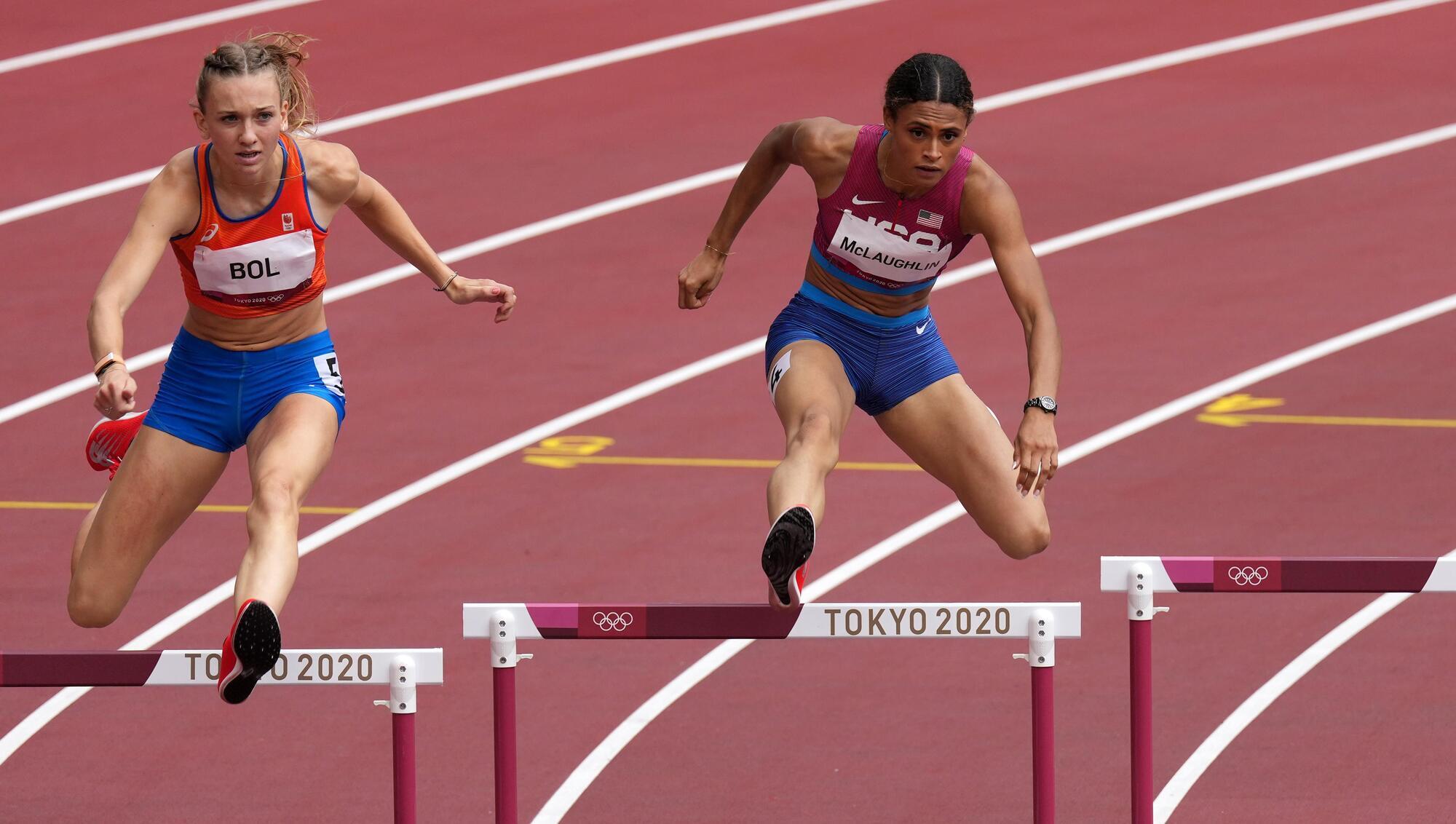
SUPERSTARS: USA's Sydney McLaughlin on the way to winning the gold medal in the Women's 400m Hurdles, alongside Netherlands' Femke Bol who finished third at the Olympic Stadium on the twelfth day of the Tokyo 2020 Olympic Games in Japan. Pic: PA/AP
How many events is too many events? In the year ahead, athletics is about to find out. Because the sport is changing, fast, trying to capitalise on the buoyancy of the Paris Olympics and keep its head above water ahead of Los Angeles 2028.
Like many of the traditional Olympic sports, it has an ageing audience and while it will always have that once-a-year big bang – the major summer championships – everyone knows that’s not enough to sustain a fanbase. It needs a professional circuit that’s accessible to roving sports fans, which can keep athletics part of the mainstream conversation and not just exist, as it often does, in the shadows.
But the problem it has is one many individual sports face as the most popular team sports gobble up everything in their path – the era of live streaming, podcasts and fan channels meaning the a la carte sports fan no longer has to sample the menu and can gorge on their favourite thing.
Since 2010, the Diamond League has been the leading professional circuit in athletics, running between April and September with 15 meetings in total. But next year, it will have a rival in Grand Slam Track, an idea conceived by US sprint legend Michael Johnson.
That will also run between April and September but with just four meetings, each of them three days’ long, with only track events. It will involve 48 contracted athletes who will compete twice at every meeting, and a changeable cast of 48 challengers – eight athletes in each race. US superstar Sydney McLaughlin-Levrone, who’s no fan of racing Diamond Leagues, was the first to sign up as a contracted athlete, with world 1500m champion Josh Kerr and former world 100m champion Fred Kerley also joining her.
The prize money of Grand Slam Track dwarfs that of the Diamond League, with $100,000 for winning the event category at each meeting down to $10,000 for eighth place. At the regular-season Diamond League meetings, it’s just $10,000 for first, $500 for eighth, with the respective figures for the final being $30,000 and $1,000.
Speaking to a senior figure on the athletics circuit earlier this year about the clash ahead in 2025, they made a confident prediction: “The athletes will follow the money.”
So far it seems they have, though the likes of Jakob Ingebrigtsen, Karsten Warholm and Femke Bol have not committed. Conscious of the threat of Grand Slam Track, the Diamond League announced that it will significantly increase its prize money next year, dishing out $500,000 at each meeting and $2.24 million at its final, with between $30,000 and $50,000 on offer for each discipline at series meetings and $60,000 to $100,000 at the final.
Still, that’s way below Grand Slam Track, which looks set to attract the best of track talent in 2025. But there’s simply not enough top-level runners to go around both leagues and there’s a risk the increased fragmentation will see both circuits struggle to truly connect with the masses.
And they’re not the only show in town. The first edition of the Athlos 776 Invitational took place in New York recently, a women-only track meeting that offered a $60,000 first prize in each of its six events. It was the brainchild of Alexis Ohanian, the co-founder of Reddit, husband of Serena Williams and an avid investor in women’s sports.
"Every four years, during the Olympics, this is a really popular sport, and then all the coverage and everything seems to go away," Ohanian told ESPN. "And looking at the existing professional infrastructure, I did some work and then I just started DM'ing a bunch of track athletes. I was like, 'Hey, do you mind getting on the phone so I can learn?' That's when I realised how low the prize money was and how low the coverage was and how difficult it was to even watch."
But there’s more. Duael Track, another US venture, will stage its inaugural edition in March next year, featuring head-to-head races over 100m, with a similar event planned for mile races later. Eight men and eight women will compete one-on-one in a bracket-style format, with a total of $500,000 of prize money at its first event.
“We want the best of the best,” said Brandon Wimbush, Duael’s Vice President of strategic partnerships, in an interview with Front Office Sports. Duael’s founder, Barry Kahn, said they are “not trying to fill up a stadium” and that it would be an event made for TV, which suggests it’ll likely try to tap into the massive sports betting market, which is now legal in the majority of US states. Wimbush compared Duael’s format to the UFC or Power Slap, the latter being the brainchild of UFC CEO Dana White: an event where opponents take turns slapping each other until one drops or is ruled the winner.
“These sports have kind of been able to reignite what entertainment looks like,” said Wimbush. “10-second sprints are going to be organically created for social media, and that’s where a majority of social sports content is being consumed these days.”
If this all feels a bit dystopian, a bit ADHD, it’s the direction of travel the market demands, with sport increasingly having to leave behind its traditions to snag the attention of the TikTok generation. But with so many new ventures coming on stream at once in athletics, and the Diamond League trying to hold its position, the sport’s professional arm is approaching saturation point. More events won’t necessarily mean better events. It just means a dilution of existing talent and audience attention that will make many events mean less – with some dying off and the best of them thriving.
During the Paris Olympics, I asked Michael Johnson whether the massive investment in Grand Slam Track – he has already raised $30 million – would return enough to make it sustainable. He noted it was not the plan to turn a profit in its early years, merely to grow the sport’s fanbase.
“UFC took 20 years to become what it is,” he said. “For the first 15 years, they were losing money so you’d have to ask: How does an organisation that’s losing money continue to operate and continue to lose money for 15 years? It’s because investors continue to put money into that organisation. Then you’d have to ask: Why does the investor put money into a company that’s losing money? It’s because that company or organisation is growing their customer base. The most important thing we have to do is grow the fanbase. As long as we do that, we’re on track to be successful.”
It’s likely some of these new formats will disappear just as fast as they showed up, but what’s certain is the athletics circuit will look a lot different in 2025. But can any of them make fans watch and care in the way they do at major championships? So far in athletics, that’s a code no one has been able to crack.