Tommy Martin: VAR in the GAA would be an act of cultural vandalism
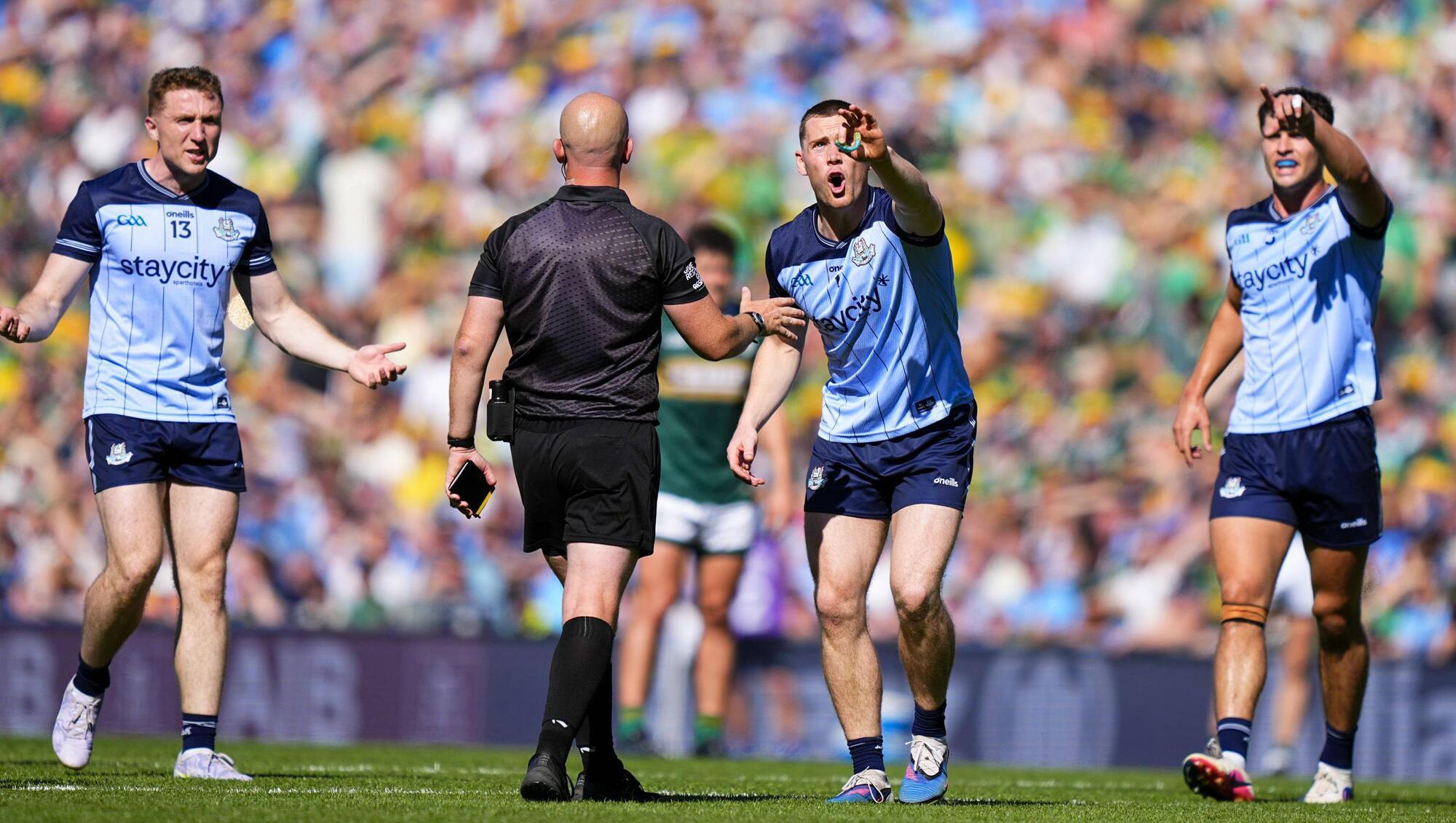
SCREEN TEST: Con O’Callaghan of Dublin telling referee Brendan Cawley to look at the Croke Park big screen during last Sunday's defeat by Kerry. Pic: ©INPHO/James Lawlor
If anything should act as a belated wake-up call for the class of bungling administrators, refereeing jobsworths and tech-obsessed fun sponges who have foisted the current version of video technology on top-level soccer, it’s that so few people want VAR to come to the GAA.
This despite the events of last Sunday when Dublin’s hopes of beating Kerry in the All-Ireland football semi-final were, arguably, fatally damaged by refereeing calls that some sort of technological input could have swung their way.
In the debate that ensued, many wanted to lean into the existing Hawkeye gizmo but few longed for the day when Brendan Cawley and his ilk are shuffling back and forth to a pitchside monitor to watch slow motion replays of microscopic fouls, as is the soccer fan’s current lot.
The GAA-VAR discussion was kicked off post-match by Dublin manager Ger Brennan, who lamented the three major decisions that went against his team: the penalty given against Peader Ó Cofaigh Byrne for an enthusiastic first half cuddle on Joe O’Connor; the square ball call that Kerry’s Sean O’Brien dodged for his crucial 43rd minute goal; and Ross McGarry’s palmed effort that freeze-frame footage revealed had probably just crossed the line before being shooed away from danger by Kerry defender Mike Breen.
“I feel very strongly that both sets of players today and other inter-county players,” said Brennan afterward, “even hurling as well watching some of the games, that video assisted technology has to come into play for key decisions because there were obviously three key decisions that didn’t go our way today.
“If the officials had an opportunity to have just a quick look, take 30 seconds out, stop the clock, those decisions would have gone a different direction,” he maintained.
Spoken like a man who has never seen the use of video technology in professional sports, where the idea of a quick, 30 second look is a mythical holy grail.
Brennan’s beef could be broken down into the sort of objective calls that goal-line technology looks after – McGarry’s goal and O’Brien’s positioning in and around the Dublin square – and those, in the case of the Kerry penalty, which lead to subjective differences of opinion even when viewed on review countless times and from multiple angles.
Now, it could well be that McGarry’s non-goal becomes the GAA’s Frank Lampard moment. Lampard, you’ll remember from the ghosts of World Cups past, was denied a clear goal in England’s 2010 Round of 16 tie against Germany in Bloemfontein, when his shot cannoned off the underside of the crossbar and bounced over the line in a manner obvious to everyone but the team of Uruguayan officials on duty that day.
Two years later, IFAB, the body that fixes and fiddles with the laws of the game, approved the use of goal-line technology. "That [Lampard goal],” then-FIFA president Sepp Blatter later admitted, was the moment for me to say, 'You can't afford for something similar to happen in the next World Cup'.
Goal-line technology was in place in the Premier League by the 2013/14 season and at the 2014 World Cup in Brazil and has been a frictionless addition to elite level of professional soccer, unlike its ugly sister, VAR, brought in nine years ago and still driving soccer fans globally into the very apoplectic paroxysms of paranoia and rage it was meant to stop.
In short, GLT can tell you with a buzz on the referee’s watch the objective information that a ball has crossed a line. VAR, on the other hand, in futile search of refereeing perfection, has descended into a quagmire of subjectivity, including some cases wherein the laws of the game have been rewritten to fit the new technological hellscape.
Not only that, but as seen at the current World Cup, it hasn’t spared officials charges of bias and outright corruption by the injured party in pernickety decisions like the one that denied Egypt a second goal against Argentina in the Round of 16. Which is not even to mention the interminable delays and baffling inconsistencies that mark the general user experience.
It has been encouraging, then, to note that most GAA commentators have reacted to the trifecta of hard calls visited against the Dublin footballers last Sunday with a sensible verdict, borne of the experience of watching other sports: GLT good, VAR bad.
The general view is best summed up by Mayo boss Andy Moran, who predicted that, while goal-line technology will soon be in place using the existing Hawkeye system, anything more intrusive is to be avoided. “If it goes to decisions of fouls and all that sort of stuff,” Moran said, “I’d be totally against it. But if it’s just for the scores and the big decisions, I think it’s probably only right.”
Most GAA folk have the innate understanding about the incompatibility of their sport with the farrago of video assisted interference. The fewer natural stoppages your game has, the less suitable it is to have bunker-bound Poindexters pointing at a screen and gabbling in the referee’s ear. So: fine for cricket and NFL, tolerable for rugby, terrible for soccer and potentially catastrophic for both GAA codes.
Hurling is a game where a referee is metaphorically chaired from the field as a hero if he has the foresight to forget his whistle, while Gaelic football literally rewrote its rulebook to rid itself of the boring bits where nothing happens. TV directors in both codes get slated for running a replay that crashes over a kickout or puckout, such is the desire for continuous, breathless engagement with the action. Bringing in stoppages to review contentious decisions would be an act of cultural vandalism far outweighing any benefit accrued from avoiding the odd terrible refereeing call.
But while, despite the spillover into Liveline territory, the debate about VAR in GAA has struck a generally measured tone, a word of warning. Soccer’s fate tells us that once the tolerance for bumbling human incompetence is banished by the use of technology in one area, a sense of momentum gathers for the machines to take over everything.
The tech-wielding nerd vandals could be emboldened, as they have been in other codes, to wedge themselves further into the wild, bucolic soul of Gaelic games and make them subject to the same Kafkaesque bureaucracy of processes and procedures that govern the rest of our lives.
Read More
They will say that VAR in soccer has improved correct decision-making from 92% to 98% but neglect to mention that no one is any happier, simply because the person on the wrong side of the decision still thinks they’ve been shafted, except now it’s by shadowy figures crouched behind screens rather than middle-aged men with whistles.

At the heart of all of this is the fact that technological advancement always comes with the promise to improve some aspect of life but without the admission of the harm it will cause to another. For example, the invention of Facebook led to the partial destruction of Western liberal democracy, but on the plus side, I can get back in touch with a guy I sat beside in Geography class in 1993.
As always, there’s a responsibility on all of us on this one, namely, to abandon the culture of incessant referee bashing that eventually led soccer inexorably down the VAR route. There’s a fine balance to this: like players and managers, referees should be held to account in the pursuit of better standards but the search for perfect fairness is the path to madness. Or worse, VAR.
In the 53rd minute last Sunday, Brian Howard, a two-time All Star and five-time All-Ireland winner, ballooned a ball so far wide they had to send out a search party to find it. People make mistakes. They’ll try better next time. We don’t need to check that on the video.