Colin Sheridan: Why is women’s sport still searching for the finishing line?
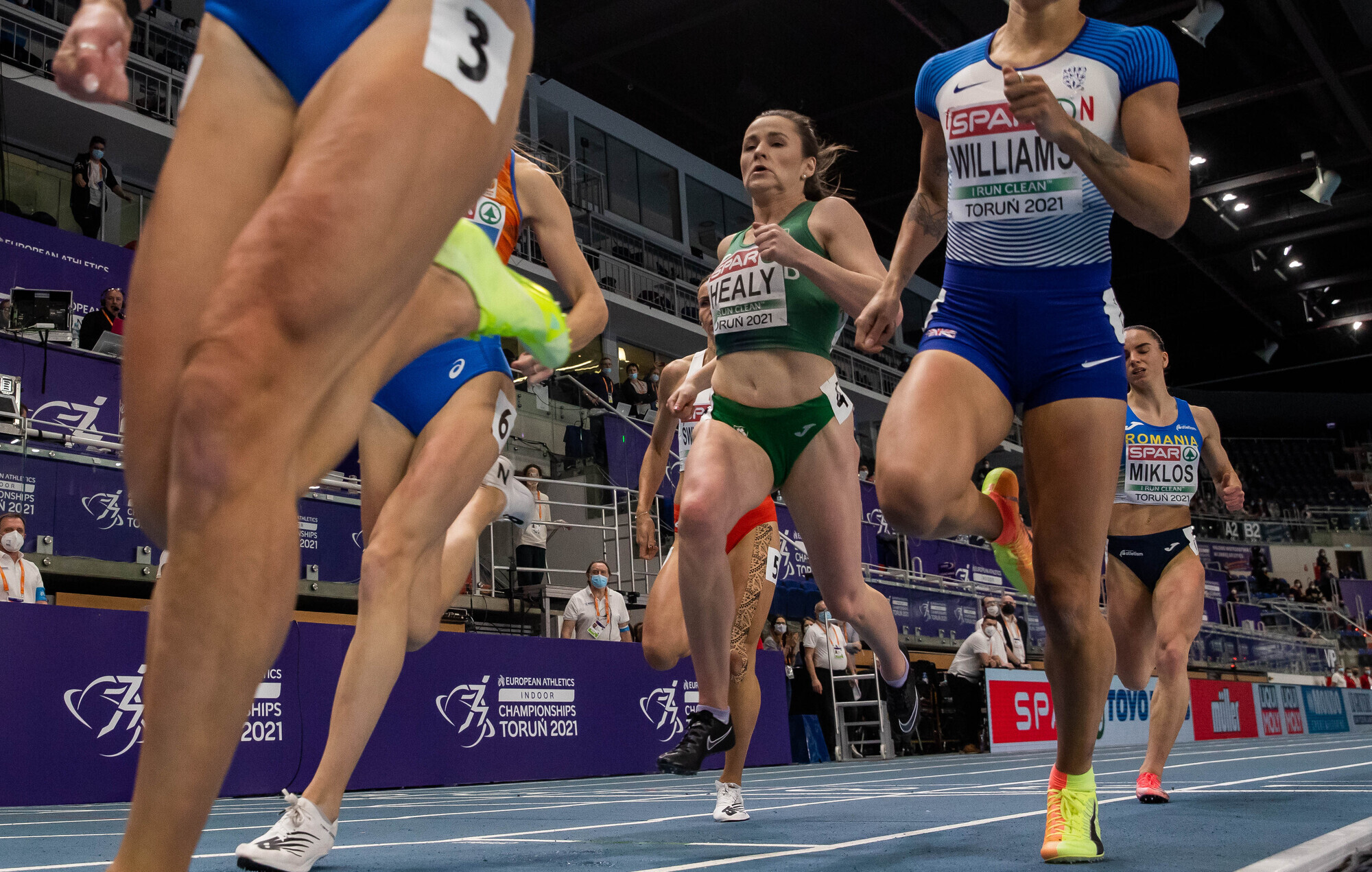
FINE MARGINS: Ireland’s Phil Healy just misses out on a medal in the final of the Women’s 400m at the European Athletics Indoor Championships in Torun on Saturday. Picture: Inpho/Morgan Treacy

“At the time, the prevailing mindset and myth were that women were not physiologically able to run 26.2 miles. They said women couldn’t do something that arduous, that it might turn a woman's features into that of a man, and a doctor had told me straight away that my uterus would fall out.”
— Kathrine Switzer
Marathons are brutal. Talk to those who run them and they will recount any number of tiny details that could potentially upset their race; an ill-fitting sock, a dicky tummy, a calf muscle, suddenly tight. 26.2 miles is a long way to carry doubt.
When Kathrine Switzer ran the Boston marathon in 1967, she didn’t have the luxury of worrying about the state of her stomach. She had registered for the race using her initials rather than her actual name to avoid detection and subsequent red flags; women were not allowed enter the race, still deemed physiologically much too fragile for the pursuit.
Switzer, naturally worried she may draw negative attention to herself on the start line, initially only encountered support from her surprised fellow runners. So, she relaxed. Within miles of the start, however, she had been assaulted by race manager Jock Semple, who entered the course in his leather shoes and corduroy slacks, repeatedly grabbing Switzer by her neck and shoulders in an attempt to rip the official race number from her bib.
Semple was eventually flattened by Switzer’s boyfriend, who was running alongside her. The assault emboldened the then 20-year-old student; Switzer — who had entered the race just to run it, not make a statement — before resolving that quitting would make her look like a clown, and set back the cause for future inclusion of others.
Semple faced no sanction for his assault, but the image of him grabbing Switzer became an enduring totem for the cause. It still took a further seven years before women had their own race. Furthermore, the first Olympic marathon for women was not until 1984.
Switzer’s struggles that day seems ludicrous in the context of the weekend Irish athletics has just had, epitomised by the brilliance of Phil Healy in the 400m. What is more ludicrous, however, is that some 30 years after Sonia O’Sullivan was our most celebrated sportsperson, women are still fighting for recognition in sports, not just in Ireland, but around the world. Throughout the ‘90s — with Mary Robinson as president — Sonia, Catherina McKiernan, and later Michelle Smith were ubiquitous, not due to fame or celebrity, but achievement (later in Smith’s case — notoriety).
This was a decade when our men’s national football team largely underperformed after early promise, our men’s rugby team was an irrelevance, and our male golfers were plucky underdogs.
Yet, O’Sullivan and McKiernan prevailed consistently on the biggest stages, perhaps unsurprisingly in an individual sport, unsupported by a system. Two women driven by unquestionable talent, the raw materials required for them to excel being nothing but an open road and a pair of running shoes. As a nation, we watched, enthralled. We gave them the same homecomings we gave our men. Then, we just kinda forgot.
Why? Maybe because, as a society we are still believing men are stronger than women. That is the conventional wisdom that has perennially plagued the prospects for women in all sports. It is the argument that has dismissed the fight for equal pay for female athletes and the right for transgender athletes to compete as the gender they identify with.
But, how do we define strength?
If gender is a social construct, the measures of strength assigned to each one are also social constructs. In our patriarchal societies, the concept of strength is too often measured by the yardstick of masculine physiology.
There is perhaps no greater counterpoint to the assertion that men are ‘stronger’ than women than Serena Williams, who has won 23 Grand Slam titles, the most remarkable of which was the 2017 Australian Open, which she won while pregnant.
The subsequent birth of her child almost cost her her life (having to self-diagnose and convince her male doctor that she was having a pulmonary embolism, after the doctor dismissed her own diagnosis), she returned to tennis just nine months later, reaching the Wimbledon and US Open finals, while also admitting to suffering from postpartum depression.
Suffice to say, no man has ever done this. Still, we subconsciously see an imbalance.
Twenty two years after Sonia O’Sullivan won World Championship gold at the 5000m in Gothenburg, our women’s national football team had to go public about the degrading treatment they suffered from the sports national governing body — the FAI. Being forced to share kit and change in toilets for games, many players taking unpaid leave in order to join up or travel with the squad. Only by going public (countless discreet overtures for resolution went unaddressed by the FAI) did they get something close to what they wanted.
Last winter’s late notice change of venue for the All-Ireland Ladies SFC semi-final between Cork and Galway further highlighted that, while things may have improved on the surface, there still remains a considerable chasm in how we treat our women and men as sports people.
Undoubtedly, increased exposure has closed the gap. Lidl Ireland’s sponsorship of Ladies GAA has done wonders for the sport in terms of visibility and access (advertising works; who knew?). Similarly, the mini-exodus of footballers such as Brid Stack and Sarah Rowe to the AFLW has further showcased their considerable talents as extraordinary sportspeople.
For far too long, we have been first to the airport to clap home brilliant individuals, no more brilliant an example than Katie Taylor, an Olympic gold medalist and two-weight world champion, only to ignore the work required to nurture their talent, especially in team sports.
Speaking recently in a Q&A, Michelle Obama spoke to the role of team sports for girls: “As women, we are taught that our value is in our perfection...Boys are allowed to fail, because when you are competing, there are going to be winners and losers. A lot of times, we (women) are not used to competing. There is something about the practice in sports and competition where boys learn to fail a lot earlier.”
International women’s day, like European Indoor championships, allows us all to take pause and celebrate “strong women”.
But, today is not the problem. It’s what we do tomorrow when nobody’s watching that counts.
Perhaps it’s time we re-evaluate the concept of strength, and the way we choose to define it.