'What is next for offshore wind?' asks Wind Energy Ireland chief

Ireland has six projects, known collectively as the Phase One projects, that are the only ones which can be generating power by 2030. This image shows a wind farm in Oresund, Denmark.
, chief executive of Wind Energy Ireland, looks ahead to the development timeline for Irish offshore wind

On the last day of October, the Government approved the terms and conditions for the next offshore wind energy auction, due to take place early next year, in a major boost for the industry.
This follows the approval by the Oireachtas of the first Designated Maritime Area Plan (DMAP) for offshore wind energy. Four development sites within the wider area off the southern coast of Ireland were identified with a total potential capacity to generate over 5 GW, more than Ireland’s entire current onshore generating capacity.
One of these sites, Tonn Nua, will be the site for Ireland’s second offshore auction and there is huge excitement about its potential to drive significant green investment to coastal communities in the south-east while reinforcing our energy security.
Once operational Tonn Nua will deliver enormous amounts of clean, affordable, electricity to families, businesses and industries across Ireland while cutting our carbon emissions.
Finalisation of the terms and conditions for the auction is a major achievement by the Department of Environment, Climate and Communications and underlines again this Government’s commitment to offshore renewable energy.
It is important to understand that winning the auction is not the same as getting planning permission. Whichever bidder wins the auction will need to carry out extensive surveys in the area, likely over several years, before making an application to An Bord Pleanála With luck, the project might obtain planning permission before the end of the decade and would then be operational at some point early in the 2030s.
Our focus now needs to turn to identifying new sites, for fixed and floating wind energy, in other parts of Ireland’s maritime area to build a strong and attractive pipeline of projects but to do that we need more DMAPs to be identified.
The Government has yet to decide where these will be and when work on them will start but this needs to be done soon to support the acceleration of offshore wind energy.
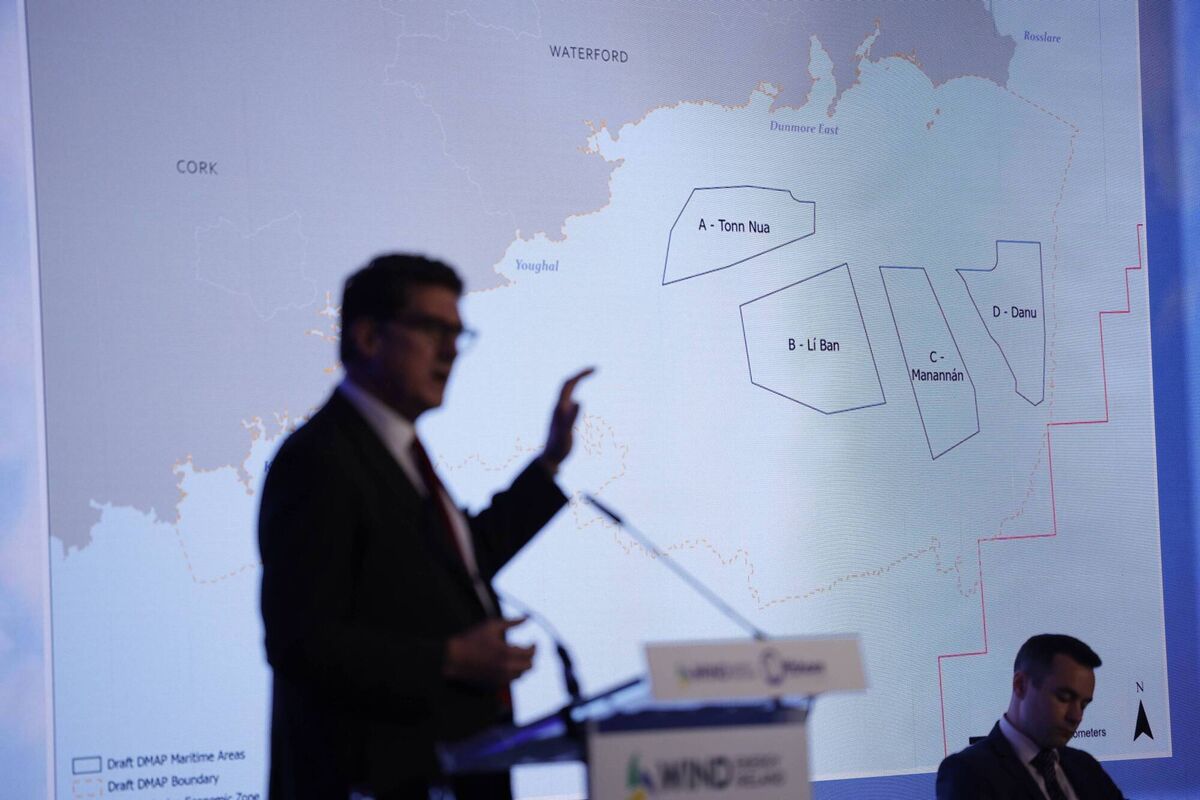
While Tonn Nua is only one of four sites identified in the south-coast DMAP it is not clear when the other sites might be opened for development. In the meantime, for wind energy investors and developers, it is critical they have a robust pipeline of future opportunities for fixed and floating wind energy if they are to stay invested and interested in Ireland.
We are hoping to see a roadmap as soon as possible but this would only be the beginning of a process that would involve serious and sustained engagement with all stakeholders before any new DMAPs are finalised.
Alongside this it would be important to build on the very welcome recent announcement that the Irish Strategic Investment Fund will be working with Port of Cork to get ready to support the construction of offshore wind farms. But we will need more of this kind of investment to ensure we build Irish wind farms from Irish ports.
This needs to be supported by the Government’s new industrial strategy for offshore wind energy which will help to ensure the benefits from our offshore wind revolution stay in Ireland, creating Irish jobs, supporting local businesses and revitalising our coastal communities.
Next year’s auction and the other approved new sites represent the next generation of offshore wind energy projects. However, critical to building the supply chain for them is ensuring Ireland’s first phase of offshore wind projects, which are applying for planning permission this year, get built by the end of the decade.
These six projects, known collectively as the Phase One projects, are the only ones which can be ready to generate power by 2030. Ensuring their delivery, and in doing so laying the foundation for Irish energy independence, must be a top priority for the next Government.