Planning reforms would pave the way for significant onshore renewable energy development
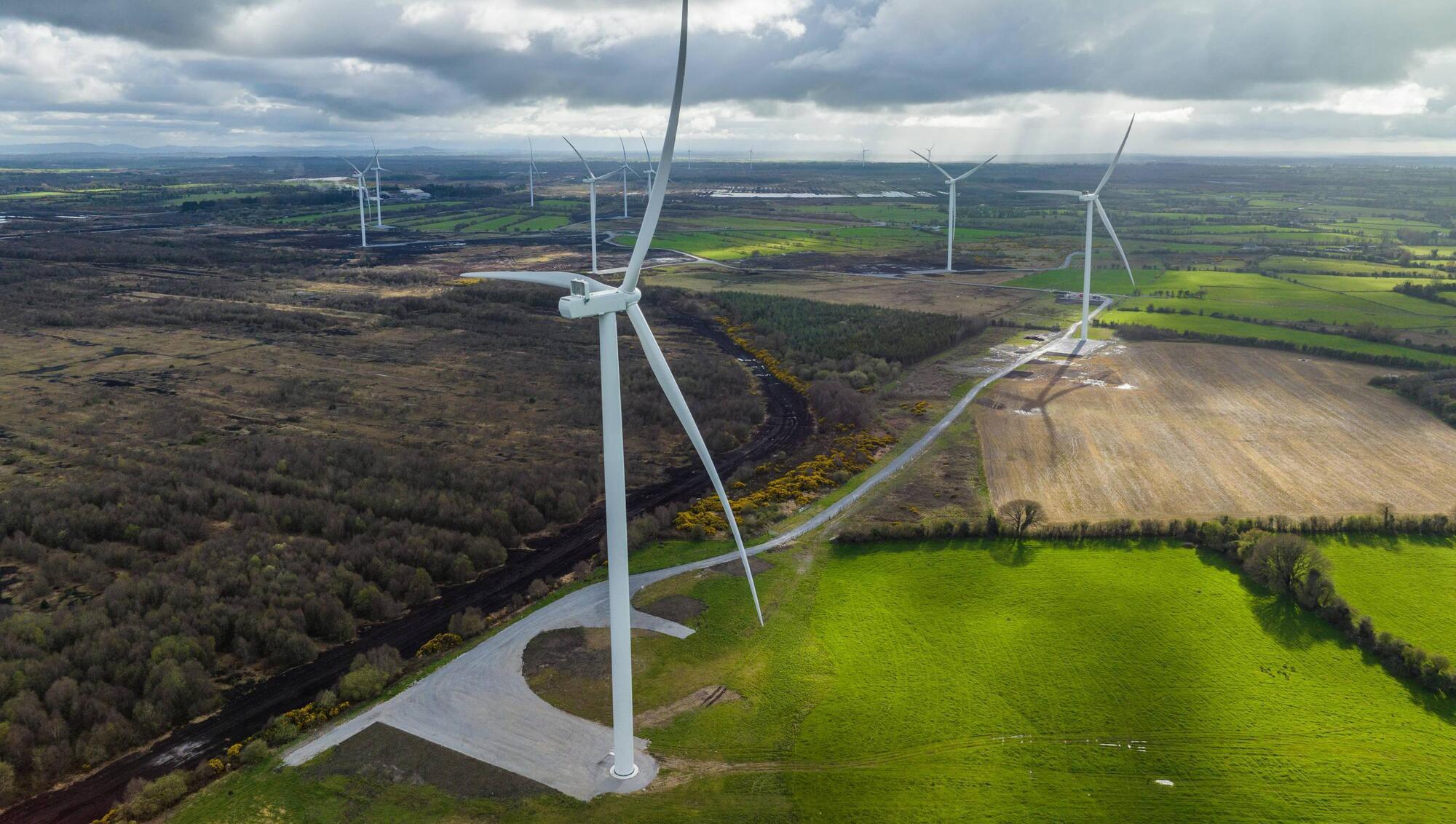
In August, Statkraft Ireland's plans for a site designated for wind energy development were refused as ‘the area was re-zoned due to local political pressure'. Statkraft recently finished construction on Cloghan Wind Farm in Co Offaly. The nine-turbine, 34MW project could power as many as 27,000 homes.
Ireland’s onshore renewable energy journey has not been a smooth one.
The Government recently released the results of the fourth auction for onshore projects under the Renewable Energy Support Scheme (RESS) and while it was hailed as a success by many, the details tell a slightly different story.
The results of Ress4 failed to meet initial procurement levels, which puts the Government’s ambitious target of 80% renewable energy further out of reach.
The fourth auction under the Government’s Renewable Electricity Support Scheme (RESS 4) showed that 1,146 Gigawatt hour (GWh) of wind energy applicants were successful alongside 925 GWh of solar energy.
This is well below the initial procurement target of 2,500 GWh–4,500 GWh set out at the start of the auction process, but the target was changed before the auction process was finalised.
A total of 56 projects applied to participate in the RESS4 qualification process and 43 of these qualified for the auction. Of those that did not qualify, 10 projects decided to formally withdraw from the process.
Out of the 43 that qualified, 27 projects were successful, climbing slightly higher than 23 in Ress3 but trailing behind the results of Ress1 which had 82 successful projects, suggesting lingering challenges for developers in the industry.
Of the 27 provisionally successful projects in RESS4 only four were onshore wind with the remainder of projects being solar PV. No other eligible technologies such as hybrid wind and solar or hybrid wind and storage were successful.
Commonly cited reasons for the scarcity of wind projects competing in Ress include issues with securing the necessary planning consents and projects opting for Corporate Power Purchase Agreements (CPPAs) as an alternative route to market with estimates of up to 150MW of projects opting to seek a CPPA over a Ress4 contract.
CPPAs have been a contentious point in some renewable energy circles as Big Tech enters into contracts with green energy providers to power data centres.
However, recent research from Bloomberg found that tech firms using renewable energy certificates enable them to claim that their energy consumption is more environmentally friendly, even if they are still relying on fossil fuels.
This practice significantly distorts the true carbon footprint of these tech giants, according to CarbonCredits.
Justin Moran, director of external affairs at industry body Wind Energy Ireland, said that these agreements between Big Tech firms with renewable energy companies, which are largely now created to fuel growing AI operations, can “help cut carbon emissions and push down the wholesale electricity price.”
“We are seeing some wind farms choose to go for CPPAs rather than compete in the auctions but I think this is less about the planning system and more people making a comparison between the Government’s Renewable Electricity Support Scheme and a CPPA with a large energy user and making the best decision for their project,” said Mr Moran.
“I do think we need to recognise that while Ireland, with our established onshore wind industry and our enormous offshore potential, is an incredibly attractive place in which to invest we are competing for finance, for interest, for access to a very tight supply chain,” said Mr Moran.
Mr Moran made his comments after the industry was dealt another blow by the planning system which is consistently mentioned as an obstacle for renewable energy development in the Irish market.
“The best ways to ensure people get interested in Ireland — and stay interested — is to sort out what is clearly a broken planning system, to reinforce our electricity grid as quickly as possible,” he said.
Just three wind energy projects received planning decisions between July and September and planning body An Bord Pleanála granted planning permission to only a single new wind farm.
Onshore energy development, particularly wind farms, have been hindered by chronic backlogs in the planning system and a lack of skilled staff to move projects quickly through the system.
However, a new planning problem, dubbed Anti-Wind County Development Plans, has arisen that is creating further headaches for onshore renewable energy developers.
In September, chief executive of Wind Energy Ireland Noel Cunniffe said national efforts are required to ensure “the delivery of renewable energy projects are not impeded by county councils across Ireland amending County Development Plans to block the development of new wind farms.”
This was a key point of contention for Statkraft Ireland vice-president for wind and solar development, Donal O’Sullivan, in a recent interview with the Irish Examiner.

Local councillors have allegedly de-zoned areas previously designated for onshore renewable energy development, leading to planning refusals for some developers looking to get projects off the ground in certain areas.
“There’s a crisis coming where the county councils haven’t zoned enough land,” Mr O’Sullivan said.
The establishment of the Planning & Environmental Court has so far tackled this planning issue, according to Mr Moran.
He added that “significant resources” have been pumped into An Bord Pleanála and the National Parks & Wildlife Service which he said has led to an “improvement in the time taken to make decisions”.
“But the hard reality is we’re not getting anything like the volume of decisions we need in the time that we have,” said Mr Moran.
“We can’t build wind farms if we can’t get them through the planning system and the longer they are stuck there the longer Irish families are stuck with higher electricity bills and dirtier energy,” he said.
Research from Wind Energy Ireland also signalled the need for increased battery storage to house energy generation from onshore renewables during calmer and darker days where wind turbines and solar panels are not generating enough to power homes.
Without battery storage, households continue to rely on fossil fuels like gas which is also more exposed to economic volatility which was evident during prices surges following Russia’s invasion of Ukraine in 2022.
“We need additional battery and long-duration energy storage projects and we need a strong electricity grid. Reinforcing Ireland’s electricity grid needs to be an absolute national priority for the next Government,” said Mr Moran.
Professional services firm KPMG said, overall, the results of RESS4 showed a considerable improvement from RESS3. Combined with technological developments, the structural changes introduced in Ress4 have contributed to securing increased volumes of energy at lower prices.
Measures to reduce risks associated with planning and grid delays are seen as particularly important to the improved results from this year’s auction, KPMG said.
However, the success of future RESS auctions require significant improvements in the planning system and the electricity grid, warned the company.