Picking up a hammer and chisel to learn how to carve granite is one of the best things I've done
I will try my hand at most DIY. But I will be honest: part of me assumed this would be a gentle, dabble-y sort of activity. Reader, it was not
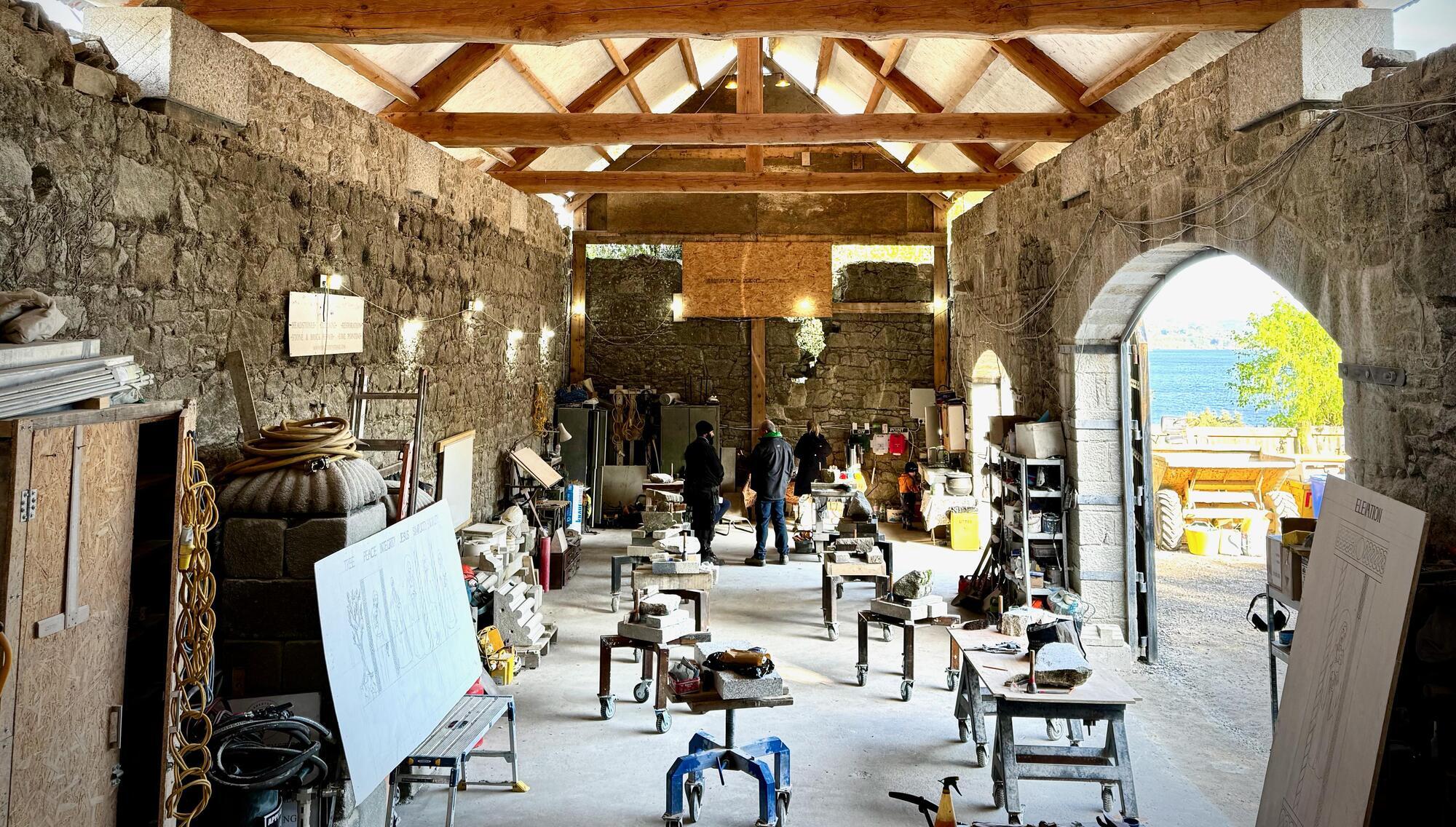
O'Flaherty Stone Workshop in Ballyknockan, Co Wicklow.

O'Flaherty Stone Workshop in Ballyknockan, Co Wicklow.

There are two solid granite window sills in my little cottage, and I adore them. They have presumably been there since the house was built, back in the 1890s, and they are still perfect. 

At least four generations have lived in this house, and there is but a slight hint of the wear you would expect from enduring well over a century of use — Irish weather, damp, ladders leaning on them, shopping bags dumped temporarily while keys were fished out, children climbing up to sit and swing their legs. 

A little smoothness at the near edges, a tiny chip underneath the left one. I have admired those sills for years without once stopping to think about how they were made. Then I was invited to spend two days learning to carve stone myself, and now I cannot pass them by without a sense of wonder.

The two days came courtesy of an invitation to a stone-carving workshop run by O’Flaherty Stone in Ballyknockan, Co Wicklow — known, fittingly, as the Granite Village. (Note: It was a PR invite and did not influence this piece.)

I am deep into my DIY era, as regular readers will know, and I will try my hand at most things these days. But I will be honest: a small part of me assumed it would be a gentle, dabble-y sort of activity. A nice day out. Reader, it was not. It was one of the most absorbing things I have done in a long time.

An unexpected meditation

We worked on pieces of local Wicklow granite, each of us armed with nothing more than a hammer and a chisel, carving a simple shape. Our teacher was Killian O’Flaherty, the owner of the business and — extraordinarily — an eighth-generation stonemason. The man has stone-cutting in his blood going back two centuries, and watching him work is like watching someone read a language the rest of us cannot yet understand.

A hand-carved sign over O'Flaherty Stone.

Killian’s sister, Petra O’Flaherty, recently became the first registered female stonemason apprentice in Ireland in over 30 years, collecting numerous awards along the way.

I expected to find it fiddly and frustrating. Instead, I found it transportive. Once I got the hang of how to effectively wield the tools, which takes a while — I fell completely into the rhythm of it all. The steady tap of the hammer and the reverberating sensation of stone giving way, grain by grain.

The slow reveal of a shape that was, a few hours earlier, just a pencil line drawn on a rough block. 

The time simply vanished. In a world dominated by screens, I have rarely been so present in recent years. By the end of the first day, my hands and arms ached comfortably, and I had that deep, clean satisfaction of a hard day’s work. Though I had very little to show for it after only one day, the hours that passed left me transformed.

Jennifer gets 'in the zone' while stone carving.

I should add that I was not, by any measure, a natural. My first attempt was a bust, the wrong kind, and I ended up starting again on another piece. But that didn’t matter a bit.

Ancient craft

I came away with a deep new respect for the craft. Carving stone is hard. Physically, yes, but also in the sense that it is utterly unforgiving. Wood you can sand back; a wonky shelf you can rehang. Stone offers you no such mercy. Take off too much, and it is gone forever — every single tap is a risk.

The precision I now notice in carved stonework, the crisp lettering on an old shopfront or the clean edge of a Georgian doorstep, looks to me now like a small miracle performed by hand.

Jennifer's first attempt.

What struck me more was learning how alive the trade still is, even if it had flown under my own personal radar. Aside from kitchen countertops and old fireplaces, I rarely thought of stone at all.

Stonecutting and stonemasonry is a recognised apprenticeship here in Ireland — a four-year programme leading to a QQI Level 6 qualification, run through SOLAS and the Education and Training Boards, with off-the-job phases at training centres such as Kerry College in Monavalley. 

Apprentices learn everything from banker stonecutting and lettering to relief carving and the conservation of historic buildings. Much of the heritage work you admire on our abbeys and cathedrals, and the painstaking restoration of stone walls and re-pointing of period homes, is done by people who have achieved this prestigious qualification.

Beneath our feet

I had a vague notion that there is a lot of nice stone available in Ireland, but it turns out we are actually spoiled for choice with native material. There is the silvery granite of Wicklow and the Mourne Mountains; the handsome blue-grey limestone of Kilkenny (the dark, fossil-flecked variety is often called Kilkenny “marble”); the warm golden sandstone of Donegal; the dramatic green Connemara marble (my personal favourite); and the rippled, blue-grey Liscannor flagstone from the cliffs of Clare.

Different regions reach for different stone — depending on local availability, current trends, and the relative qualities and suitability for the job — and you can read a building’s geography in its walls once you know what to look for. I find I cannot stop noticing it now.

What stonemasons can do

You do not need a cathedral to commission a stonemason, and this is the part I most want you to take away. A good mason can make or restore an enormous range of things for an ordinary home: window sills and door surrounds, a stone fireplace or hearth, gate piers and garden walls, paving and steps, even hand-carved lettering for a house name or plaque.

If you live in an older house — and so many of us do — a skilled mason is also exactly who you want for sensitive repointing and conservation; work that keeps a period home weathertight without smothering its character under the wrong mortar.

Jennifer Sheahan's finished product, her sample logo.

It needn’t cost the earth to start a conversation, either. You can approach a working mason directly, or call into one of the stone yards dotted around the country — there’s O’Flaherty in Wicklow, of course, but also Harding Stoneyard in Kilkenny and Loughrey Stoneworks in Galway are both good places to see the range of native stone and understand applications of the craft.

It’s always a good idea to ask to see samples and previous work before you commit, exactly as you would with any other trade — good ones will be happy to show you and talk you through it.

If you want to try it out

I’d encourage anyone with an idle weekend and a bit of curiosity to give carving a go. O’Flaherty Stone runs two-day workshops in a working stonemason’s shed in Ballyknockan, where you will carve your own piece of Wicklow granite to take home — beginners are welcome, and you do not need a shred of artistic talent to enjoy it (I am living proof).

More in this section

Revoiced

Newsletter

Had a busy week? Sign up for some of the best reads from the week gone by. Selected just for you.

Cookie Policy Privacy Policy Brand Safety FAQ Help Contact Us Terms and Conditions

© Examiner Echo Group Limited