Potty for pots
IT’S getting late in the afternoon and a watery, anaemic winter sun has tempted a cloud of midges to dance in its light before settling for yet another long night.
The rain has temporarily stopped, and for the first time in days it is possible to walk up through the garden to the end boundary. The soil is sodden.
Winter, whether I like it or not, continues to move along in an easy, almost inconspicuous manner bringing with it its share of harshness, and more often than not, its share of beauty. Even when all looks dark and sodden there is, it seems, always something to be admired, something that appears to have gone against seasonal death.
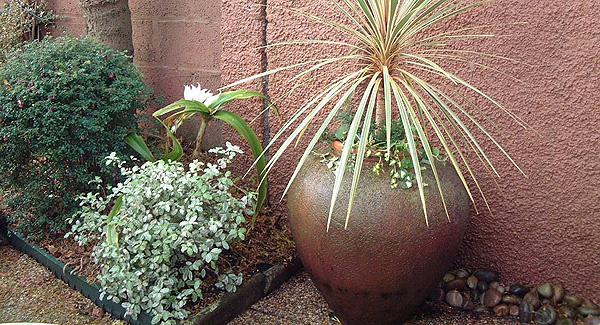
I notice a few favourites still showing colour and substance in a modest collection of pots sited along a sheltered pathway.
Now some gardeners (and I’m no exception) seem to collect pots with almost the same zeal as they do plants. So popular are they nowadays that you will find huge areas of space given over to them in garden centres.
Certainly, at this time of year attractively filled pots are particularly useful, and those containing shapely evergreens definitely help the place retain a lived-in air, instead of looking as though everyone went off in September to spend the winter in a warm place.
To look right, outdoor pots need to be of ample size — anything with less than a 12 inch inside diameter will look puny. And since evergreen shrubs in pots inevitably have to put up with a bit of neglect in summer, allowing them to have ample soil round their roots reduces the risk of sickliness due to dryness.
The really enthusiastic pot gardener will grow evergreens in ordinary clay pots and then conceal these within larger, permanently sited pots that have been partly filled with soil. This is how I plant for winter, then, come the spring, the evergreens in their clay pots are removed and replaced by new pots which have been planted with bulbs and later, with summer bedding.
The evergreens can then be rested during the summer in some shady spot which will prevent them from drying out totally. It is essential therefore to use clay pots not plastics for the regime as these allow moisture to permeate through to thirsty roots.
For evergreens to really make their mark in winter they need to have architectural form and a high gloss on their ample leaves. Then, they will glisten after rain or in thaw, after an early morning frost.
Choose carefully for they should ideally be modest in their growth habit and have an engaging matronly stance. Most of all, they should look magnificent and have a touch of the exotic about them, as though they had just been brought in from the orangery.
Take Cordylines as an example, for these will always look smart in winter and if you use one as a centre-piece and surround it with a Heuchera, (which I have often mentioned), its leaves will delight in all weathers.
Varieties such as ‘Tiramisu’ are so intricately stippled and lined that they look as if they have been decorated by a pointillist painter, while the gold and lime green forms looks almost Impressionistic.
There are many others you could choose, Box topiary, variegated Hebes, evergreen grasses, Camellias, Pieris, Skimmia, even winter-flowering wallflowers. Any of these in a suitably sized pot would make a very acceptable and welcome Christmas present.
There’s no point hanging on to the brittle stems of late flowering clematis through the winter. Varieties such as ‘Gipsy Queen’, ‘Hagley Hybrid’, ‘Jackmanii’ and Perle d’Azure’ are some of the popular varieties. Hard-prune now to about knee level. If you live in the south or in a warm county do it before Christmas for new growth during mid to late January.
Continue to clear and compost leaves. Their fall has been slow enough this year, and to have them with us almost to Christmas is an unusual occurrence. Don’t burn them — it’s against the law — but they can be used to make a wonderful soil conditioner. If you haven’t got a bin for them, just bag them up, damp, in black dustbin bags and leave for 12 months.
Many winter-flowering, scented shrubs start to bloom early in December and in my part of the world Viburnum fragrans and V. tinus often make a charming picture during the festivities. Frost will damage many blooms but there are usually many buds to follow and these open willingly with a return to milder weather. Cuttings of numerous trees and shrubs, including those of the yellow-flowered Jasmine nudiflorum, will certainly be in bud and flower by Christmas.
If small branches containing closed buds are cut and brought indoors to a warm room they will open and last a considerable time. Try not to disfigure the plants when removing pieces for indoor use.
Incidentally, the yellow jasmine will be an ideal plant for training on a wall or fence, and it will thrive in situations facing east or north, in shade as well as in sunny places. It is not fussy as to soil type.
Established hellebores attract few pests but unfortunately diseases are no respecter of maturity and the hellebore leaf spot fungus will attack plants from time to time. Any systemic fungicide will prevent the spread of this debilitating condition. Removing any suspect leaves is a good idea, so too the removal of the old leaves during early autumn.
The birds are moving back nearer to towns because their food supply in the countryside is getting rather thin. During winter, all fish move into deeper water for warmth and protection, movement becomes more sluggish and many hide under rocks and river ledges for safety. In the garden pool, hiding places are few and far between. It would be advisable to not alone cover the pool with netting or wire, but provide some form of shelter in which the goldfish can hide. Short sections of plastic piping sunk on the pool bottom will give them a safe, quiet, resting place for the winter.
CONNECT WITH US TODAY



Be the first to know the latest news and updates