Letters to the Editor: Ireland will have to beef up its spend on defence
'We cannot hope to be strong enough to act in isolation from our partners
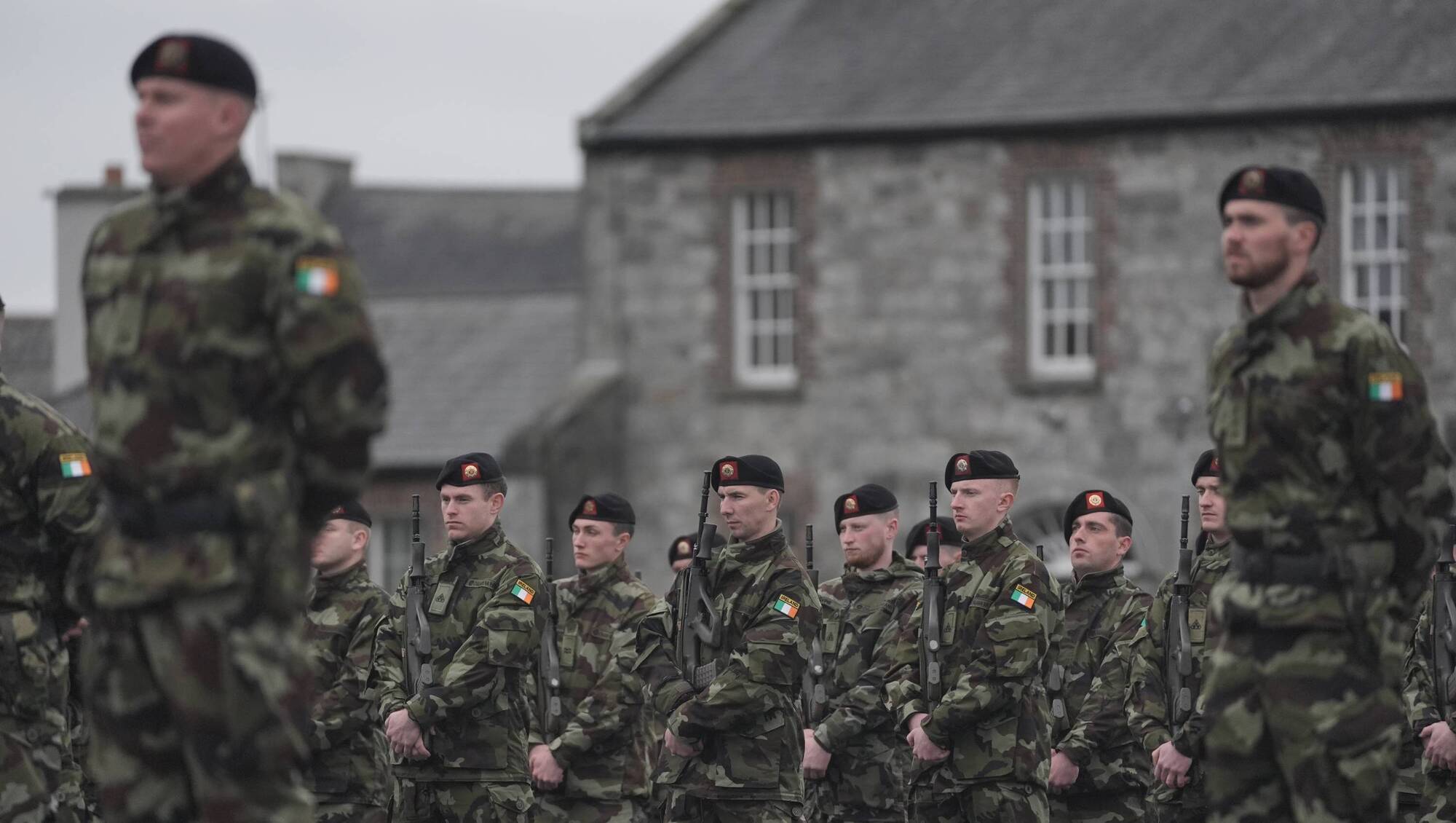
'Our failure to develop armed forces capable of defending our “neutrality” unlike “heavily armed” Switzerland, and indeed Finland and Sweden as neutrals, makes a mockery of our claim to be such, and has resulted in our effective dependence on Nato for our ultimate security.' File picture: Brian Lawless/PA

'Our failure to develop armed forces capable of defending our “neutrality” unlike “heavily armed” Switzerland, and indeed Finland and Sweden as neutrals, makes a mockery of our claim to be such, and has resulted in our effective dependence on Nato for our ultimate security.' File picture: Brian Lawless/PA

As one of those who has, until recent geopolitical shifts, supported “policy traditions that have ensured security for well over half a century”, and having no connection with any of the organisations criticised by the authors, I would take issue with some of the points raised by Patrick Bresnihan and Rory Rowan in your paper.

In the first instance, I would suggest Ireland has never been truly neutral, but has rather adopted a policy of non-membership of Nato or any EU common defence arrangement, should such be adopted. 

In respect of the latter, we are constitutionally prohibited from doing so. In the interests of transparency, the article might have referenced this constitutional provision. We are certainly not neutral in the current war between Russia and Ukraine, but, in line with our general policy, are non-belligerents.

As someone who has undertaken six peacekeeping tours, I am acutely aware that this aspect of our “policy traditions” has been positive for our reputation. I am also conscious, however, that our failure to develop armed forces capable of defending our “neutrality” unlike “heavily armed” Switzerland, and indeed Finland and Sweden as neutrals, makes a mockery of our claim to be such, and has resulted in our effective dependence on Nato for our ultimate security. However, I would acknowledge that this policy was, in the past, a pragmatic one, taking advantage, as it did, of our geographical location.

As Sweden and Finland have acknowledged however, the world has changed. Trump’s America, not just Trump himself, has grown more isolationist, and, with some justification, is resentful of Europe being protected by USA, without making adequate contribution to its own defence. The Ukraine invasion, and, in recent days, the drone probes of Polish defence and the military manoeuvres on her borders, underline that an expansionist Russia, led by a dictator, is a real and present threat to European security.

The consultative forum was at least an attempt to highlight the need to reassess policy in the light of very significantly altered geopolitical circumstances. To fail to have done so would have constituted an alarming breach of duty by the Government. We need to pause our moralising and consider our policy options in a pragmatic manner.

Given US ambivalence, Nato is much weakened, and there is a constitutional prohibition on adhering to a common EU defence. Irish options are therefore limited, and we cannot hope to be strong enough to act in isolation from our partners. We need to enhance defence and security co-operation with UK (with whom we have an existing air defence arrangement) and our EU partners, support maximising European strategic autonomy, and urgently implement the recommendations contained in Option 3 of the Commission on the Defence Forces. 

This will, of course, mean dealing with arms manufacturers. We already do so for all of our military equipment, and needs must.

Michael O’Dwyer, Clogheen, Cork

Ten-year-old’s awareness of war

A few days ago, a 10-year-old girl attended with me for psycho-educational assessment. During a vocabulary test, she was asked to explain the word ‘migrate’. Usually, children of this age respond by referring to birds migrating to warm countries for the winter. Instead of this reference to the wonders of the natural world, this young girl said people migrate during war, to get away from the war.

This is a very sad and, indeed, tragic reflection of the world in which our young children are now living. Instead of being fascinated by the wonderful natural world around them, they are witnessing other children and their families fleeing in terror and desperation from the horrors of war.

Future generations will not thank us for our warmongering recklessness and our cruelty.

Marian Naughton, Chartered educational psychologist, Naas, Co Kildare

Consign coursing to pages of history

On July 2, the Dáil will vote on a bill to ban hare coursing in Ireland, sponsored by Paul Murphy TD; the third such attempt to protect our native Irish hare from a sport that shames our nation.

The late deputy, Tony Gregory, moved a similar bill in 1993, and Maureen O’ Sullivan TD in 2016. Both were heavily defeated when the main political parties applied the whip to block the measure.

On those two occasions, Fianna Fáil and Fine Gael refused a free vote, compelling even anti-coursing TDs to opt for cruelty over compassion.

Hare coursing stands condemned on both animal welfare and conservation grounds. The widespread use of nets to capture hares involves widespread disturbance to habitat, a level of human interference the species can do without, assailed as it is by the loss of its abode caused by urbanisation and the ravages of modern agriculture.

The spectacle of hares — the gentlest creatures in our countryside — running from hyped-up dogs at venues nationwide should have ended long before now. It had no place in the 19th century, let alone in the 20th or 21st.

The Irish hare is one of our few truly native mammals, rightly hailed by conservationists as the flagship of Ireland’s biodiversity.

How perverse to see this wildlife icon hurtling through the air after being pummeled by a greyhound, or mauled like a rag doll on the field, or having its brittle bones crushed.

The parties could allow a conscience vote next month, as indeed they did on a completely different issue recently.

The Dáil can strike a blow for a mammal feted in song and folklore, one that threatens nobody and enriches our countryside. Let’s draw a line under this medieval sport.

We can end the hare’s sad plight ... and consign coursing to the pages of history.

John Fitzgeraldl Callan, Co Kilkenny

US disaster in Iran

As I read through the ‘Islamabad’ Memorandum of Understanding (MoU) in recent days, I wondered if the former Venezuelan ruler, Nicolás Maduro, in the austerity of his US prison cell, might have conjured up a wry smile as he reflected on how his capture would have undoubtedly distorted Trump’s already bulging ‘supremacy algorithm’ and as a consequence buttressed his utter failure in assessing the strength of Iranian resilience.

On March 1, just two days into the war with Iran, Trump told The New York Times: “What we did in Venezuela, I think, is the perfect, the perfect scenario.” 

When the successful leadership decapitation in the opening hours of the war and thereafter all the bombs his administration could muster couldn’t topple the regime he had no ‘Plan B’.

The perfect scenario of Venezuela was a disaster for Iran, as the past week’s MoU clearly shows.

Michael Gannon, St Thomas’ Sq. Kilkenny

Magnificence of Páirc Uí Chaoimh

Páirc Uí Chaoimh stands as a magnificent landmark on the banks of the Lee, a source of great civic pride for all of Cork.

Huge credit is due to the GAA and the county board for opening the doors to other codes, for instance our women’s national soccer team defeating the Netherlands 3-2 in a thrilling World Cup qualifier earlier this month and two days later the magic of the Munster hurling final between Cork and Limerick, and clash of the ash, with only a single point separating the teams after 77 mins.

For our youth, boys and girls, across the city and county — whatever they play — to dream of representing their club, county, province or country in the Páirc is priceless.

Sport has always been at the heart of Cork life — whatever your choice of sport, take an opportunity to experience the cauldron that is the Páirc where memories are made on the pitch or viewing from the stand or terrace — it is a part of who we are.

Barrie O’Connell, Glencoo Park, Ballinlough

More in this section

Revoiced

Newsletter

Had a busy week? Sign up for some of the best reads from the week gone by. Selected just for you.

Cookie Policy Privacy Policy Brand Safety FAQ Help Contact Us Terms and Conditions

© Examiner Echo Group Limited