Letters to the Editor: Cyprus occupation lends global perspective
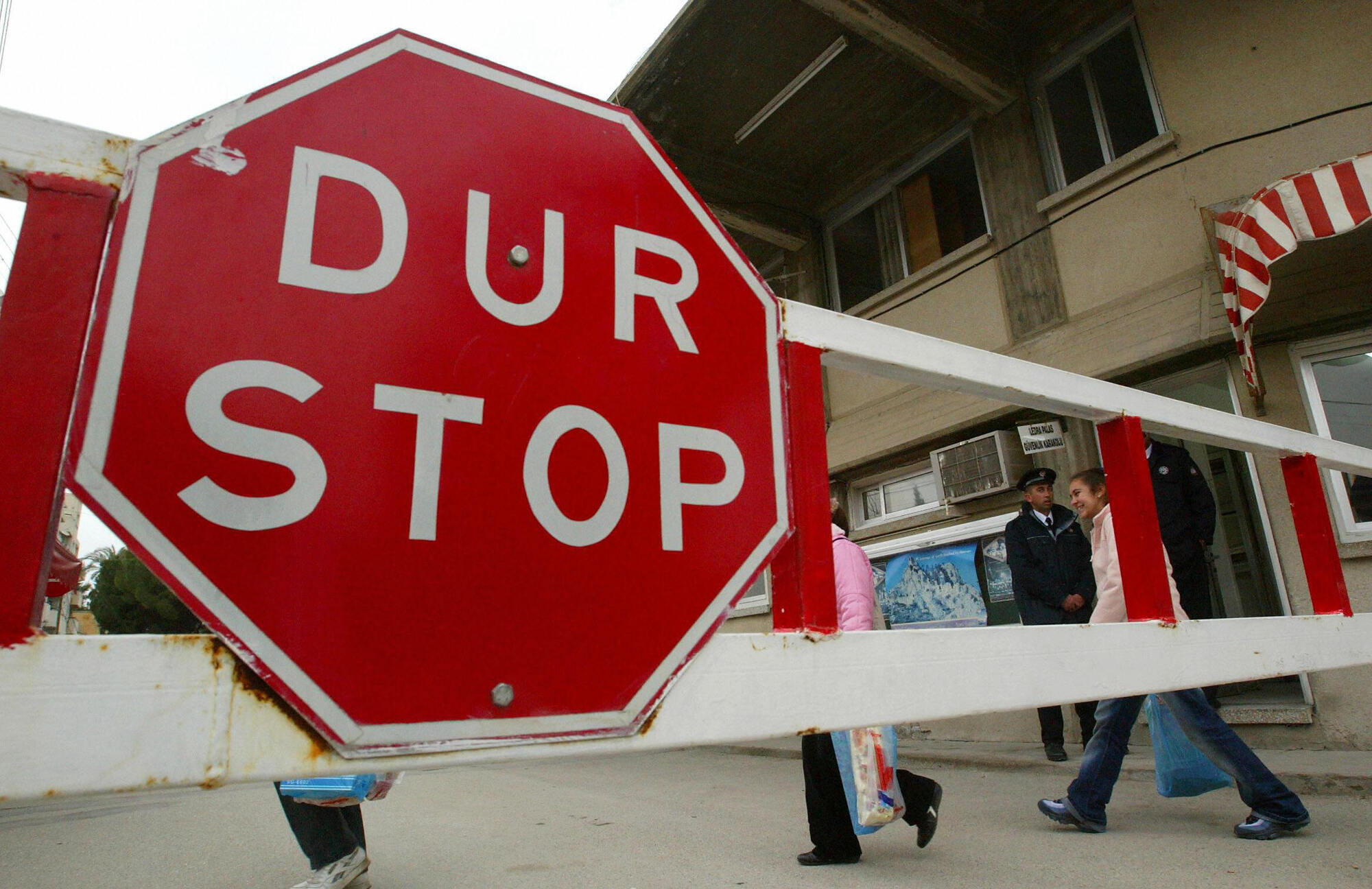
A Turkish Cypriot girl crossing a checkpoint on the Turkish side of the Green Line that divides the Cypriot capital Nicosia in 2004. Turkish forces invaded and captured 36% of the sovereign territory of the island in 1974. File photo: Laura Boushnak/AFP/Getty Images
Teresa Trainor (Letters, July 15) is correct to point out that the Occupied Territories Bill cannot be enacted because it contravenes EU laws.
That issue aside, however, the persistence of correspondents such as Fintan Lane and other activists in pushing for such enactment is highly revealing.
There are at least six cases of territories around the world that can be described as “occupied” — lands of sovereign states that are held militarily by the armed forces of other states.
The West Bank and the Gaza Strip, though controversial, are not among these, since they have never been sovereign territory.
As it happens, however, we are about to mark the 50th anniversary of a true occupation — that of north-eastern Cyprus by Turkey.
Beginning on July 20, 1974, Turkish forces invaded and captured 36% of the sovereign territory of the island, driving from their homes an estimated 150,000 Greek Cypriot refugees, with 1,500 civilians of that community killed or injured. An estimated 1,200 civilians are still missing.
Although Turkey has set up an illegal Turkish Republic of Northern Cyprus and settled it with tens of thousands of mainland ethnic Turks, and prevented the Greek refugees from returning, the ongoing occupation of Cyprus receives only a tiny fraction of the publicity given to the Israel-Palestine issue.
On the face of it, it would seem a situation tailor-made for the Occupied Territories Bill and for the attentions of the activists writing to Examiner letters. The fact that the latter ignore Cyprus and other occupations, to focus so obsessively on Israel, causes one to wonder if it is the non-involvement of Jews that makes the difference for them.
Dermot Meleady, Dublin 3
Would have been
A question. When did the construction “He would have been a friend of mine....” make it into common use?
On my return to English-speaking territory after many years in other language zones, this construction seemed to have gotten everywhere. And several years later it seems to be getting even more ubiquitous.
“He would have been a friend of mine.” What, if you’d ever met him? Why wasn’t he a friend of yours? Was he killed in a freak accident?
“We would have done that a lot.” Why didn’t you do it a lot? What was the issue preventing you from doing it a lot?
In terms of grammar, it seems as bad as saying that you were literally in bits when you’re merely a tad hungover. Or maybe even worse since the words imply you would have done something but didn’t, when the meaning seems to be that you did do that something.
Is it an Irish construction translated into English? I’ve heard English people and Americans use it too, so maybe not. But where does it come from and can we stop it?
Hugh Sheehy, Dublin 4
Changing places
To mark Changing Places Awareness Day today, I would like to highlight the campaign for changing places. These are accessible toilet facilities that include a ceiling track hoist and a height-adjustable adult changing bench — equipment that is essential for people like my daughter Ailis who is a wheelchair user, to use the loo.
The campaign has grown from small beginnings when I began it in 2008 to January this year when our campaign resulted in the change to Part M of the Building Regulations that ensures changing places toilets are compulsory in certain public buildings.
In June, Minister of State for Disability in the Dept of Health & Dept of Children, Anne Rabbitte, launched the universal guidelines for changing places toilets produced by the National Disability Authority. To date, there are 25 of these toilets registered on the Changing Places Ireland website but many more are needed.
We believe that there are toilets around the country yet to be registered and would like these venues to get in touch with us at changingplaces.ie to ensure that people who need them are aware of their location and can plan their outings accordingly.
Ann Healy, Manor Kilbride, Co Wicklow
Spending advice
Finance Minister Jack Chambers and Public Expenditure Minister Paschal Donohoe have both rejected criticism from the Irish Fiscal Advisory Council over Budget 2025. Both ministers have said that they are not risking overheating the economy.
The Government’s summer economic statement reminds me of the phrase “here we go again”. Along with the Irish Fiscal Advisory Council, we have had the Central Bank and many eminent economists reminding the Government with the following utterance: “That you are now doing exactly what we told you not to do.”
The advice that was being given by many of these entities was for the Government to stick to their own self-imposed limit of not increasing spending in the budget by more than 5%.
The combination of spending increases and tax cuts as promised in the summer economic statement now comes to about 6.9% which has resulted in this administration busting through their own self-imposed limit. It now means a package of a minimum of €8.96bn between additional spending and tax cuts which comes to €1.4bn.

One’s suspicion is that there will be additional spending on budget day because one senses that there will be more of these one-off measures. There are many commentators who are proffering the notion that this is fiscal recklessness at its best and is tantamount to bribing the electorate with its own money on spending that is not necessarily judicious because it could be perceived as being inflationary.
Many observers will also feel that money should be set aside for the rainy day too.
I have to ask myself, “is this behaviour the political reality of what it means to be a government that is going into a general election?”
One is curious about whether this administration is feeling under pressure to actually spend money and give tax cuts or else the electorate will take retribution.
John O’Brien, Clonmel, Co Tipperary
Nato escalation
Elizabeth Cullen is so right in her piece on Monday ‘Nato has little to do with peace’. One has only to look at its catastrophic intervention in Libya which has left the country divided and a source of terrorism and people trafficking.
It is also interesting to note that your paper carried a full-page coverage of the Taoiseach and Mr Zelenskyy meeting at Shannon Airport. Many of the contributors here saw nothing wrong with arming Ukraine to defend itself.
There is a very mute difference between giving arms for self-defence and open aggression. There already have been incursions on Russian territory by Ukrainian factions.
In May 2024, Nato secretary-general Jens Stoltenberg, French president Emmanuel Macron and German chancellor Olaf Scholz said Ukraine should be given permission to attack targets inside Russia with Western-supplied weapons.
It is also interesting to note that Shannon Airport is where US weapons are reportedly transited to support wars in Gaza and Ukraine. The latter war is being stoked by potential Nato membership for Ukraine.
There is thus the danger of further escalation to this conflict which will have a very detrimental effect on Europe. Ireland’s efforts should go into encouraging peace talks between the waring factions rather than engaging with Nato on further confrontation.
Donal Deering, Kilkenny
Double standards
The terms “democracy” and “rule of law” are regularly mentioned by politicians, both local and international. It seems there are double standards when both terms are applied by some.
Russia attacked Ukraine — sanctions were imposed on Putin and his associates (and rightly so). Israel invaded Gaza — continues to cause deaths of innocent civilians. Destroyed hospitals, schools and aid centres. Denies innocent civilians access to basic food aid.
Yet many democracies not only stand silently by but provide military assistance to Israel.
Let us not forget those the United States of America continue to detain at Guantanamo Bay in violation of basic human rights and the Geneva Convention.
I ask where is the consistency in application of “democracy” and “rule of law”.
Michael A Moriarty, Rochestown, Cork
Thanks needed for the metal detectors
It was noticeable that the people from the museum in Dublin on RTÉ TV news did not utter one word of thanks to whoever sent them the bronze axe heads, presumably found by a metal detector.
Instead there were admonitions regarding the illegality of digging on forbidden sites for such artefacts, without any proof that the axes were found on those places.
There is not a blanket ban on people owning metal detectors.
We are free to roam far and wide in pursuit of our hobby, so let the precious museum folk acknowledge they are not our prison guards, given the double-speak they are wont to expound upon.
If I was to make the find of a lifetime with my trusty Minelab, the least I would expect from an employee at their museum would be words of thanks and appreciation.
It is much less harmful having a metal detector as an enthusiastic non-degree-holding lover of archaeology, than being one of the ‘educated’ site destructors of graves and skeletons which are not left to rest in peace but which are selfishly desecrated in the name of the nation.
Robert Sullivan, Bantry, Co Cork