Irish Examiner view: Ireland could learn about sovereignty from Canada
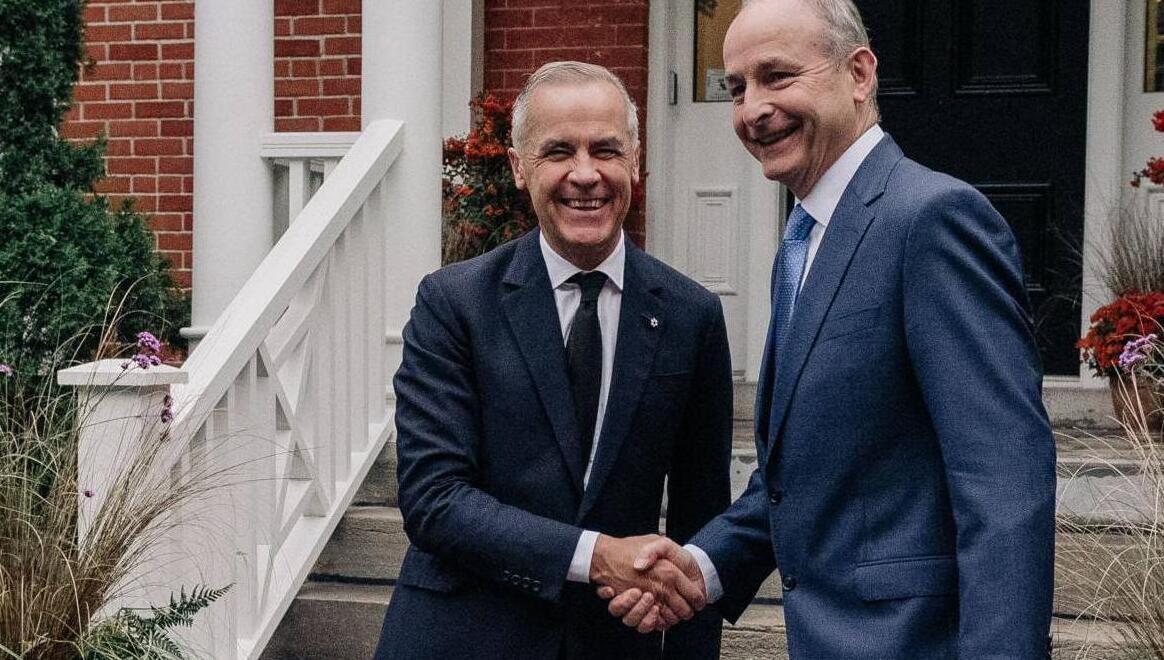
Canadian prime minister Mark Carney greeting Taoiseach Micheál Martin during his visit to Ottawa last year. Picture: Colleen Anne/GIS
Canadian prime minister Mark Carney’s planned visit to Ireland comes just a week after he launched his country’s artificial intelligence (AI) strategy.
The topic is on the agenda for discussions between Mr Carney and Taoiseach Micheál Martin in the context of expanding relationships between the two countries.
The Government also recently published its new national digital and AI strategy which lists 90 “deliverables” in preparing Ireland for the brave new world.
There are commonalities between the two national strategies. Both feature programmes and policies to improve AI literacy among the population.
Both outline measures for scaling up the use of AI in businesses and in the public sector, and both address the requirement for improved digital safety and consumer protection and regulation. There is also an acknowledgement of the need for ongoing research in both strategies.
One significant difference, however, lies at the heart of Canada’s strategy.
Read More
A key objective is to protect sovereignty by reducing dependence on foreign providers of AI technology. No equivalent goal appears in Ireland’s plan.
Mr Carney warned that “AI could be weaponised against us” before he went on to outline measures that would reduce the risk of that happening.
Canada plans to build a “world-leading” public supercomputer that would be secure and accessible for Canadian researchers and businesses. The Government will also support the building of large-scale AI data centres to serve Canadian clients, with a goal of significantly enhancing computing capacity by 2030. It plans to halt the brain drain by funding AI research at its universities, attracting highly skilled AI workers from elsewhere by offering fast-track entry and residency, and investing directly in Canadian AI companies.
The context in which Canada’s strategy emerged helps explain this emphasis on self-reliance: Canadians have had to watch the president of the US repeatedly refer to their country as the 51st state, while attacking longstanding trade and diplomatic norms.
Canada has also been a global hub for AI research and home of pioneering figures such as Geoffrey Hinton, often described as the ‘godfather of AI’. Given these factors, it is hardly surprising that Canada believes it can, and should, reduce its dependence on the US in this critical matter.
Ireland’s position is different. Our technology sector remains intertwined with US investment and expertise. Much of the infrastructure that powers AI systems in Ireland is owned and controlled by American technology giants.
It is not realistic to think that Ireland could replicate Canada’s approach. However, working alongside our European partners, it may possible to develop greater strategic resilience and reduce vulnerabilities in an uncertain technological and geopolitical landscape.
The results of this year’s litter survey, produced by Irish Business Against Litter (IBAL), were generally positive. For the first time since the surveys started back in 2002, no town or city fell into the ‘seriously littered’ or ‘litter blackspot’ categories. Two areas, Dublin’s North Inner City and Cork’s Northside, previously categorised as litter blackspots, have moved into the ‘moderately littered’ band.
The country has come a long way since IBAL was founded 30 years ago on the premise that our continued economic prosperity, particularly in the areas of tourism, food, and foreign investment, was contingent on a clean, litter-free environment. Back then, newspapers frequently ran stories about visitors — tourists and potential investors — being horrified at our litter-strewn streets and beauty spots.
The plastic bag levy, introduced in 2002, reduced the once-common spectacle of shredded bags, clinging tenaciously to tree-tops, hedges, and lampposts. IBAL credits local authorities and tireless Tidy Towns volunteers with improvements of recent years. However, some problems persist.
Despite the success of the deposit return scheme, plastic bottle and/or can litter was found in around one fifth of the sites inspected by An Taisce for the survey. Cigarette butts continue to be a major source of litter, while another persistent problem — disposable coffee cups — has yet to be tackled in a meaningful way. An estimated 500,000 single-use cups are discarded every day in this country, with most ending up in landfill or incineration. Too many end up on the ground.
A proposed ‘latte levy’, intended to curb the use of disposable cups, has remained in limbo since legislation enabling it was passed in 2022. With households under pressure from the cost-of-living crisis, there is little political appetite for an additional charge. But the scale of the problem cannot be ignored. The progress made in tackling litter shows that behaviour can change. The challenge now is to apply that lesson to the sources of waste that continue to blight our environment.
With the Fifa World Cup kicking off on Thursday, a sizeable chunk of the population will be busy figuring out how many of the 104 matches they can feasibly squeeze in before the final on July 19. Many others prefer to scan programmes and book tickets for the music, literary, and community festivals now in full swing up and down the country.
Evidence strongly favours getting out from in front of the television and into the heart of a live event.
Earlier this year, University at Buffalo researchers used the term ‘collective effervescence’ to describe the feelings of wellbeing and social connection experienced by people attending live music events.
They found that the positive feelings did not come entirely from what the performers give to the audience, but from what the audience unwittingly share among themselves. The sense of connection and “a sensation of sacredness” felt by people when they are in a crowd, engaged in a shared experience, like a live musical performance, was real and lasted long after the last encore.
Similar effects have been noted among attendees at sports events. Academics at Anglia Ruskin University in England found that attending live sporting events resulted in higher scores of two major measurements of subjective well-being — life satisfaction and a sense of life being worthwhile — as well as lower levels of loneliness. And if live music or sport don’t appeal, fear not; similar boosts to social, mental, emotional, physical, and even spiritual wellbeing have also been found among people who attend book festivals.
The message is clear. Whether it is a concert, a local match, a book festival, or a community gathering, shared experiences help forge social connections, combat loneliness, and lift our spirits.
Enjoy the World Cup, but make time to get out there and become part of the crowd.
CONNECT WITH US TODAY



Be the first to know the latest news and updates