Suzanne Crowe: A decade on, we must learn lessons from Sláintecare
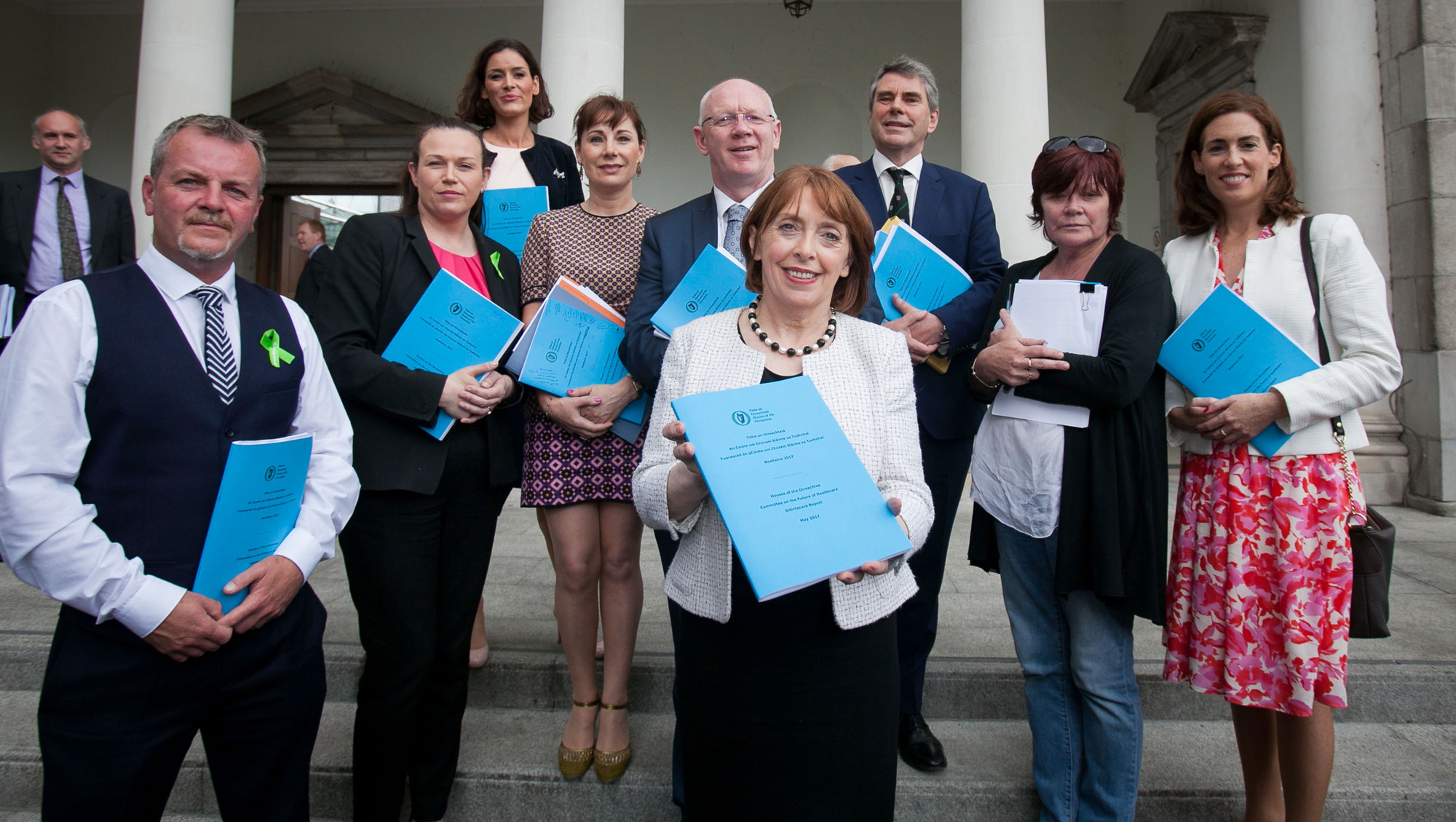
Former minister of state for primary care Róisín Shortall with Health Committee members during the 2017 launch of the Sláintecare report.
It is hard to believe it is 10 years since cross-party agreement was reached on Sláintecare.
Envisaged as a 10-year programme, it promised to transform the patient experience. The rhetoric was built around a singular, powerful ambition: to dismantle Ireland’s “unfair, dysfunctional and deeply inequitable” two-tier healthcare system.
Billions have since been invested in reforming the health service. But what has that investment delivered? If a patient had fallen asleep for 10 years, like a weary shepherd lying beside a fairy fort, what difference would they notice in their access to healthcare on waking in 2027?
Sláintecare policy objectives were set out in the historic 2017 Oireachtas Committee on the Future of Healthcare Report. They included a single-tier system, based on medical need rather than ability to pay. The policy was framed as a binding social contract with the Irish public rather than a party-political manifesto, lifting it out of debate and election cycles.
Read More
Comparing patient experience today to delivery of 2017 commitments, it’s possible to grade performance of the policy against its own objectives of universal access, community-based care, timely access and separation of public from private care.
The first aim of expanding free GP care and abolishing hospital charges has seen some notable progress. GP visit cards have been extended to children under eight and people over 70.
Yet an estimated 378,000 people who became eligible under the expansion have not applied, with the application process cited as a barrier.
The other significant obstacle is the insufficient number of GPs available. Inpatient and day-case charges have been abolished, although a charge remains for attending an emergency department without a GP referral.
The establishment of primary care centres was a key element in the Sláintecare vision, shifting healthcare out of hospitals and into the community. There has been solid progress in building the necessary infrastructure, with 180 primary care centres operational and dozens more in the pipeline. Severe staffing bottlenecks have slowed centres becoming fully operational.
We have a relatively low number of GPs, with geographical shortages. The HSE projects a need for another 1,660 GPs by 2028. Training places have increased dramatically to bridge the gap, but retention of doctors remains a challenge.
Difficulties in retaining and recruiting allied health professionals such as physiotherapists and speech and language therapists have hampered multidisciplinary primary care and community service development.
Both the Chronic Disease Management programme and the GP Access to Community Diagnostics scheme have improved access to aspects of community-based care. The GP Access to Community Diagnostics scheme, which allows GPs to refer patients directly for scans through private radiology clinics, quickly exceeded its allocated budget, prompting tighter eligibility criteria.
The evidence is less positive for improvements in timely access to care. Sláintecare promised outpatient access within 10 weeks, and inpatient or day-case procedures within 12 weeks. By September 2026, public hospital waiting lists had surpassed one million entries for the first time in history, totalling 1,000,226 entries.
Most patients are nowhere near the Sláintecare targets. The Government’s ‘Waiting Time Action Plan 2026’ sets an interim target of getting 50% of patients below the Sláintecare thresholds, rather than delivering the original waiting times for everyone.
The 2017 policy promised ED patients would not wait more than four hours. This has not been achieved in any hospital in the state.
The National Treatment Purchase Fund spent €226.8m on inpatient and outpatient care in 2025, down from €235m in 2024. Yet about 69% of this expenditure went to private hospitals. Meanwhile, the potential of public surgical hubs remains constrained by recruitment caps.
The public-only consultant contract faces its own obstacles, with newly appointed consultants lacking sufficient access to outpatient clinics, ward beds and operating theatres.
It appears the public has come to a similar conclusion on Sláintecare: A lot has been done, and the reforms offer significant potential to transform patient experience, but they have not advanced enough to encourage people to stop paying for health insurance.
Overall implementation of Sláintecare earns a D grade. Some important reforms have been delivered, but the defining promise of a universal, single-tier health service remains unfulfilled. The failure to deliver timely access weighs heavily in the overall assessment.
With 50% of the population choosing to pay for private care and continued growth of private health services, the inequitable, two-tier system remains entrenched.
Large-scale reform is notoriously difficult to deliver. In his Iron Law of Megaprojects, Bent Flyvbjerg, chair of major programme management in Oxford, summarises major public projects as "over budget, over time, over and over again".
He attributes this phenomenon to human optimism, a deliberate reduction in estimates of time and money by policymakers to persuade politicians to support them, and consistent underestimation of the difficulty in changing behaviour.
The original Sláintecare report recommended €3bn in transitional and legacy funding over six years, alongside additional annual funding of €380-465m for expanded entitlements and capacity. Within a couple of years, funding for reform was submerged into general Department of Health funding. It is not possible to easily ascertain the total cost of Sláintecare.
As Sláintecare approaches the end of its original 10-year horizon, a successor reform programme is being planned. Its details have not yet been shared. The limited mention of Sláintecare in Budget 2027 speeches raises a question about whether the cross-party consensus that sustained it will survive into the next phase of reform.
Sláintecare was supposed to transform Irish healthcare within a decade. Instead, as its original 10-year horizon approaches, more than a million waiting-list entries, persistent barriers to access and an entrenched two-tier system remain for patients seeking healthcare.
Before the Government embarks on its next great reform project, it must confront the lessons of this one. The final cost remains difficult to establish, the original timetable has stretched, and the central promise remains unfulfilled. If Sláintecare is to be given a successor, it must first be given a reckoning.
- Dr Suzanne Crowe is a consultant paediatric intensivist and a former chair of the Medical Council

CONNECT WITH US TODAY



Be the first to know the latest news and updates