ieExplains: Why are solicitors escalating their strike action against legal aid reforms?
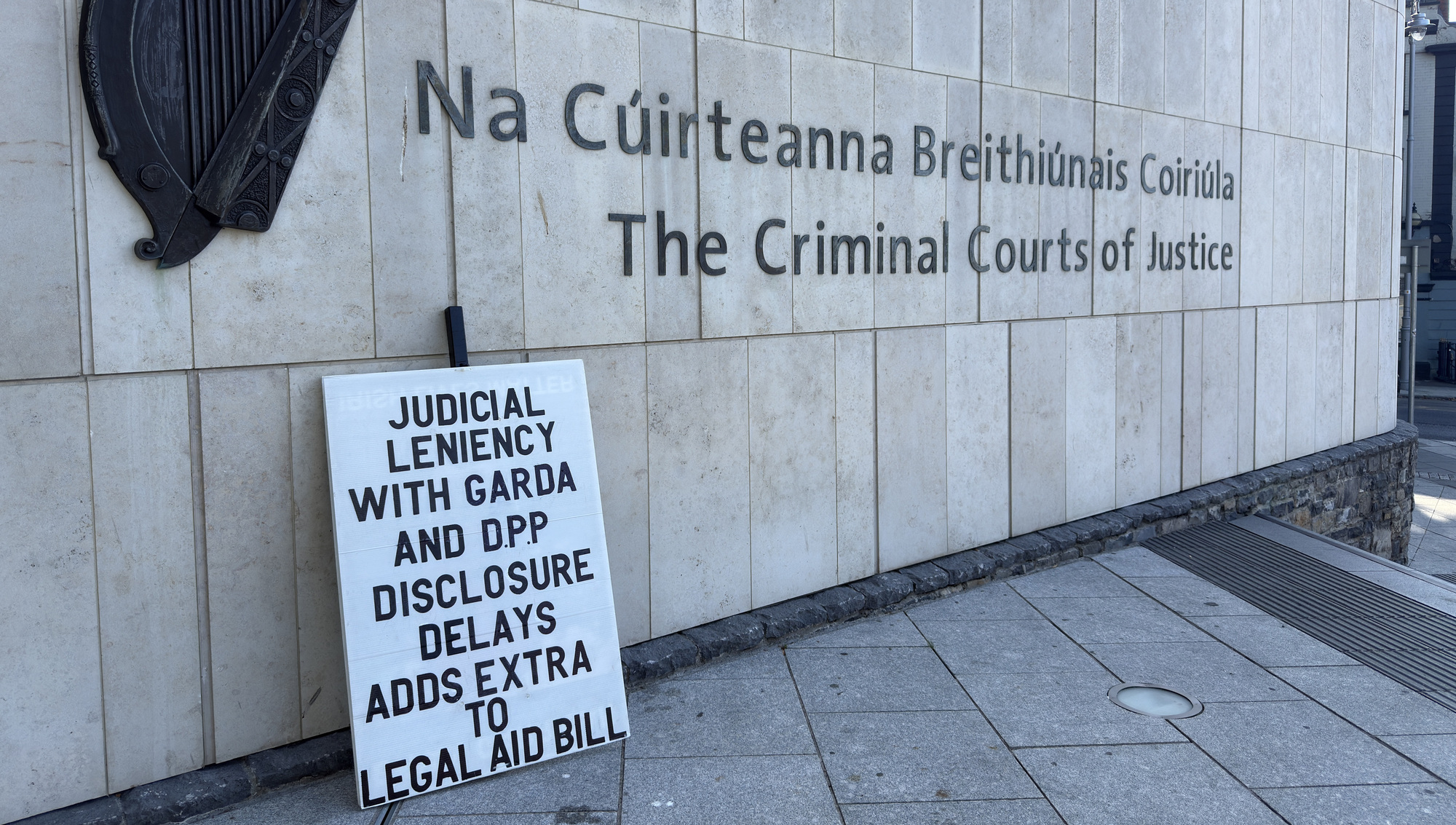
A protest placard highlighting one of the issues in dispute between the minister and solicitors outside the Criminal Courts of Justice on Parkgate Street in Dublin in July. File picture: IrishPhotoDesk.ie
Solicitors have escalated their strike action against legal aid reforms as their dispute with justice minister Jim O'Callaghan continues.
Striking solicitors had withdrawn from any criminal defence cases in the district court supported through the legal aid scheme since it was changed in July.
In practice, the strike has resulted in many people accused of a crime, who do not have the means to pay for a solicitor themselves, appear before judges without representation.
The court is informed a solicitor is not available to represent them because of the ongoing strike; after this, the accused then might represent themselves in a bail hearing or be remanded in custody — with concerns raised some people may be detained for longer than is appropriate.
Other cases are adjourned in the hope the legal aid dispute is resolved by the next hearing date.
From Monday, some striking solicitors are withdrawing from all criminal defence work.
This is said to have left much of the district courts in the west — including counties Galway, Mayo, Sligo, Roscommon and Donegal — without solicitors engaging in criminal defence work.
From July 1, criminal defence solicitors working in the district court under the legal aid system have been paid a flat fee of €520 when the case concludes, equivalent to about five appearances.
Previously, they were given about €240 for the first appearance and about €60 for subsequent appearances.
Solicitors have argued the changes are impractical and will mean in the most complex cases that take more time, solicitors will effectively be working for free.
At the end of July, Mr O’Callaghan said the payment of the flat fee would be “split”, so two-thirds of the fee would be paid at the start of a case and the remaining third would be paid at the end of the case, or after 12 months after the case starts, whichever is first.
Despite this, the strike action has continued.
Solicitors have called the changes to the scheme “unviable” and “unworkable”.
They have two main issues: treating separate and distinct criminal cases as a single matter where they happen to come before the court on the same day; and if there are complicated or lengthy cases, that a separate certificate should be issued after a certain number of appearances, for example, the five appearances the flat fee is meant to represent.
They have also raised issues with figures issued by the Department of Justice, that 75% of cases have concluded with just one court appearance, and 99% of cases have been finalised within five appearances.
Solicitors have cited a letter sent by the minister on September 15 that 25% of all cases had been disposed of, and 75% of those had been disposed of in one appearance, meaning it is 75% of the 25%, which is closer to 19%.
The Department of Justice has said 150 solicitors are “actively working” the new system, and more than 3,385 certificates, or invoices for payment for legal aid, have been issued since July 1, worth about €1.7m.
In a statement issued by the department at the start of the new legal term, it said the minister was “committed to improving efficiencies” for the Irish taxpayer, court users, and legal practitioners through the new criminal legal aid scheme for the district court.
He said further changes sought by solicitors “are not compatible with the objectives of the reforms” and reaffirmed his commitment to a flat-fee model.
The Department of Justice is reviewing the changes, including how they may affect more complex cases, such as those before the Children’s Court and remand hearings.
Solicitors have said Mr O’Callaghan is refusing to engage with them.
The minister has indicated he is awaiting the determination of a judicial review on the legality of the reforms before engaging in further mediation.
That case was due before the courts last week, but was adjourned until November 3.
Solicitors sent correspondence to the presidents of the High Court, Circuit Court and District Court last Friday to say they would escalate their strike.

CONNECT WITH US TODAY



Be the first to know the latest news and updates