Why the Republicans' voter fraud messaging may backfire
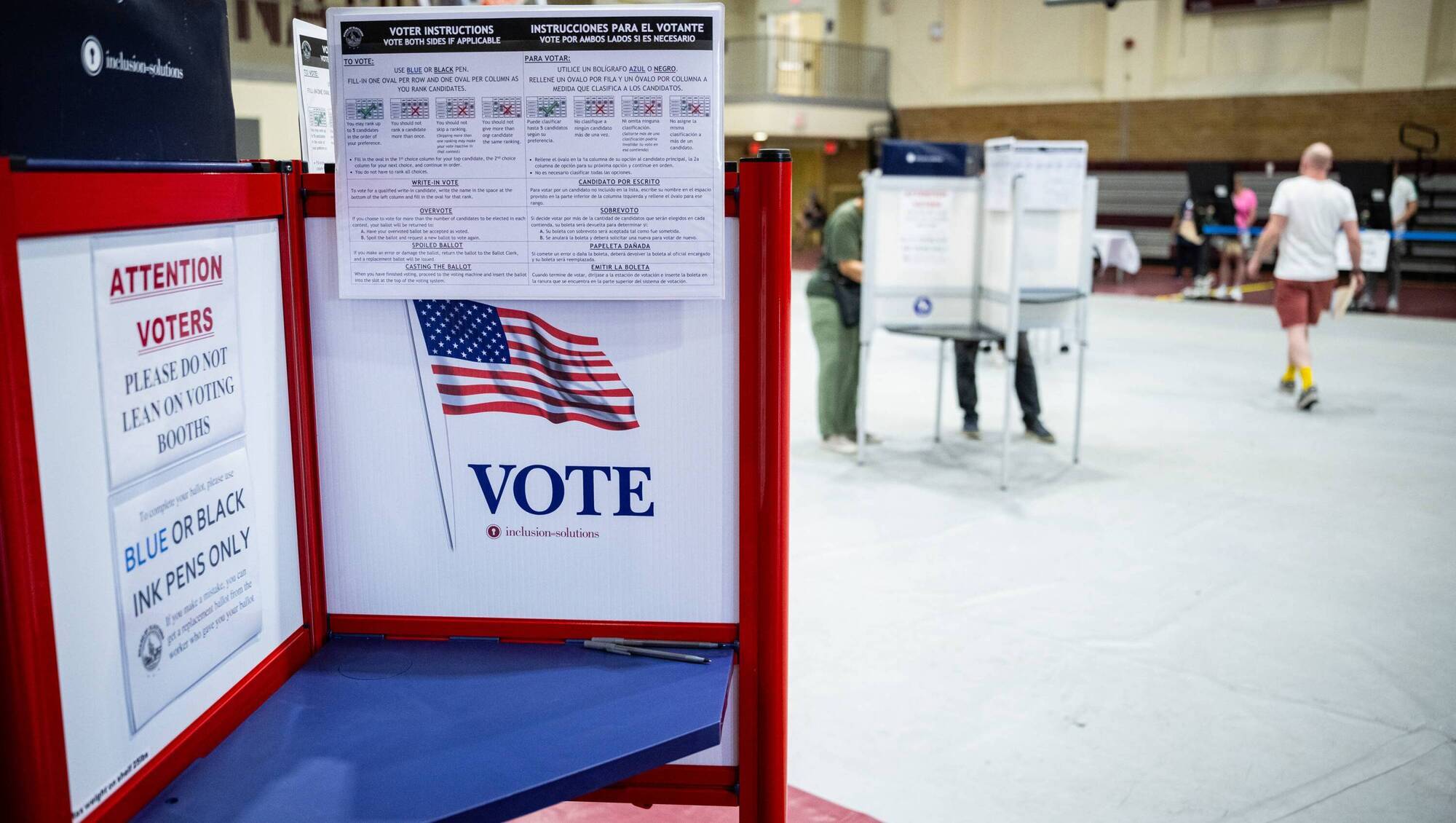
A voting booth as voters cast ballots at a polling location inside McKinley Technology High School during a primary election in Washington in June. Picture: Getty Images
With Election Day 2026 just weeks away and control of Congress hanging in the balance, the results will almost certainly hinge on voter turnout, just as they did in 2024.
Given that genuinely undecided voters are scarce — as little as 5% to 7% of the electorate, according to major polls — both Democrats and Republicans must look to mobilise their rank-and-file supporters. To do so, the Republican Party has bet strongly this year on a strategy of convincing people that voter fraud is rampant.
As a scholar of US politics, I see this as a high-risk strategy for Republican candidates and American democracy. That’s because reduced trust in election integrity can reduce motivation to vote — even if based on flawed information. But it’s not at all clear which Americans are most likely to stay home in November.
Voter fraud is not a real problem in the United States. Study after study, by public officials and think tanks, has shown that voting by non-citizens and other ineligible voters happens only at minuscule, statistically insignificant levels.
Nonetheless, rhetoric from the Trump administration about voter fraud has been pervasive. Consider the recent claim by homeland security secretary Markwayne Mullin that Nevada had nearly 16,000 non-citizens on its voter rolls — a number reduced to 185 when state authorities pressed for details, and reduced to zero when the state investigated the names provided.
There is comparable behaviour from Congress. My own research on political communication has shown that a substantial number of members of Congress, strongly skewing Republican, make frequent use of rhetoric that undermines democratic norms and delegitimises political institutions.
The strategy ties readily into president Donald Trump’s persistent false claims that he won the 2020 presidential election. It also ties into his administration’s strongly anti-immigrant agenda, which spreads fear of non-citizens corrupting US politics.
How does this uncertain political environment influence voters?
There is clear data showing that voter confidence in elections has fallen across party lines: Only 65% of Republicans, 64% of Democrats and 57% of independent voters are very or somewhat confident that the 2026 vote count will be reliable. Conventional wisdom suggests such discouraging numbers would depress turnout.
It’s not as simple as that, however.
Extensive research confirms the axiom that a sense of civic duty is the strongest predictor of whether someone will vote. It supersedes trust, partisanship and policy preferences.
Any campaign’s quest to mobilise additional voters, therefore, must find them among citizens without a strong sense of civic duty. But among these people, diminished trust in democratic processes can play out in counterintuitive ways.
Recent research on German voters is relevant to the US. It shows that among more passive voters — those following cues from political elites — reduced trust in elections can depress motivation to vote. That’s because there’s no trustworthy result that voters are seeking to affirm.
What does this mean for potential voters in the US? Among Republicans, it appears that the party’s strategy carries a strong risk of backlash.
Findings from MIT’s Election Lab confirm that cues from political elites are a powerful factor in voter behaviour. Specifically, cues setting expectations of a disappointing or untrustworthy result will reduce motivation. Why vote if you don’t expect it to help achieve the desired result?
The same study finds Republican voters broadly inclined to believe Republican leaders’ cues about voter fraud and to frame their expectations accordingly. And once they’ve made that shift, they cling firmly to the belief, even in the face of contrary empirical evidence or messaging from within the party.
In the current election cycle, 50% of Republicans surveyed distrust mail-in voting, and 51% fear voting by non-citizens. They expect election results to be fraudulent. This likely won’t mobilise them, as there’s no positive result they can expect to affirm. The Republican Party’s messaging has painted its voters into a corner.
Democrats, meanwhile, are less inclined to believe claims of voter fraud. But they are more inclined to be concerned about attempts to undermine the midterms by political elites making such claims. Examples include the Trump administration’s efforts to sow doubt about voting by mail and about alleged non-citizen voting.
These efforts increase motivation to vote among Democrats. Unlike Republican voters, they see the capacity to correct for the system’s vulnerabilities — the potential and urgency to overwhelm attempts at voter suppression through higher turnout.
Opponents of Trump and the Republicans may find these diverging effects encouraging. No matter the results this November, however, we’re left with a precarious dynamic. Increasing numbers of voters lack trust in elections and make their decisions to vote — or not — based on limited or flawed information.
Fortunately, there are signs of hope.
Although voters in general are poorly informed about how elections are conducted, they can and do respond to clear information familiarising them with election processes.
I’ve seen this myself over the years, working with nonpartisan efforts to register young adults and train them as poll watchers. And in the current election cycle, there have already been widespread efforts to broaden public awareness about the fact that state officials, not federal ones, have authority over voter rolls and election security.
Meanwhile, fewer Americans are expected to vote by mail this year — whether due to fear of fraud or fear of the post office. If they instead vote in person, a silver lining is that positive personal experiences with poll workers are also associated with increased voter trust.
Looking beyond November, what Americans can hope for is a cycle in which clear election outcomes provide an opportunity to inform voters of how and why the system works. That’s the way to motivate more political engagement and voter turnout in the future.
- Christopher Miller is visiting assistant professor of philosophy, politics, economics, and law at the the University of Richmond, US.
- The Conversation

CONNECT WITH US TODAY



Be the first to know the latest news and updates