Solicitors' walkout raises fears of 'covid-level backlog' in court cases as legal aid strike continues
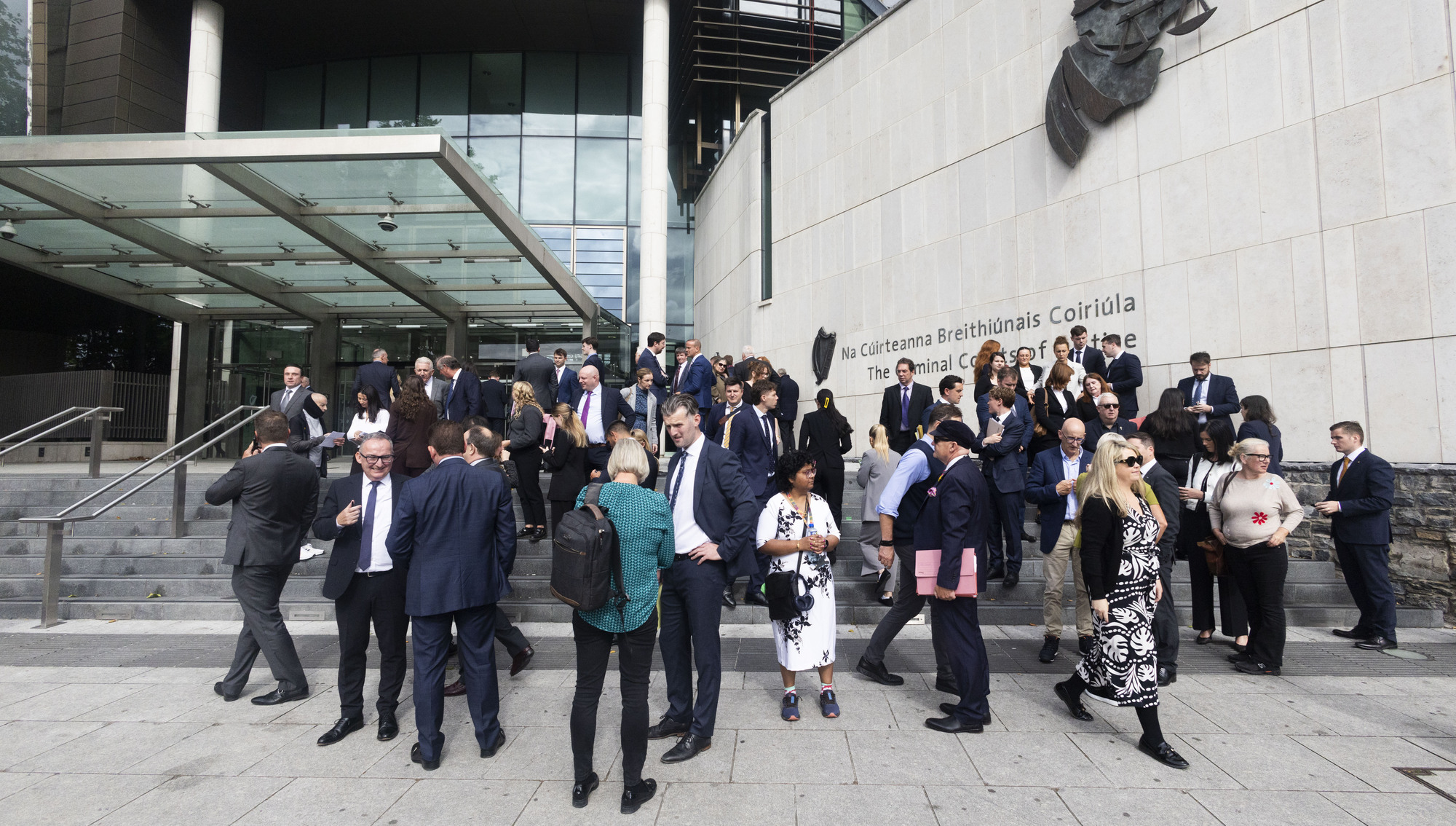
In Dublin, around 100 criminal defence solicitors walked out of the district court at the Criminal Courts of Justice on Tuesday in protest over the changes by justice minister Jim O’Callaghan. Photo: Sam Boal/Collins photos
There are fears of a pandemic-level backlog of court cases as solicitors continue to oppose changes to the criminal free legal aid scheme.
In Dublin, around 100 criminal defence solicitors walked out of the district court at the Criminal Courts of Justice on Tuesday in protest over the changes by justice minister Jim O’Callaghan.
From July 1, criminal defence solicitors working in the district court under the legal aid system are paid a flat fee of €520, equivalent to around five appearances.
Previously, solicitors were given around €240 for the first appearance and around €60 on subsequent appearances.
Solicitors have been withdrawing from the criminal legal aid scheme in opposition, arguing they were not adequately consulted and the changes are impractical.
Read More
They have called for separate certificates to be permitted for separate and distinct offences if they are being heard on the same day; and if a case goes above 10 appearances, solicitors should be able to apply for a new certificate.
Ian McNamara of McNamara Solicitors from Tipperary, and among those who walked out in Dublin, said that a third of their work is through free legal aid and the scheme “as it stands is unworkable”.
Solicitor Colleen Gildernew said there are just three solicitors in the entire Dublin area still engaging in the free legal aid system, and none in the northwest.
“The entire north and west are out, so you have no solicitors working in Donegal, Louth, Meath, Cavan, Monaghan, Mayo, Galway, Sligo and Leitrim. From the north right down to the west, they’re a complete legal aid desert.”
Eoghan O’Sullivan, a partner at Powderly Solicitors, said in theory it is good to encourage reforms that would see court cases conclude quicker, but even criminal cases that appear simple at first “can grow legs”.
“If there is an opinion from the department that criminal cases should be finished quickly, and they’re going to put the pressure on practitioners to finish things quickly, there is a concern then that people won’t do the complex cases; they’ll only do the simple ones which will finish quickly, and then we have an issue with access to justice.”
He said of the strike’s impact: “Unfortunately, what’s going to happen now is we’re going to have a massive covid-level backlog of cases.”
In a statement, the Department of Justice said more than 600 solicitors remain on the panel and over 700 new criminal legal aid certificates, worth around €400,000, have been issued since July 1.
“The further changes sought by the Law Society are not compatible with the objectives of the reforms introduced as they would reintroduce the possibility of multiple certificates being awarded when the intention is to move to a single fee per case.”
It said it would continue to keep the scheme under review, and that Mr O’Callaghan had already indicated he may consider changes to reflect cases that require multiple hearings, such as remand hearings and cases before the Children’s Court.
CONNECT WITH US TODAY



Be the first to know the latest news and updates