Students who go abroad on Erasmus have better opportunities — why don't more of us do it?
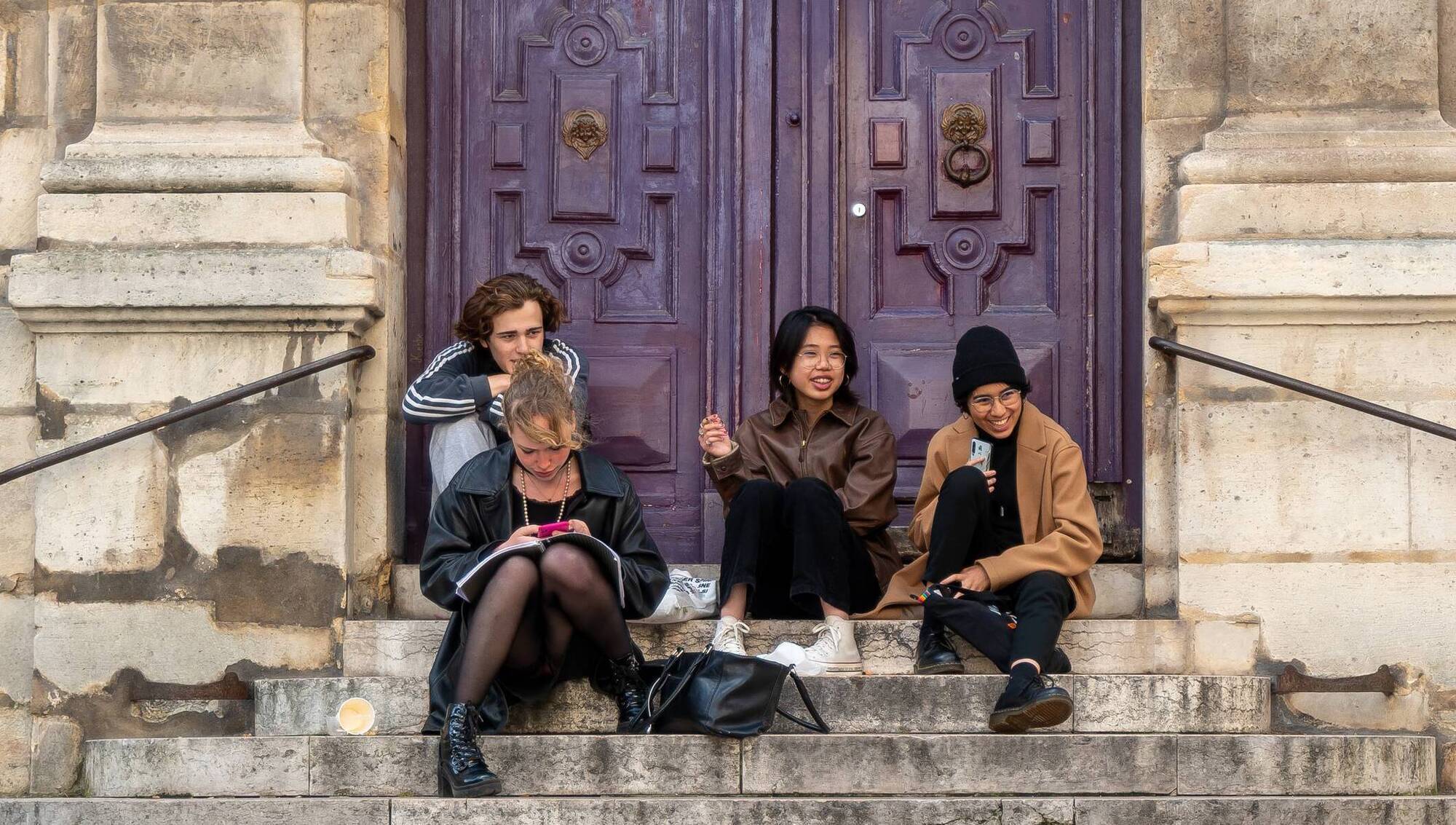
Students from Paris Université sit on the steps of the Église Saint-Étienne-du-Mont. The idea behind Erasmus+ is to enable students to develop a broader, future-oriented set of skills and perspective through their experience. File picture
The verb devenir (to become) is a word that I remember from my time teaching French students in Lyon last summer.
I was there for an Erasmus+ teaching assignment as I had never done Erasmus+ as a student and had always felt that I was missing out. I’d watched friends in college come back from different countries, transformed from their experience.
Those who had gone to France talked about the cafés and bakeries; those who had gone to Italy came back full of style and glamour; and those who had gone to Germany had tales of beer garden fun and festivals.
Haircuts had changed, even their vocabulary was different, but the biggest change was their confidence. Their eyes had been opened by the experience abroad, by engaging with a completely different culture, perspectives and place. They had “become” European in their outlook and were eager for the next challenge.
Today, students in Ireland see the world through their phone, but they can’t smell it, taste it, feel it. Granted, we have a more diverse student population than before, which means that students can hear the perspectives of students from different countries. But that doesn’t give the same kind of rich, life-changing experience of living and studying abroad that Erasmus+ enables.
With the academic year fast approaching, students and their parents should be planning when they do Erasmus+, not if. Research shows that students who have studied abroad for a term have a better chance of finding a job after graduation than those who haven’t.
In 2024, Ireland sent 14,900 students and staff on Erasmus+. This is from an overall student population of 278,880 or 5.4%. Ireland received 34,557 students. Compare it to similarly sized EU countries; Slovakia sent 25,900 students and Finland sent 26,000. Slovakia received 16,300, and Finland received 32,200.
EU member states have set a target that by 2030, a minimum of 23% of university graduates will have completed a mobility period. This target is based on a wide range of types of learning mobility experience that are taking place through funding from the Erasmus+ programme and is part of a drive to encourage internationalisation across the higher education sector in Europe and the employability of learners.
The idea behind Erasmus+ is to enable students to develop a broader, future-oriented set of skills and perspective through their experience.
Students can travel to a university within the EU or further afield to study for a term in a partner university of their home institution.
They then return to their home university to complete their degree. Students can also do an internship or work experience abroad through Erasmus+.
European research in 2024 shows that studying abroad is associated with tackling multiple new experiences at once. These vary from adapting to a new learning environment, different peer abilities, different teaching approaches, acquiring language skills, to orienting themselves to a new people and culture.
Erasmus+ internships enable the student to have exposure to different work cultures; numerous studies describe how students gain insights into how businesses operate in other countries, learn about international business practices and develop a global mindset.
Just over 10 years ago, the World Economic Forum reported that 92% of employers were looking for personal qualities and skills such as curiosity, problem solving ability, tolerance and confidence. 64% of employers stated that international experience was an important factor.

A student who has completed Erasmus+ as part of their Bachelor’s degree has already demonstrated their appetite for this level of challenge and development of their skills before they get to the recruitment table.
The Erasmus+ Annual Report 2024 states that the EU supported close to 1.5 million learning opportunities in 2024 in higher education. The top areas of study were business, administration and law; arts and humanities; and engineering, manufacturing and construction.
So why are Ireland’s students not using Erasmus+ compared with other countries?
The difference between the figures might indicate a lack of language skills on the part of students and subsequent fear of being overwhelmed while learning abroad. You can study through English on your degree, so this is myth rather than reality.
It might also point to a broader issue, that Irish citizens are not as European in their mindset as other member states.
One obvious issue might be the financial cost of doing Erasmus+. The EU doesn’t cover every expense for the student but it covers a significant part of the cost.
The EU also offers a contribution to living costs abroad in the form of a grant which is competitive. This contribution varies depending on the country where the university is based and the projected cost of living in that country.
There is some academic evidence to show that students who are studying a Bachelor’s degree and who have completed a term abroad through Erasmus+, achieve higher grades than those who don’t.
The student tends to perform better academically on Erasmus+ than in their home university, which can have a knock-on impact on their final grade for their Bachelor’s degree.
The real value of Erasmus+ to the degree is to give the student international exposure and a European mindset which is invaluable in a global marketplace..
Doing Erasmus+ won’t give you a job. But it will give your degree a boost above others who haven’t studied abroad.
As my friends from college learned, vous deviendrez une nouvelle version de vous-même et plus attractif (you will become a new version of yourself — and more attractive)!
A student taking part in Erasmus+ is the best possible return on time and money spent.
- Dr Ruth Casey is a lecturer in TU Dublin and a member of the NUI Senate.

CONNECT WITH US TODAY



Be the first to know the latest news and updates