Our children deserve early years education that prioritises their needs over profits

We have become so used to thinking of childcare as big business that we have forgotten there are many, some quite obvious, solutions to the crisis we are facing
The youngest among us deserve a good education. It seems obvious that market-led early years provisions alone will not provide this for all children. File picture

The youngest among us deserve a good education. It seems obvious that market-led early years provisions alone will not provide this for all children. File picture

Across Ireland, there are childcare deserts where market-based providers do not deem it profitable enough to establish early years centres.

These are areas that badly need the Government to either provide a fully subsidised service, or to work with social enterprise service providers who can establish a sustainable centre.

StartBright runs a number of early childhood education and care services across Dublin using the social enterprise model. 

Operating from a central hub, our organisation turns a small profit which is re-invested into our services, meaning we can provide a standard of excellence to our families without charging astronomical fees.

StartBright is also an active member of the Together for Public campaign, composed of an alliance of 50 organisations calling for the Government to provide public childcare, in a model similar to our primary school system.

The youngest among us deserve a good education. It seems obvious that market-led early years provisions alone will not provide this for all children.

The StartBright social enterprise model has a particular mission to improve outcomes for children and their parents. 

Our model places children and their families at our core, not profits or payments to large investors.

Because we reinvest any profit gained back into our services, we are continuously improving our facilities, increasing access to services in underserved areas, and offering more to the families and children we work with.

We can afford to hire staff in roles such as family facilitator — a qualified professional that provides one-on-one support to parents and links them to supports in the wider community — and educational leaders who mentor and lead high-quality practice and pedagogy. 

StartBright builds our services around child and family needs, and by offering flexible hours delivers positive outcomes because profit extraction is not our primary driver.

This model is not only better for children and families, but also for staff. 

Across our sector, recruitment and retention rates among educators are extremely poor, with precarity, low pay, and inconsistent working conditions affecting educators throughout the sector. 

The educator workforce is overwhelmingly female, adding another layer to the gender inequality rooted in this crisis.

At the heart of this early years organisation and the public childcare approach is to offer less administrative burden on workers in their day-to-day workplace schedules, so more time can be given to caring for and educating the children in their services. 

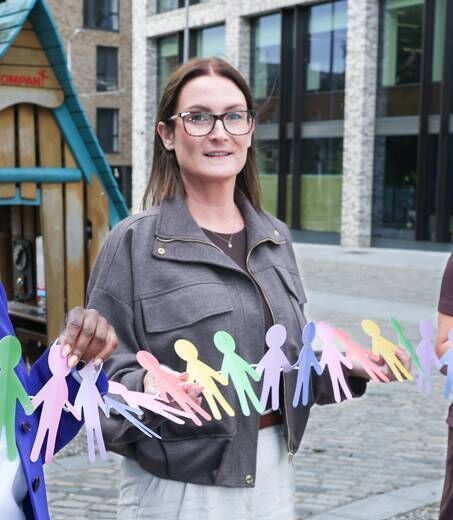
Elaine McQuillan: Public provision can — and should — be piloted in childcare deserts where families, especially women, are crying out for decent early years education and care.

StartBright offers career progression opportunities and roles in addition to educator roles, supporting staff to feel valued and empowered.

Therefore, the social enterprise model can sit comfortably within the public model, and the public model can in turn sit comfortably alongside private provision. 

The State has the means to acquire buildings, and we have the expertise and capacity to operate out of them, and to scale up our model.

Public provision can — and should — be piloted in those childcare deserts where families, especially women, are crying out for decent early years education and care.

Government would have to provide capital upfront, but our sustainable model means soon the services would begin to pay for themselves.

So, how can the Government progress the right of every child to education and care from birth?

As proposed in our Together for Public position paper published this year, ideally, the State would start by taking on educators’ wages.

In order to provide staff with the professionalisation and acknowledgement they deserve, this public policy move would be a huge indication of a positive shift away from the currently market-led model, bringing us far closer to the programme for Government commitment of €200 per month per child.

The State has existing systems for the wages of primary and secondary school teachers, without their being employed directly by the State. 

This allows for standardised pay scales, collective bargaining, and greater job security, would support educators while removing administrative and cost burdens from providers.

This is the wage structure we encourage and support the State initiating through Budget 2027.

In light of this, the State-led Acquisition Programme, into which minister for education Norma Foley announced an investment of €135m, is extremely welcome.

But it’s merely the beginning. 

State-led and public provision are each respectively necessary to end the childcare crisis and care for children in Ireland.

Elaine McQuillan is chief executive officer at StartBright Early Learning Centres

More in this section

Revoiced

Newsletter

Had a busy week? Sign up for some of the best reads from the week gone by. Selected just for you.

Cookie Policy Privacy Policy Brand Safety FAQ Help Contact Us Terms and Conditions

© Examiner Echo Group Limited