Two Mercury-bound spacecraft draw closer to planet after near decade-long voyage
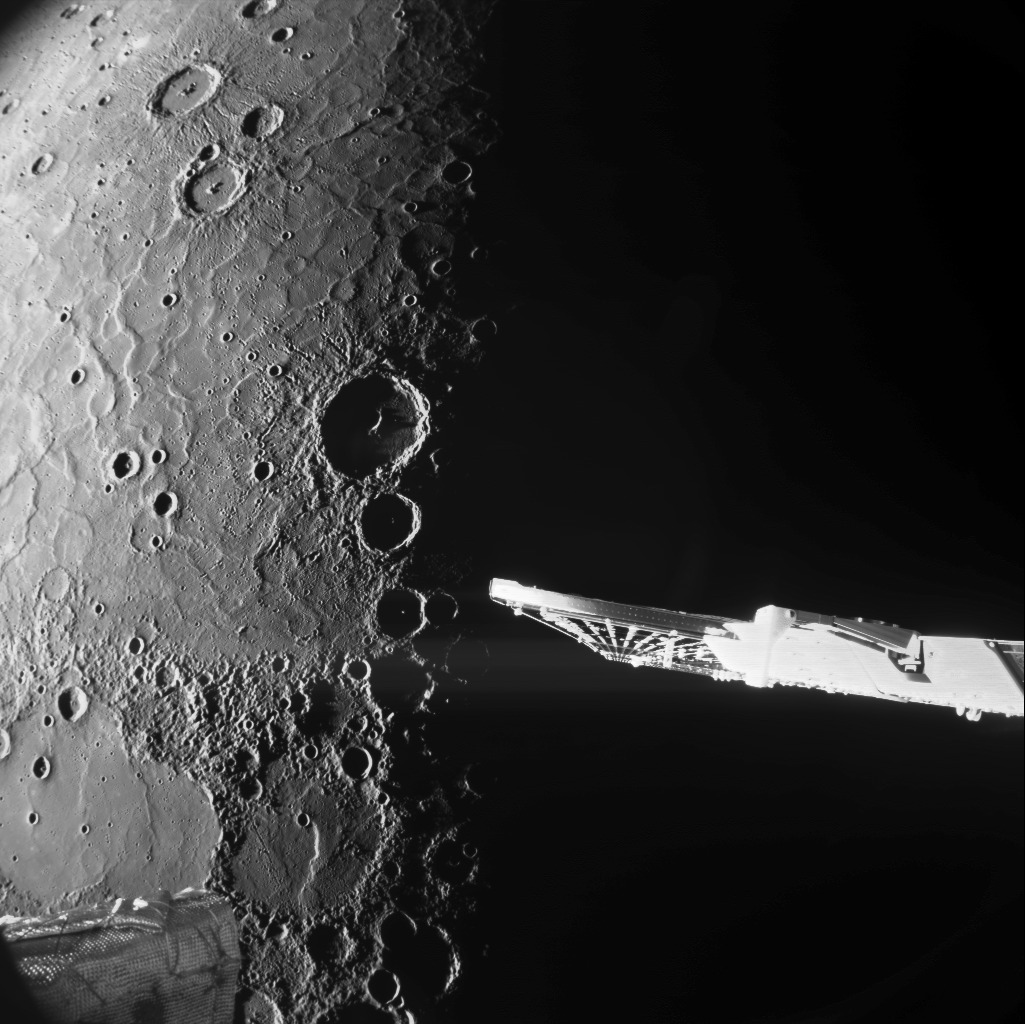
Two Mercury-bound spacecraft have left their mother ship behind and are headed down the home stretch of their nearly decade-long voyage to the solar system’s smallest planet.
The linked European and Japanese spacecraft separated as planned from their cruiser, but controllers had to wait two anxious hours to receive confirmation via radio signals.
The crucial operation was broadcast from the European Space Agency’s control centre in Germany, more than 124 million miles away.
“It’s a brilliant moment,” said lead project scientist Geraint Jones.
If all goes well, the conjoined spacecraft known as BepiColombo will enter orbit around Mercury in November and split from each other in December to map and study the entire planet from different altitudes.
As of Thursday, the spacecraft still had two million miles to go before reaching its destination.
Launched in 2018, the BepiColombo mission is named after the Italian mathematician who took part in Nasa’s Mariner 10 mission to Mercury in the 1970s.
Only one other spacecraft, Nasa’s Messenger, has explored the puzzling, scorching planet that is just a little bigger than our moon.
“How tiny Mercury is and still it holds some of the biggest mysteries of our solar system,” mission manager Santa Martinez said earlier this week.
Mr Jones added: “There’s a huge amount still left to be learned.”
BepiColombo already has travelled more than six billion miles on its roundabout route, according to Ms Martinez.
It needed nine planetary flybys to reduce its energy enough to be caught in Mercury’s orbit. The last flyby, in January 2025, yielded stunning photos of Mercury’s impact craters and volcanic plains.
Beginning next spring, a range of science instruments on the European and Japanese spacecraft will study the magnetic field that envelops Mercury, the planet’s dense interior, and the geologic processes at the surface, including the hollows, or depressions, that scientists believe are being eaten away by minerals vaporising from rocks.
It is a strange world of contrasts. On a planet where the temperature can top 427C, the poles are frigid with deep, permanently shadowed craters packed with ice.
Given Mercury’s proximity to the Sun, engineers had to design the spacecraft to withstand “extremely punishing” conditions, said the European Space Agency’s Ignacio Tanco, a mission operations chief.
“It’s essentially equivalent to operating with a very hot pizza oven running right on your back,” he said.
Science observations should begin next spring, with the European Space Agency covering most of the mission’s cost.

CONNECT WITH US TODAY



Be the first to know the latest news and updates