Terry Prone: In the fight for women’s rights Gloria Steinem always stepped up
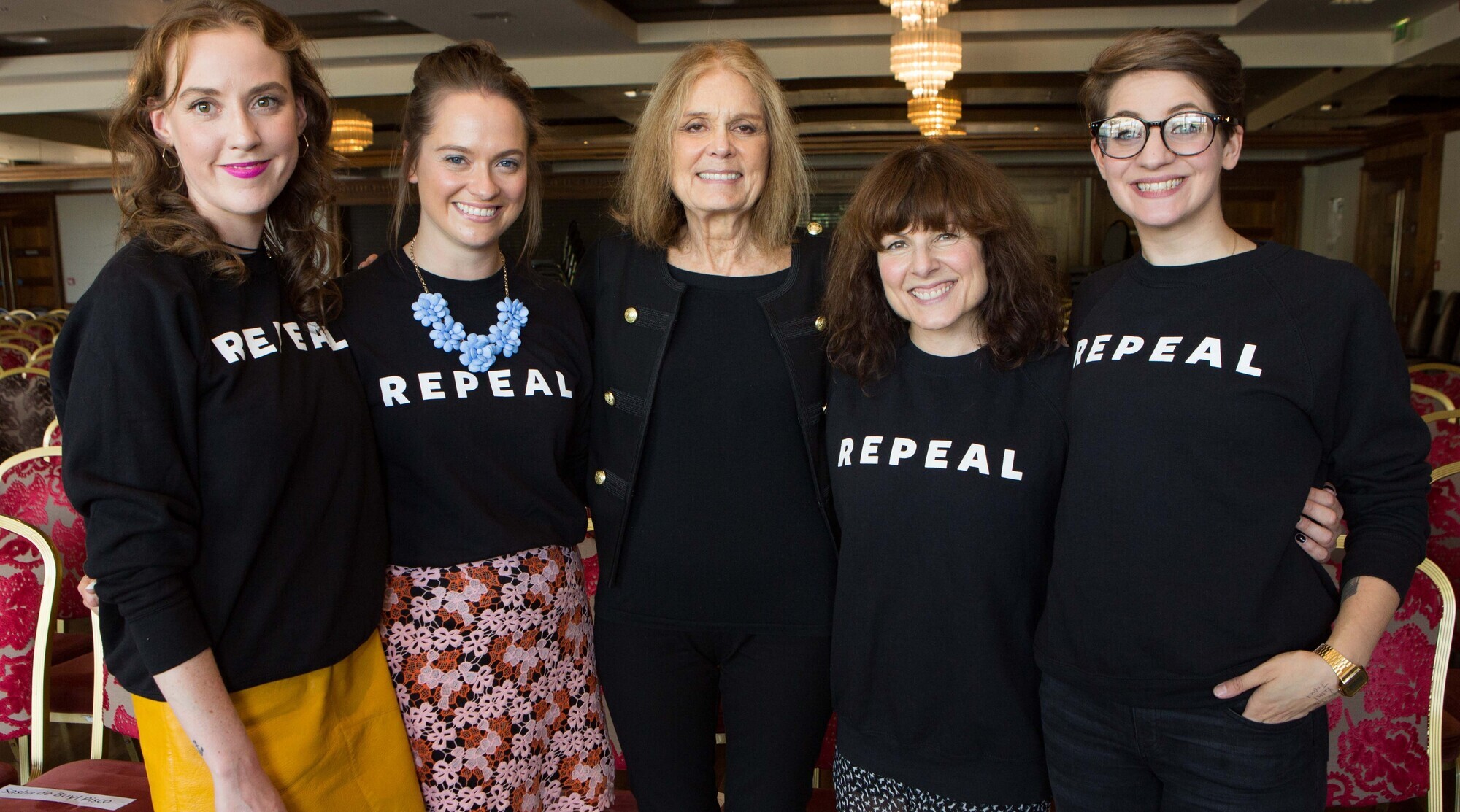
Activist and writer Gloria Steinem (centre) with (left to right) Louise O'Neill, Aoife Murray, Tara Flynn and Sasha Buyl-Pisco at the 2016 West Cork Literary Festival in Bantry. File picture: Darragh Kane
The current edition of the carries an ad for her participation in a symposium. Until her death, Gloria Steinem was working, had a voice, personified the feminist wave that started in the 1970s.
That makes 80 years of commitment. At 10, Steinem effectively became the full-time carer for her mother, who suffered such severe mental illness that the caring must have been frightening for the little girl. But choices were few. Her father abandoned them, divorcing her mother before his daughter was even a teenager.
Gloria stepped up. She always stepped up. She stepped up and watched. Mostly, she watched male doctors treat her mother with bored disrespect. Seeing that seeded her belief that women were disregarded and dismissed by the medical profession.
As time went on, she realised that women faced many other obstacles which no organisation had tackled. That, she decided, had to change.
Meanwhile, she earned prestigious degrees, and, in London, at 23, underwent an abortion. Abortion was illegal at the time in Britain, so the doctor who performed hers made her promise she would never reveal his identity.
She kept the promise until 12 years ago, when he was dead, in a memoir dedication praising his courage. The intervention made that much to her, all those years later, that she quoted him telling her, after she had recovered, that she should now do what she wanted with her life. And she did.
She moved to New York. Her mother would never be able to live on her own but could, and did, visit Gloria in her new city.
“She seemed both proud and scared that I was where she had once wished to be,” her daughter recalled.
In New York, Gloria Steinem became a journalist. At 28, she wrote a piece that established her and came dangerously near to defining her. It was called “A Bunny’s Tale” and recounted her short experience working as a Bunny Girl in Hugh Hefner’s New York City Playboy Club.
Playful sexiness was contextualised in that piece. She surrounded it by descriptions of constant sexual harassment, discomfort caused by the uniform, awful behind-the-scenes working conditions and rotten pay.
It ran over several pages in a now-defunct magazine, and was picked up by newspapers in America and elsewhere. It may have become the first entry in many newspaper files under “Steinem” and it was trotted out, later, when she was one of the founders of “Ms” magazine and began her public fight for women’s rights.
Oddly, it wasn’t the main thing that was trotted out to denigrate her. It suited misogynistic men of the time to portray “women’s libbers” as ugly bra-burning extremists.
They couldn’t cope with the new, glamorous blonde arrival with the aviator sunglasses who couldn’t be stereotyped the way they stereotyped many of her colleagues, so, instead, they peddled the message that she was beautiful, therefore exceptional, therefore suspect.
Her looks were constantly used in unsuccessful attempts to make her unacceptable to other women. The not-so-hidden message: “How could someone so good looking be really part of the feminist movement?”
It was undoubtedly hard. But Steinem knew how to placate the irrational and disarm the angry. Perhaps caring for her mother had given her the phenomenal human skills she demonstrated.
She resolutely refused to collude with portrayals of her as the glam exception to the general pattern of emerging feminism, and refused, also, to be pitted against other women in the movement.
She was exceptionally good at non-judgmental friendship. She was global in her contribution: in Bantry in 2016 she met local repeal activists, including then unknown Louise O’Neill and Ailbhe Smyth, and gave them campaigning advice.
In speeches and media appearances she helped re-frame the position of women in the West.
She didn’t get it all right, as witnessed by giving Meghan Markle an ill-judged award. Steinem had a weakness for men who hardly stood for the values she espoused.
Her writings were unmemorable and could be regarded as weak in their contribution to the historical positioning of feminism.
But she stepped up and never stopped. She stepped up and helped change the possibilities for generations of women. She stepped up…

CONNECT WITH US TODAY



Be the first to know the latest news and updates