Jess Casey: Are we any nearer to fixing the Leaving Cert's fundamental flaws?
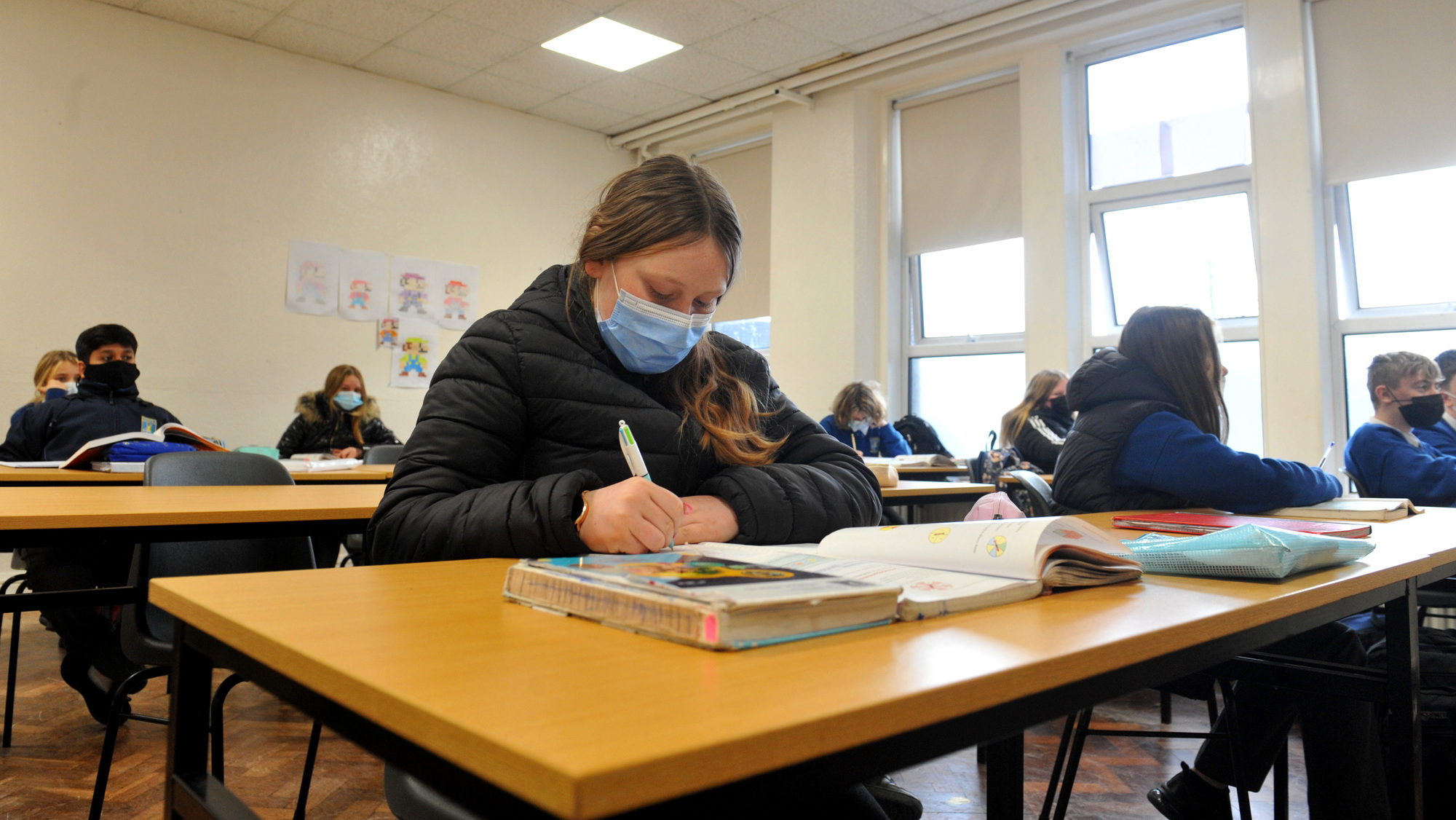
In November 2021, at the height of the covid pandemic, the Ombudsman for Children issued a stark warning about a 'brutal' and 'traumatic' Senior Cycle exams process, concerns still being echoed to this day. See links below. File picture: Larry Cummins
Ombudsman for Children Niall Muldoon had a stark warning for TDs and senators as he addressed the Oireachtas education committee in 2021.
The committee was meeting with children’s rights advocates during the height of covid, as it was tasked with examining the glacial pace of changes to the Senior Cycle, at that point still in its infancy.
Those attending heard that the “traumatic” and “brutal” final exams held each year in June placed a disproportionate amount of mental stress on students, something that had not gone unnoticed by the UN Committee on the Rights of the Child.
It has now been more than five years since that warning, and the early stages of the reformed Senior Cycle are now underway, but are we any closer as a country to getting to the real source of Leaving Cert stress, or to the bottom of the reasons why those final exams are so traumatic for students?
Even its staunchest defenders would concede the Leaving Cert has fundamental flaws. Much of the rhetoric and rationale for change often cited by various ministers highlighted the need to reduce stress and anxiety by moving away from the focus on exam halls.
By and large, this is hoped to be achieved through the introduction of new additional assessment components (AACs), contentious in their own right. Teachers have previously warned that the introduction of the AACs could inadvertently increase stress for students by increasing their workload throughout the year.
Read More
Regardless of these changes, a totally reformed Senior Cycle, due to be fully rolled out by the beginning of the next decade, still fails to address the elephant in the room. How closely wedded the Leaving Cert remains to the college application system.
The seemingly intrinsic link between the marks a student collects in their final Leaving Cert grades and the CAO system is also the reason why the effects of the pandemic are expected to be felt on the college admissions system here until 2032.
Over the past 10 years, a large body of work has been undertaken to modernise the Leaving Cert. Reforming the college admission process now could be like pushing an open door amongst parents, teachers, principals, and students.
It is also prioritised under the current Programme for Government, but when asked on Wednesday of his plans, further and higher education minister James Lawless was non-committal.
On Wednesday, as the CAO issued 90,866 Round One offers to 62,166 CAO applicants, the Irish Second Level Students Union (ISSU), the National Parents Council, the Teachers’ Union of Ireland (TUI), the National Association of Principals and Deputy Principals (NAPD) and the Children’s Rights Alliance issued a joint call for CAO reform.
“We have no idea yet whether [current Leaving Cert reform] will reduce the stress or not,” Tanya Ward, chief executive of the Children’s Rights Alliance, told the Irish Examiner.

“Young people say it's the points-based system that’s the problem,” she added.
“What young people tell us is that they are terrified they won’t get onto the next rung of the ladder.
"What they have a tendency to do is to withdraw from friendships or from doing sports, during the two years [before their exams], things that would actually help them reduce anxiety and stress, and they put an extraordinary amount of time and energy into studying for this end of year exam.”
Its a failure of a points-based system that groups of young people who “withdrew completely from their social life” and who had “given up everything to study” could achieve the maximum points available and still miss out on their chosen course, Tanya Ward said. “It has to change.”
In CAO data, an asterisk* marks the college courses where entry has essentially been determined by a lottery. Random selection was used again across 35 Level 8 courses this year.
Of this, 16 courses attracted points upwards of 555. An example of Leaving Cert grades required for this level of points would be two H1s, three H2s and a H3 in higher level maths.
For 2026, dentistry in University College Cork (UCC) and dental science in Trinity College Dublin attracted cut off points of 625, and entry was still determined by random selection. This means that students who achieved the top marks available across all subjects, including a H1 in higher level maths, missed out on their top choice.
Random selection was also used to determine entry to five of the country’s six undergraduate routes to medicine, which also requires students to sit the additional HPAT exams.
Points ranged between 741 and 730, with a max of 565 of these points directly coming from Leaving Cert points.
Harrison Rossiter McGuire, president of the Irish Second Level Students’ Union (ISSU), said second level students “struggle immensely” with stress and anxiety tied to the points-race.
“It takes no account for extra curricular activities, and purely focuses on academia with more subjects than other countries which drive stress and burnout.
"While there is a large number of courses that require a specific grade in certain subjects, many courses don’t have this and simply require a certain number of points, which can lead to students picking subjects not out of passion but out of perceived ease or ‘gameability’.”
Mr Rossiter McGuire described random selection as deeply unfair saying it massively decreases the value of the work of the student.
Other courses whereby entry was determined by random selection included speech and language therapy, physiotherapy, vet medicine and occupational therapy, all courses training key professionals crucial to delivering critical services across the country.
On the other hand, pharmacy also saw continued strong interest again. This year, two new courses have been introduced at the Sligo campus at the Atlantic Technological University (ATU) and at Waterford campus at the South East Technological University (SETU).
Cutoff points for entry were 544 at both courses, where random selection was also used to determine entry.
However, in a sign that the extra capacity does help to alleviate some pressure, cut off points dropped at each of the four established pharmacy courses in UCC, Trinity, Galway and the RCSI. This ranged between 10 to 12 points.
On Wednesday, further and higher education minister James Lawless said he believed the impartiality of the CAO system is something that should be retained. He believes students could benefit from being exposed to a wider range of disciplines in college before choosing a specialisation at a later stage.
Paul Crone of the National Principals and Deputy Principal Association (NAPD) called for creative thinking.

“If you want to be an engineer, the bonus points should be in physics or maths,” he told reporters on Wednesday.
“At the moment they’re only in maths. If you want to be a doctor, they should be biology or chemistry. If you want to be a journalist, they should be in English.”
Academics are predicting that volatility caused by the State Examinations Commission (SEC) post-marking adjustment will impact on the college admissions system until 2032, four years after it is phased out.
To take the heat off the points race without significant reform of the CAO process will require direct funding to create additional places. There is another option at the Department of Further and Higher Education’s disposal. Since tertiary degrees were first introduced in 2023, there are now almost 80 courses available completely outside of the points race, covering 1,200 places.
This includes primary school teaching for the first time this year, a historic move for a profession whereby personality and people skills are key to success, neither of which tend best to be measured through CAO points.
With tertiary degrees, students begin their studies at their local Education and Training Board (ETB) before graduating from their participating university. From day one, they are treated as if they are a student at both institutions, and are granted access to both campuses and all facilities.
Graduates are expected to meet the same academic standards and requirements throughout their studies as their peers who entered through the CAO system, and they graduate with the same degree.
There isn’t an asterisk on their degree, noting their original entry route. The only difference is that arbitrary points didn’t determine their initial entry to the course. Continuing to vastly scale up tertiary degrees, and a bit of creative thinking, could hopefully provide more avenues for capable students to study across key skills areas.
- Jess Casey, Education Correspondent


CONNECT WITH US TODAY



Be the first to know the latest news and updates