TP O'Mahony: Slander of Mary Magdalene was a deliberate choice by early Church
The depiction of Mary Magdalene — who was probably an apostle — as a sex worker hardened over time in order to reduce the influence of women in the Church, writes TP O’Mahony
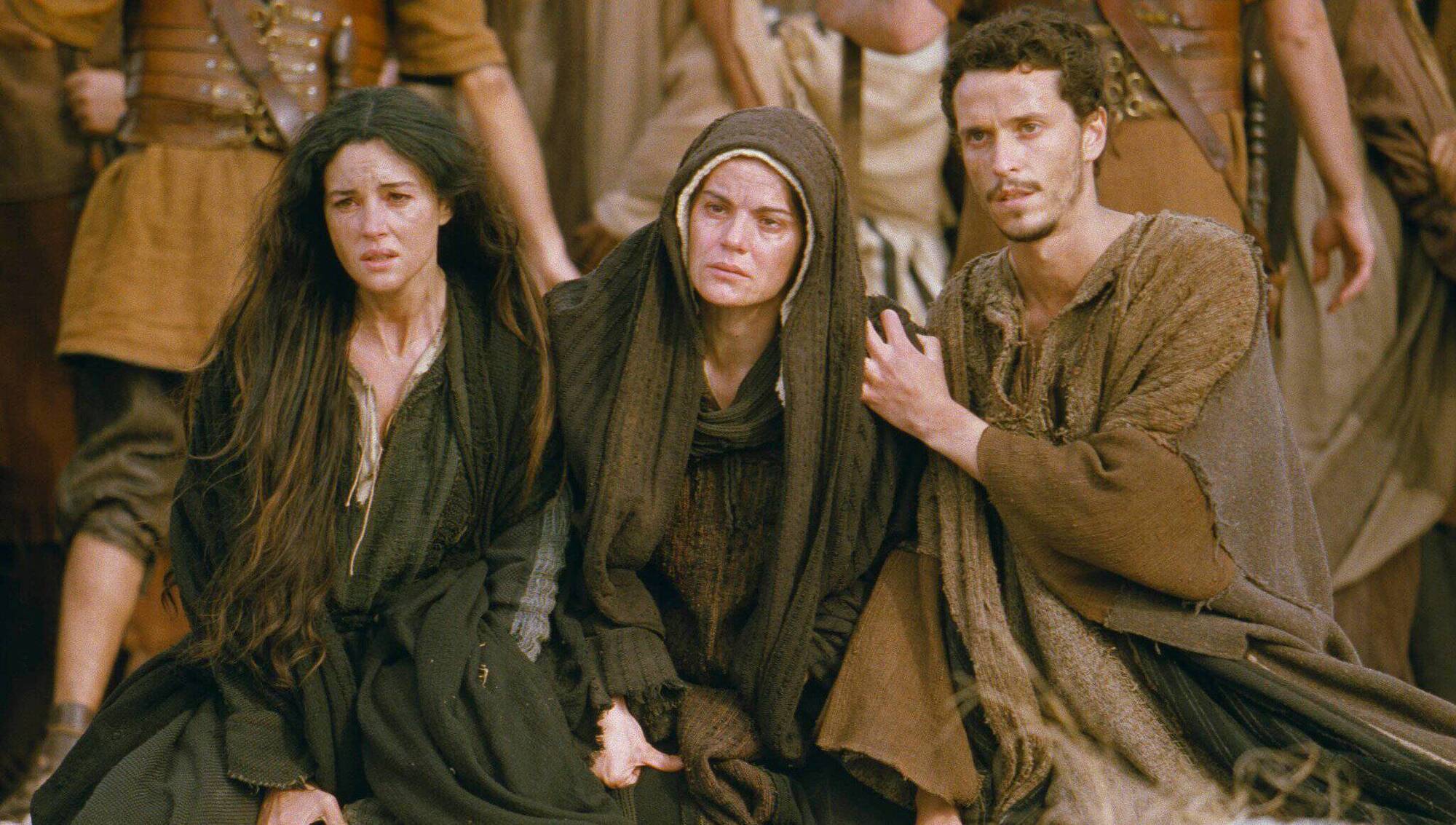
Monica Bellucci, Maia Morgenstern, and Hristo Jivkov starred in Mel Gibson’s controversial film ‘The Passion Of The Christ’ in 2004. In casting Monica Bellucci as Mary of Magdala, Mel Gibson depicted her as a femme fatale — a woman whose beauty and sexual allure drew men to her, even Christ himself. 

Monica Bellucci, Maia Morgenstern, and Hristo Jivkov starred in Mel Gibson’s controversial film ‘The Passion Of The Christ’ in 2004. In casting Monica Bellucci as Mary of Magdala, Mel Gibson depicted her as a femme fatale — a woman whose beauty and sexual allure drew men to her, even Christ himself. 

IN Mel Gibson’s controversial 2004 film The Passion of Christ, the Italian actress Monica Bellucci won critical acclaim for her portrayal of Mary Magdalene, a woman the Catholic Church has always been reluctant to recognise as an “apostle”. Her uncertain status, despite her central role in the early Christian community, is reflective of the wider refusal of popes to admit women to the priesthood — a refusal with deep roots.

The sidelining of Mary Magdalene is emblematic of the Vatican’s attitude to women. In a scene from Dan Brown’s 2003 international bestseller The Da Vinci Code, this comes into sharp focus. In one scene, Professor Leigh Teabing, described as “a religious historian”, insists that one of the figures in Leonardo’s famous painting of The Last Supper is Mary Magdalene.

The young woman detective he is addressing is incredulous: “The prostitute?” The professor shakes his head. “Magdalene was no such thing. That unfortunate misconception is the legacy of a smear campaign launched by the early Church.”

Whatever about some of the other claims made by Brown in his novel (you can make your own mind up about those) — popularised even further in the 2006 film adaptation starring Tom Hanks and Audrey Tautou — this reference to a “smear campaign” is factually based.

Gibson added another dimension in his 2004 film: In casting Monica Bellucci as Mary of Magdala, he depicted her as a femme fatale — a woman whose beauty and sexual allure drew men to her, even Christ himself. 

Whether it is preposterous — or perhaps even sacrilegious — to go a step further, as Martin Scorsese does in his 1988 film The Last Temptation of Christ (in which Mary Magdalene was played by Barbara Hershey, another beautiful actress), and depict Christ struggling with temptations, including that of a sexual relationship with Mary Magdalene (something taken even further by Dan Brown, who has them marrying), is debatable. 

Would a married Christ be any less divine than an unmarried one? Either way, the belief that Mary Magdalene was a sex worker took hold long before Brown’s bestseller, despite the fact that there is nothing in the New Testament to give credence to this view.

Beginning with Tertullian and Augustine, theologians in later centuries have consciously tried to downplay her role as an influential disciple of Jesus. The depiction of her as a sex worker persists down to the present time. The only explanation is that the papacy didn’t want any influence-wielding companion of Jesus to be a high-profile woman.

This fits in with the secondary status to which women were consigned from the early days of the papacy. It is also why the legend of Pope Joan, from the 11th century, is regarded as a scandalous and embarrassing fiction by the Vatican because of its disruptive implications (and also, ironically, why the legend persists).

For the papacy to admit of course, that Mary Magdalene was an apostle alongside the “chosen” 12 would pull the rug out from under its central objection to the ordination of women — the claim that only male apostles were chosen by Christ, and that, therefore, only men can be ordained. 

Such an admission would never do. The carapace supporting the “male-only priesthood” concept would come crashing down.

The paradox within the Church

All of this means that there is an enduring paradox at the core of all papal doctrines about the role and status of women in the Catholic Church. That paradox persists and flourishes today in the papacy of Leo XIV.

That paradox has been succinctly described by Michele Dillon, professor of sociology at the University of New Hampshire (and a Dublin woman), as follows: “It is difficult for many Catholics and others to square the Church’s emphasis on equality with its opposition to women priests.”

It received its most notable exposition in a document from Pope John Paul II — an apostolic letter published on 15 August 1988, the feast of the Assumption of the Blessed Virgin Mary. The letter was entitled The Dignity of Women

It consisted of repeated attempts to persuade readers that women are honoured and cherished in the Church, and presented a convoluted series of arguments, examples and stories all aimed at assuring the reader that women weren’t discriminated against by being excluded from ordained ministry.

The actual history of the Church tells a different story.

In their book Women Remembered: Jesus’ Female Disciples, Joan Taylor and Helen Bond (two historians of early Christianity), paint a different picture: “The story of the suppression of women in the Church is a sorry tale that still has repercussions today. Women have been silenced, marginalised, refused entry to theological discussion and blamed for it.”

What might be considered the rather harsh dismissal by our former president Mary McAleese of this whole exercise of attempting to provide “justifications” for the exclusion of women from ordained ministry as “codology dressed up as theology” may, on reflection, be far nearer the truth than anyone in the Roman Curia would be prepared to admit.

The central tenet of the pope’s letter was more fully, if also more concisely, spelled out by him in a later apostolic letter published on 22 May 1994 and entitled Priestly Ordination. It makes explicit what was implicit in the earlier document. It ends with this sentence: “I declare that the Church has no authority whatsoever to confer priestly ordination on women and that this judgment is to be definitively held by all the Church’s faithful.”

That letter, it should be noted, was prompted in part by the decision of the Church of England (following on from the Church of Ireland) to ordain women as priests (the first ordinations occurred on 12 March, 1994). The Church of England is of course the “mother” church of the worldwide Anglican Communion which recognises the Archbishop of Canterbury — now, for the first time in over 500 years, a woman, Archbishop Sarah Mullally — as primus inter pares.

What remains to be seen is whether Pope Leo XIV acknowledges the paradox inherent in the current Vatican opposition to women priests, an unlikely event on the basis of present evidence.

In her book Postsecular Catholicism, Professor Dillon outlined the basis of the Church’s opposition to female ordination: “The Vatican’s reasoning on women’s ordination is summarised in three straightforward arguments, two grounded in scripture and the third in tradition.

“First, it argues that ordaining women would contravene the will and intention of Jesus who called only men to be apostles. Second, because women do not physically mimic the male Christ, they cannot mimic him in the sacramental consecration of the bread and wine during the Eucharist (Communion), which is done in memory of Christ at the Last Supper and his command ‘Do this in memory of me’. 

"The third reason is that an exclusively male priesthood is part of the Church’s constant and essential hierarchical tradition.”

But she goes on to stress that many Catholic theologians, church historians and lay Catholics contest these claims. “They argue that scripture is replete with stories of Jesus’s positive actions toward and interactions with women. Women are highly visible, for example, in all the major redemptive events in Jesus’s life, including his death and resurrection...”

Despite this, there is no reason to believe that this pope will depart from the policy that the exclusion of women from the priesthood is a settled matter.

More in this section

Revoiced

Newsletter

Had a busy week? Sign up for some of the best reads from the week gone by. Selected just for you.

Cookie Policy Privacy Policy Brand Safety FAQ Help Contact Us Terms and Conditions

© Examiner Echo Group Limited