Tracking Ireland's transformation from cosy Catholic country to Vatican antagonist
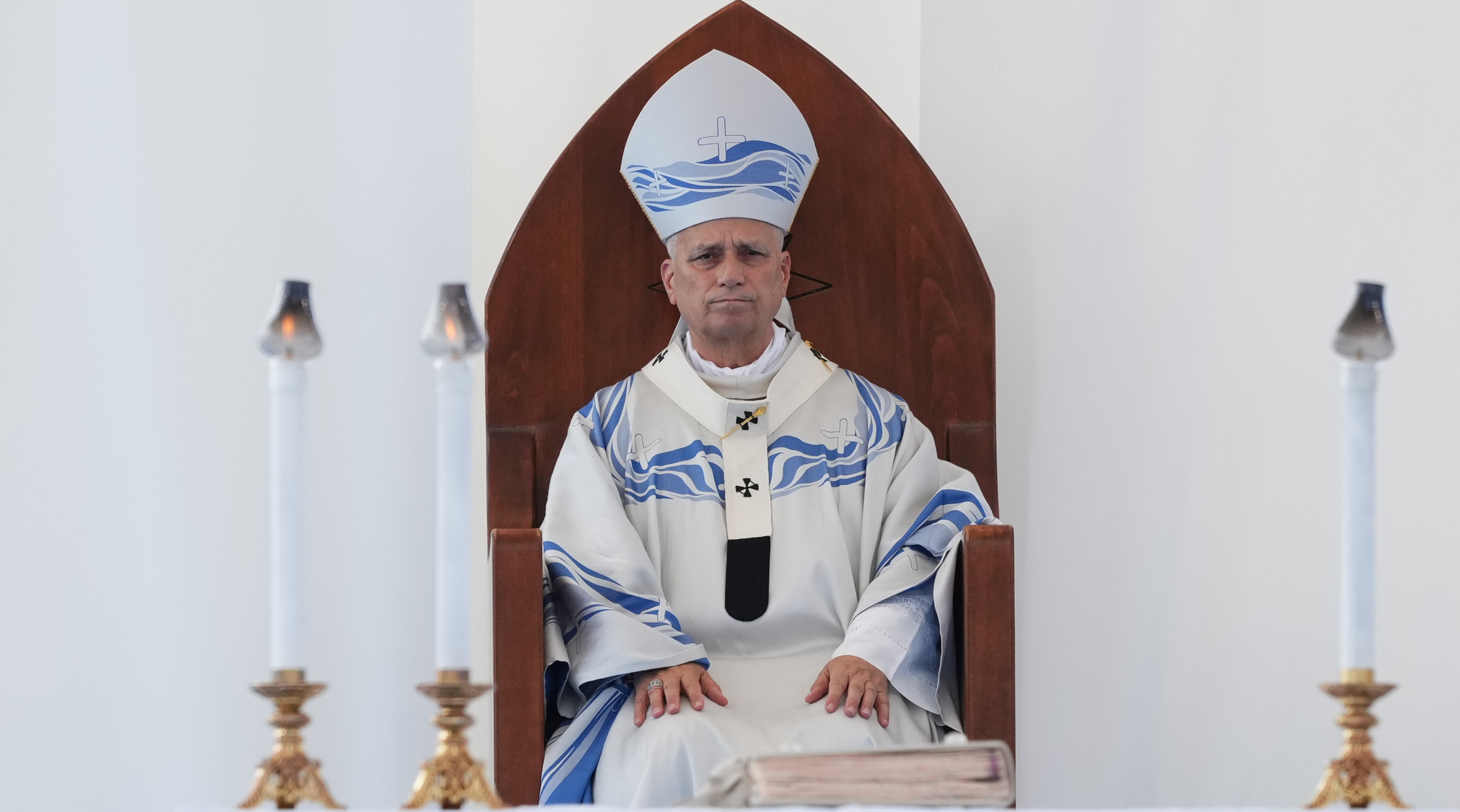
Pope Leo XIV appears committed to a synodal church in order to herald an Irish catholic renaissance. Photo: AP/Alessandra Tarantino
When Bishop Denis Moynihan had Jayne Mansfield’s cabaret cancelled from the pulpit in 1967, few could have imagined that within 50 years Ireland would repeal the Eighth Amendment by popular vote.
What happened in between is one of the most profound social transformations in modern Europe.
tracks that transformation. It tells the story of how the Irish State moved from a cosy symbiotic partnership with the Catholic Church since independence into open opposition, and even segued into an antagonistic relationship.
Nobody has painted the background picture to all of this better than Mark Hederman, the former abbot of Glenstal Abbey in County Limerick: "Throughout most of the 20th century in Ireland, the Catholic Church was involved in a symbiotic structural entanglement with the Irish Free State as this reality unfolded socially and politically.
"As the song says, both went together like a horse and carriage. This seemed normal and almost providential to the majority of Ireland’s citizens for the first half-century of our existence.
Read More
"Then, very suddenly, in a period of 20 years, more or less, the horse collapsed or the carriage crumbled, whichever way you choose to look at it; the Catholic Church melted away. How could this have happened?"
Multiple dramas were played out before it did happen. The emergence of an antagonistic State followed a long and mutually fruitful ‘horse-and-carriage’ period dating from 1922.
The famous anti-Vatican speech in 2011 in Dáil Eireann by the then Taoiseach, Enda Kenny — rightly described as a ‘philippic’ and leading to the closure of the Irish Embassy to the Holy See — was the most dramatic example of this antagonism.
The evolution of State-versus-Church dynamics began in 1951 with the confrontation between Archbishop McQuaid and Health Minister Noel Browne in the ‘Mother-and-Child’ crisis. McQuaid won — but this was, in the words of broadcaster and historian John Bowman, a ‘pyrrhic victory’.
The book title derives from the fact that in a number of key socio-sexual spheres the Church suffered a series of morally damaging setbacks — defeats, if you will — beginning with contraception, then homosexuality, divorce, abortion and same-sex relationships.
The Irish bishops had embraced a Maynooth version of the domino theory — their fear was that if the link between sex and procreation was broken, then ‘anything goes’ — the floodgates would open.
The Humanae Vitae controversy had serious implications for papal authority, and this had ripple effects throughout the universal Church. In Ireland, the moral monopoly the Church had enjoyed since independence had started to crumble long before the publication of the Ryan and Murphy Reports in 2009.
In the meantime, the State has been involved in a stand-off with the Church about appropriate redress for victims of the Magdalene laundries and mother-and-baby homes, with some voices calling for the seizure of the assets of the religious orders.
Then in August 2019, in his address in Dublin Castle in the presence of Pope Francis, the then Taoiseach, Leo Varadkar, said he believed that the time had come to build a new relationship between Church and State in Ireland — a 'new covenant for the 21st century'. What 'shape' might this take?
Will the Vatican — given that Ireland is now widely regarded as having moved into a post-catholic phase (whereas previously it was regarded in Rome as 'one of the most catholic countries in the world' even up to and beyond the visit of John Paul II in 1979) — now seek a concordat to safeguard church privileges, rights, assets and resources?
Any move towards a 'new covenant' should provide for a formal separation of Church and State — such as enshrined in the First Amendment of the US Constitution or the 1905 Separation Law in France.
This is overdue, especially since the Good Friday Agreement of 1998 and the subsequent enhanced prospects of a United Ireland — and could be most efficaciously done in the context of a new secular Constitution (replacing the 1937 model), a new foundational document for a new Ireland. This might require a constitutional convention.
It is also clear now that in the ‘new’ Ireland both State and Church must contend with growing secularisation and the cultural effects of the spread of pluralism and diversity, and the challenges which these pose.
And could a synodal church, as envisaged by Pope Francis, herald an Irish catholic renaissance? Or might synodality even cause a schism in the wider Catholic Church?
Pope Leo XIV appears committed to the synodal path opened up by his predecessor, perhaps just recognising that this genie is now out of the bottle and has to be reckoned with. But will he seek to promote, modify, negate or ring-fence it — a key question.
A key question, yes, but one that need not assume central importance in the ‘new’ Ireland that is beckoning. Deference to Rome (and to its agents here in Ireland) has left a pernicious legacy.
And it should not be forgotten that Leo XIV — the first American pope — represents an institution, the Papacy, that since the election of Karol Wojtyla as John Paul II in 1978, has turned its face against the reforms of Vatican II. Pope Francis sought to rectify that, but met stiff and unrelenting resistance.
So far there are no signs that Leo XIV shares Francis’s reforming inclinations. The result is that the current Roman Catholic version of Christianity will have little of substance to contribute to the ‘shaping’ of a new Ireland.
That, of course, doesn’t or shouldn’t rule out homegrown initiatives. Breathing new life into the concept of a ‘free church in a free state’ is a worthy and potentially enriching enterprise.
Both Church and State will look very different 50 years from now — the task, the challenge is to ensure that this ‘difference’ — in a world where authoritarian leaders, oligarchs and billionaire owners of social media corporations care less and less about the civic consequences of economic power and wealth inequality — is fashioned in a way that will be conducive to human flourishing and the promotion of the common good.
That will require a very novel and innovative relationship.
- is published by Mercier Press at €16.99.
CONNECT WITH US TODAY



Be the first to know the latest news and updates