A gamble with gas is a risk that Ireland can't afford to take
Government should be transparent withe the public about the supposed benefits of LNG infrastructure
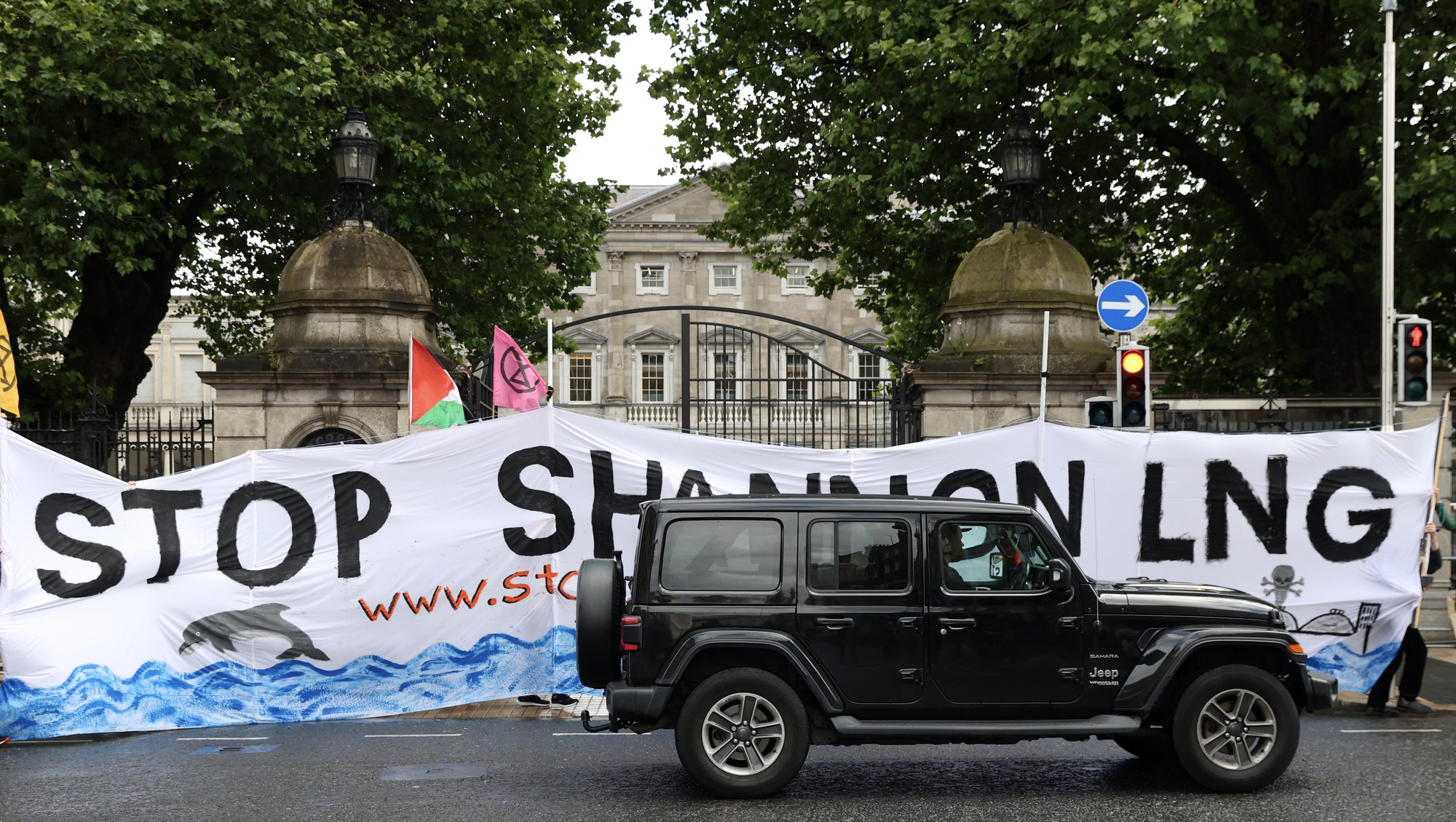
Climate activists from the Stop Shannon LNG Coalition protesting outside Leinster House in July 2025 over government plans to establish liquefied natural gas (LNG) infrastructure in Ireland. File picture: Sasko Lazarov/RollingNews.ie

Climate activists from the Stop Shannon LNG Coalition protesting outside Leinster House in July 2025 over government plans to establish liquefied natural gas (LNG) infrastructure in Ireland. File picture: Sasko Lazarov/RollingNews.ie

At a time of heightened geopolitical instability, soaring energy costs, and a deepening climate crisis, the Government is about to make one of the biggest energy decisions in our history. It is gambling with gas, a risk that Ireland simply cannot afford to take.

The Strategic Gas Emergency Reserve (known as the LNG Bill) is expected to advance in the Dáil on Thursday. Designed to pave the way for Ireland’s first State-led liquefied natural gas (LNG) emergency reserve, it is one of the most contentious climate and energy bills to come before the Oireachtas.

This bill will provide for the accelerated development of a national strategic gas emergency reserve at the Shannon Estuary in Co Clare, a huge industrial development which will devastate the natural environment in Clare, import dirty fracked gas into Ireland, and cost in the region of €900m for a ten-year period.

The Government argues that building a strategic gas reserve is essential to protect Ireland from future energy shocks. Yet the very crises used to justify this project, including Russia’s invasion of Ukraine and more recently the Iran war, have exposed just how vulnerable countries become when they remain dependent on volatile international fossil fuel markets.

Doubling down on imported gas should not be our strategy for energy security. Investing hundreds of millions of euros in new gas infrastructure just as the world is moving towards cheaper renewable technologies risks leaving Irish households and future generations footing the bill for an expensive mistake. Even the European Union is warning against increasing reliance on imported LNG because of the strategic risks associated with external suppliers and volatile global markets.

Instead of advancing this legislation, the Government should position Ireland towards homegrown renewable energy through onshore and offshore wind, community energy, with additional interconnection and battery storage.

The Joint Oireachtas Committee on Climate, Environment and Energy, which heard testimony on the potential impact of the gas reserve in Clare, noted that no examination of the potential impact of the gas terminal on the health of communities has been undertaken.

Apart from health consequences, legislators are being asked to approve a major piece of infrastructure without clarity on how it will operate, what it will cost, who may ultimately control it, or whether it remains economically viable in a radically changed global energy landscape.

Another hugely worrying factor is that at the Oireachtas Committee, department officials declined to rule out the possibility of increases in household bills as a result of this proposed development.

We also heard from officials at the committee that this bill, which involves building a large fossil fuel structure, can be ‘deemed’ compliant with the Climate Act.

How that is possible without an assessment and demonstration by the Government of compliance was a puzzle to legal experts before the committee.

Climate activists from the Stop Shannon LNG Coalition protesting in May 2025 over government plans to establish liquefied natural gas (LNG) infrastructure in Ireland. File picture: Stephen Collins/Collins

All of these concerns were raised by Friends of the Earth and members of the Joint Oireachtas Committee which repeatedly requested updated economic analysis and cost-benefit assessments, requests that have largely been dismissed as outside the scope of the legislation.

The refusal to publish a cost analysis and updated economic modelling is particularly difficult to understand. If the project remains the most cost-effective option for energy security, the Government should have no difficulty demonstrating that publicly.

If it does not, then the Oireachtas and the public deserve to know that too.

Ireland may be committing to expensive fossil fuel infrastructure as international climate policy accelerates. If renewable technologies continue to fall in cost, or if LNG demand weakens over time, Ireland could find itself owning infrastructure that is no longer commercially or strategically viable. Taxpayers would carry the risk.

Worse still, future governments could find themselves under pressure to maximise use of the facility simply to justify the investment, creating a perverse incentive to prolong fossil fuel dependence long after alternatives become available.

The Government has repeatedly stated that this facility will be state-led, state-owned and used only in genuine emergencies. Yet the Bill itself does not provide those guarantees.

The committee recommended explicit legislative safeguards to ensure the terminal remains publicly owned, cannot become a commercial LNG facility, and is used solely as an emergency reserve. We have yet to see those recommendations in the legislation.

Instead, the Bill leaves open the possibility that “private bodies” could become involved in delivering the project. That may appear a technical drafting issue, but it is far more significant than that.

It creates a legislative pathway through which commercial interests could gain influence over infrastructure that is supposedly intended solely for national security purposes.

The same questions arise regarding planning and oversight.

While environmental assessments will be undertaken by An Coimisiún Pleanála, the ultimate development consent decision rests with the Minister at a time when public trust in institutions is under pressure.

The Committee specifically requested analysis of alternatives, including reducing demand from large energy users such as data centres during periods of system stress.

The Committee report pointed out that officials and expert witnesses noted that data centres are now among the largest sources of industrial gas demand, which they viewed as conflicting with national climate and energy security objectives. And yet we still welcome even more data centres to these shores.

Before committing public money to new polluting LNG infrastructure surely it is reasonable to ask whether the same security benefits could be achieved more cheaply through managing energy demand better and pushing for more energy efficiency measures including retrofitting and renewables.

Ireland cannot afford to get decisions of this scale wrong. The public deserves a full accounting including a climate assessment before a decision on this bill is made, not after the infrastructure is built.

  • Deirdre Duffy is CEO of Friends of the Earth Ireland.
x

CLIMATE & SUSTAINABILITY HUB

More in this section

Revoiced

Newsletter

Had a busy week? Sign up for some of the best reads from the week gone by. Selected just for you.

Cookie Policy Privacy Policy Brand Safety FAQ Help Contact Us Terms and Conditions

© Examiner Echo Group Limited