Communities like Clonmel have fought back against the far right. Here's how yours can too
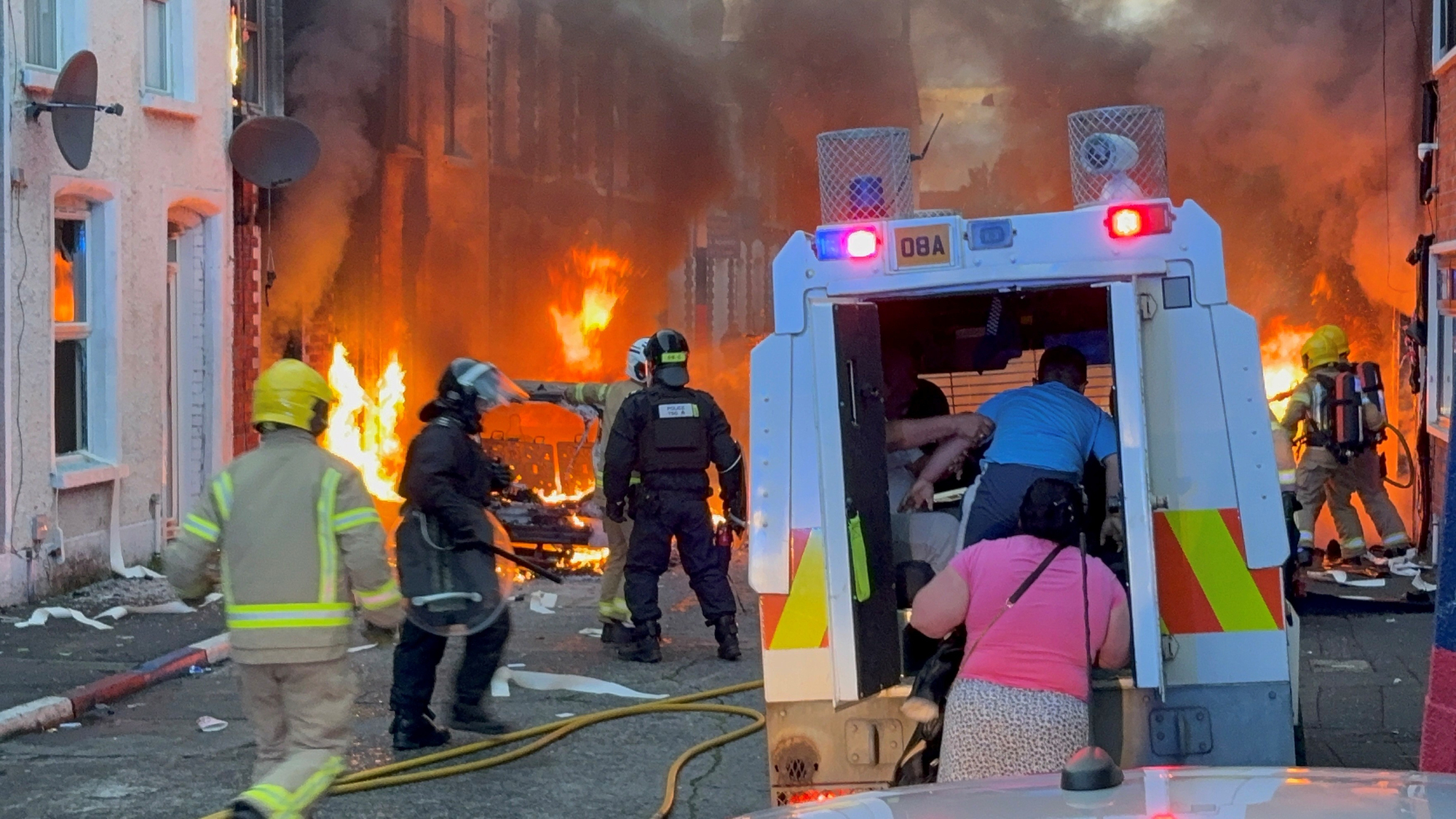
A family get into a PSNI vehicle after being rescued from houses which caught fire in Lendrick Street in east Belfast after disorder flared last week in the city.
The anti-migrant violence in the North last week may have been sparked by a brutal assault, but was a product of the organisational infrastructure of mass violence that networks of far-right loyalists have developed for decades.
The speed with which communities moved to support and protect their targets is a testament to the infrastructure of mutual aid and human solidarity people have had to build to resist this violence over generations.
As the ostensibly “nationalist” far right in the rest of the country continue to build networks of their own, the communities they’ve terrorised have stepped up to stand against them.
When politicians lose interest and the press move on to the next story, we are left to repair the damage and build our defences. What is well-worn territory in Belfast serves as a warning for the rest of us.
I live just outside Clonmel, and I was not an activist when the far right started organising here two years ago. I became one because I couldn’t live with myself if I just stood by and did nothing.
Read More
Inspired by events in Roscrea, where a genuinely spontaneous local protest motivated by longstanding grievances was seized on by far-right activists pouring in from outside, a small group of hardened conspiracists, many from other parts of Tipperary, decided they were going to try to make our town their next battlefield.
Plenty of people in Clonmel had problems with the proposed modular housing for Ukrainian families, but almost no one supported this group or their tactics. When work began on the site, the protesters livestreamed themselves screaming abuse and threats at the workers, calling out local lads by name and threatening their families with harassment.
They set up an encampment where a far-right activist from Wexford lived for the rest of the year surveilling the site, supported by online fundraising. They organised marches that brought far-right activists from all over Ireland to our streets and followed local election candidates around in public, filming and shouting at them.
They made videos threatening to destroy local businesses owned by immigrants. It went on for months.
Anyone who challenged them was inundated with abusive comments and threatening messages, mostly by people outside Clonmel, even outside Ireland.

This is how the far right operates, maintaining an atmosphere of constant hostility where those who speak against them are bombarded with negativity, up to and including death threats, not just to punish, but to dissuade others from raising their voices too.
They make people who oppose their reactionary agenda feel isolated and under siege when we actually outnumber them.
When I and others formed Clonmel Together, we weren’t interested in fighting anyone, but in protecting our town, where people from many countries and cultures have lived together happily for decades.
Immigrants are part of the fabric of our community as much as anyone else. They are our friends and family, our partners, classmates in school, teammates on the pitch, colleagues at work, fellow congregants in our places of worship.
The far right wanted to make our town a more hostile and fearful place for them to live, and we refused to let that happen.
We reached out to Hope & Courage Collective, an organisation that supports communities targeted by the far right, for advice on responding with positive, nonconfrontational action. When we attended a workshop with other groups, mostly from Tipperary, I was struck by the range of people, not just in age and background, but perspective.
Conservative-minded centrists sat next to revolutionary socialists.
Some of the women recognised each other from opposite sides of the abortion referendum. We left those differences at the door in defence of something more fundamental and precious: our common humanity.

Hope & Courage gave us invaluable support, but, just as importantly, connected us with others in the same position. It gave us confidence that, despite all the noise, there were really more of us than the hatemongers.
Their recent report, Mind the Gap, quantified how much more of us there are.
It should be a wake-up call to both politicians and the press about how much they’ve been amplifying the views of a hateful few at the expense of people who have to deal with the consequences of an emboldened far right organising where we live.
Social media plays an important role too, but it can’t be blamed for everything. I know so many people who’ve endured harassment, threats and even violence because we stood against bigotry, while politicians and pundits legitimised those attacking us as the authentic voices of our communities.
It’s not Mark Zuckerberg's fault that so many politicians would rather chase votes than stand on principle. Elon Musk doesn’t make local radio call-in shows rage bait their listeners and platform the loudest, angriest voices because they think controversy will keep people tuned in.
It’s not good enough, and it needs to change. Time and again, communities have done the slow, patient, unglamorous work of resisting the far right, and we will continue to do so.
It’s long past time the political and media establishment reflected on how much harder they’ve made our work — and our lives — by giving extremists a megaphone.