The dangerous idea at the heart of the Government's new infrastructure policy
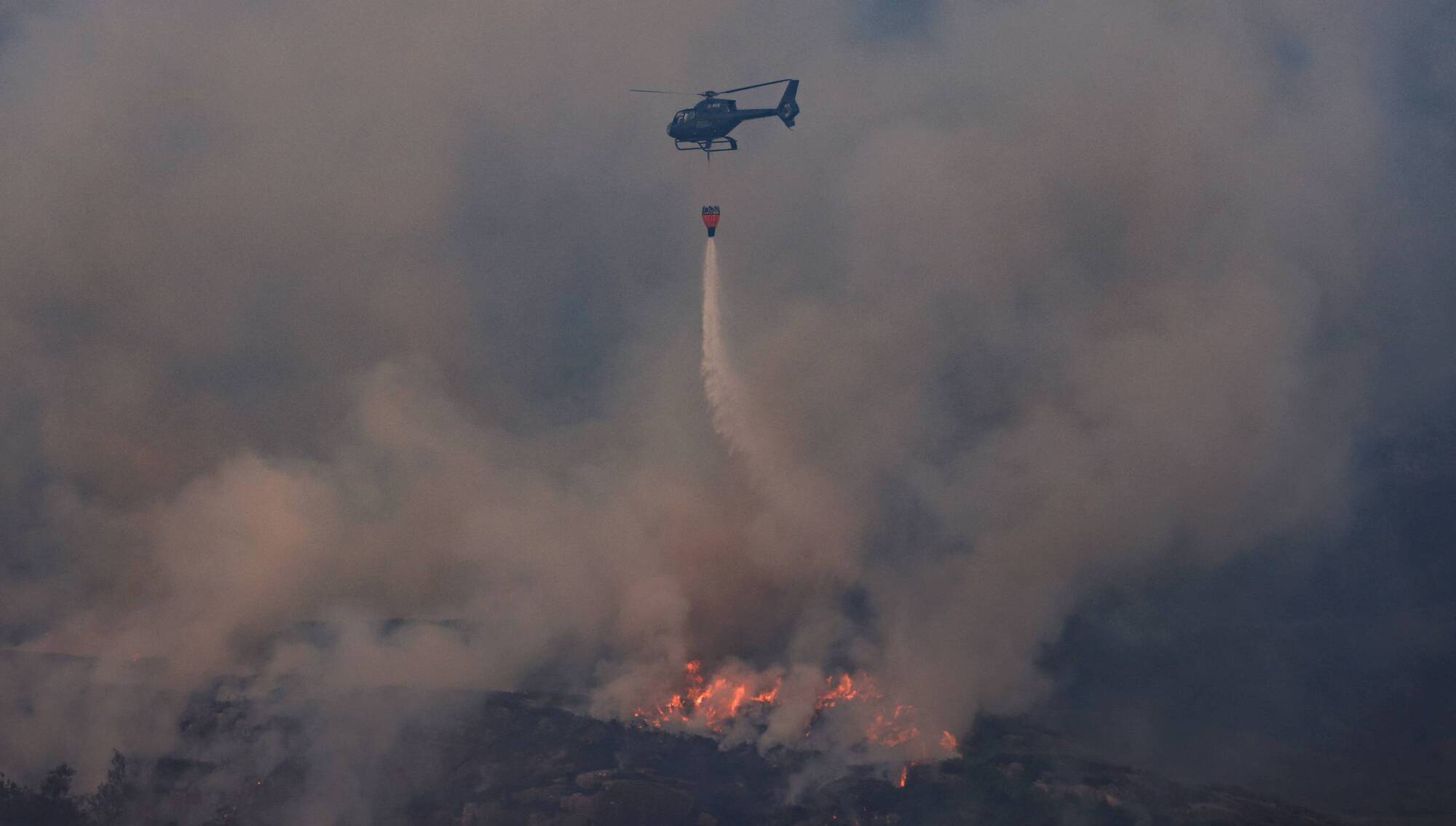
A wildfire in Killarney National Park last week. Heatwaves, wildfires and floods are again hitting populations around the globe and in Ireland. Photo: Valerie O'Sullivan/NPWS
Some of the most significant infrastructure decisions in the State will no longer be subject to obligations that continue to apply to other public bodies.
The Government says that critical infrastructure projects are too important to be delayed. We agree. But this does not mean that projects which undermine our climate policy should go ahead.
Legal loopholes in climate law are being introduced in a year in which it has become painfully obvious that climate change is hitting with greater speed and severity than climate scientists, naturally cautious, had predicted.
Heatwaves, wildfires and floods are again hitting populations around the globe and in Ireland. The Irish Central Bank has warned that the flood insurance system is no longer funded to meet projected climate costs.
Section 15 of the Climate Act, introduced in 2021, says that public bodies must carry out their functions in a way that is consistent with the National Climate Objective.
Read More
In simple terms, climate commitments are supposed to influence decisions across Government, not just environmental policy.
Whether you work in transport, health, education, energy, agriculture, local government or many other public bodies, you have to act in a manner that is consistent with the achievement of the National Climate Objective.
Reducing greenhouse gas emissions in developed economies involves a fundamental restructuring of economic activity, infrastructure and investment patterns. Such change is often slow because existing systems, institutions and assets are built around long-established patterns, especially of fossil-fuel dependency.
Since the 1992 Rio Earth Summit, governments have repeatedly attempted to reduce emissions through policy initiatives. What became evident over the following decades was that policy documents alone weren't cutting it.
People throughout the government system (and the private sector) weren't listening to the message that they needed, in a metaphorical sense, to turn the oil tanker around and go in the opposite direction.
This is easy to understand; many of the people and institutions that built modern economies did so on the assumption that fossil fuels would remain central to economic development. With hindsight, we now know building the economy on fossil fuels was a generational mistake which future generations will pay dearly for.
The conclusion reached in many countries was that a framework with legal force was needed. Seven climate bills were introduced in the Oireachtas between 2005 and 2013; The Climate Action and Low Carbon Development Act was finally enacted in 2015.
At its core was a national transition objective: "The transition to a low carbon, climate resilient and environmentally sustainable economy by the end of the year 2050." The 2015 Act did not fully achieve its purpose. Many decision-makers did not regard it as directly affecting the decisions they made.
So, in 2021 the Oireachtas, by a vast majority, correctly decided to introduce the obligation of consistency with the National Climate Objective. While some public bodies such as Bord na Móna, ESB and Eirgrid have indeed changed direction, many public bodies still don’t meet their climate consistency obligations in practice.
Finally, a wind farm developer relied on s.15 in a challenge to a planning refusal. In the Coolglass case, the Supreme Court clarified the operation of section 15, sending the refusal back to An Comisiún Pleanála for reconsideration. This decision has implications not just for planning but for all bodies covered by the Climate Act.
However, the Coolglass case has also woken the attention of those who presumably want to keep the oil tanker going in the wrong direction.
This Government has chosen to disapply that provision for designated critical infrastructure projects and programmes. In legislation designed to address delays in the development of infrastructure, it has chosen to remove the legal mechanism designed to ensure consistency with Ireland's climate objectives.
Similar exemptions are being enacted for the removal of the Dublin Airport passenger cap and liquid natural gas importation and storage. The result is that some of the most significant infrastructure decisions with long-term impacts on our ability to phase out fossil fuel use will no longer be subject to section 15 consistency obligations.
Some projects designated as critical infrastructure, such as rail expansion schemes, may well be entirely consistent with Ireland's climate objectives. That is not the issue.
The issue is that, rather than demonstrating consistency with those objectives, designated projects will be exempt from an obligation that applies everywhere else. If a project is compatible with national climate policy, there should be no need to disapply the requirement.
If the section 15 consistency obligation, one of the principal mechanisms through which climate objectives are integrated into public decision-making, can be disapplied for the projects that matter most, how seriously are those objectives being taken?
No country has ever successfully lowered its carbon footprint by exempting its biggest polluters. Furthermore, asking citizens to play their role in reducing emissions while exempting large projects from climate obligations is guaranteed to reduce popular support for climate action.
Ultimately, what kind of future is being prioritised? These projects will shape Ireland for decades.
The Oireachtas has made the transition to a climate-neutral and environmentally sustainable economy a national objective. If that objective is to be taken seriously, how can the most strategic projects be exempt from it?
Critical infrastructure projects will shape the Ireland our children inherit. They will determine whether investment goes into rail or roads, clean energy or fossil-fuel infrastructure, and whether emissions fall quickly enough to meet our climate commitments.
Precisely because they are so important, they should be expected to demonstrate the highest degree of consistency with national policy. True national progress does not mean forcing through fossil fuel-dependent developments conceived before we got serious about climate change.
By putting on the climate blinkers in the Critical Infrastructure Act, we risk infrastructure that will prolong dependence on fossil fuels for decades.
- Tony Lowes is director at Friends of the Irish Environment

CLIMATE & SUSTAINABILITY HUB
CONNECT WITH US TODAY



Be the first to know the latest news and updates