The counselling room is not a court room: Bill must protect sexual violence survivors' right to fair trial
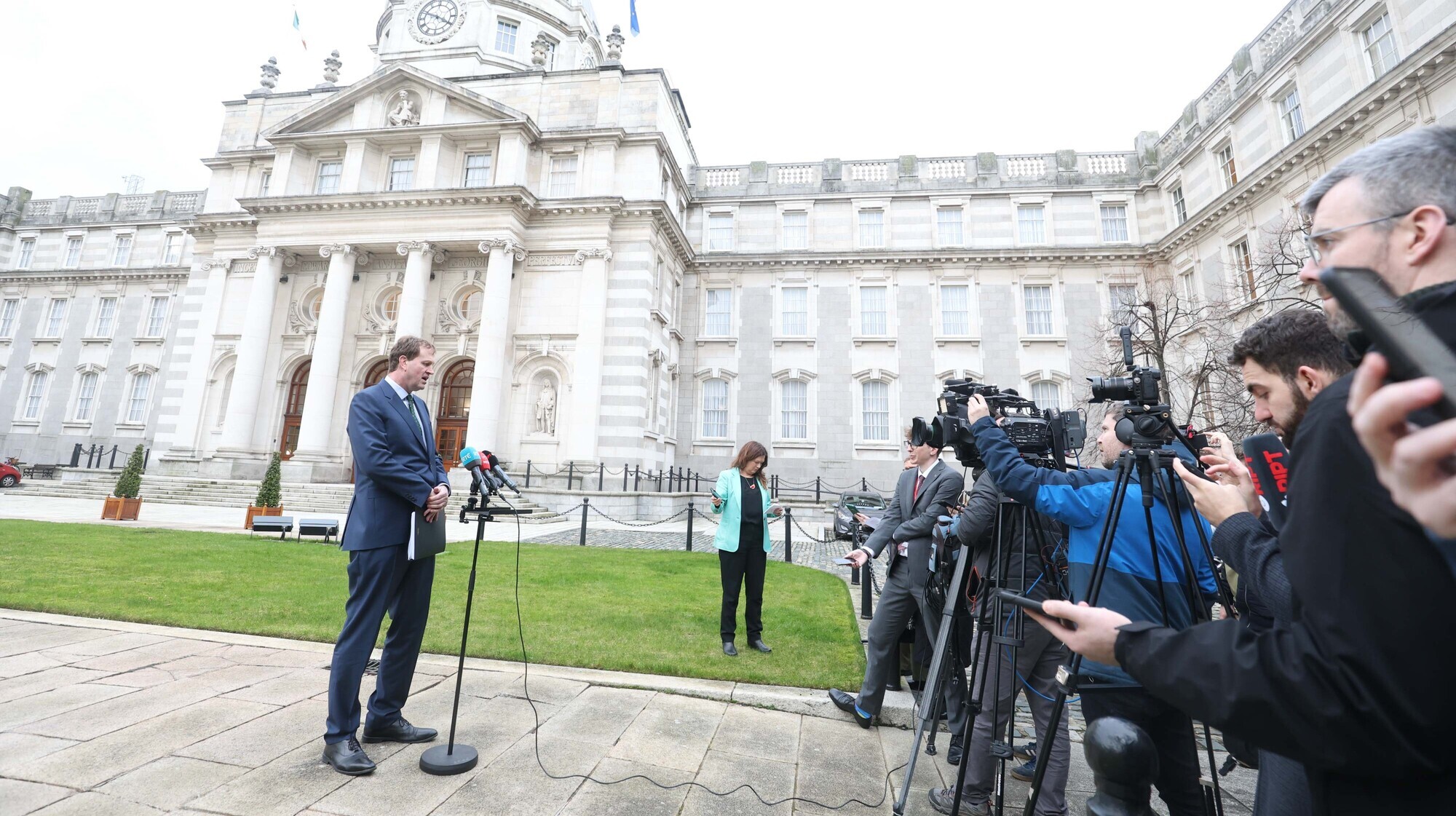
Minister for Justice Jim O’Callaghan briefs the media last February following Cabinet approval for key amendments to the Criminal Law and Civil Law (Miscellaneous Provisions) Bill 2026 which include a presumption of non-disclosure for counselling notes in sexual offence trials. Photo: Leah Farrell / © RollingNews.ie
Discussions about sexual violence survivors’ counselling notes have been hard to miss in recent media coverage. What that coverage has brought into view is a struggle that has been fought for over 20 years — and the severe toll it has taken on survivors.
The proposed amendments to the Criminal Law and Civil Law (Miscellaneous Provisions) Bill 2025 are only the latest advances in that struggle.
In an ideal world, we would not be having this conversation. Survivors’ care and support would simply be protected and private. Unfortunately, where justice is to be pursued for these crimes, the system has failed to uphold survivors’ rights.
The Section 19A amendments of the bill represent genuine, hard-won progress, and we at Rape Crisis Ireland (RCI) do support that.
For years, survivors were routinely pressured into signing away their right to a court hearing — sometimes before they had even seen their own records — and without any access to independent legal advice.
Read More
Mr Justice Maurice Collins documented exactly how that played out in the landmark case, DPP v AM [2025] IESC 16, and it makes for uncomfortable reading. Getting rid of that provision is the single most important structural change proposed to Section 19A since it came into force in 2017, and there are more reforms contained in the Bill also.
The amendments, as they stand, still leave significant gaps. Those gaps are not technical niceties; they go to the heart of what this reform is supposed to achieve for survivors, and we are calling for them to be addressed as the bill progresses.
One of them is the overarching principle of non-disclosure; another, the ‘test’ of a ‘real risk to a fair trial’ to determine whether to introduce the notes.
Both these points were raised at the Committee Stage hearing, where the AM judgment also featured in the discussion.
The AM judgment has become a central reference in the conversation about Section 19A reform, and understandably so: it is the Supreme Court’s most sustained engagement with counselling notes disclosure, and the rights of victims in sexual offence proceedings.
When you read the court’s own forensic analysis carefully, it does not sit comfortably with a permissive approach to disclosure.
Here is what happened. AM was convicted of sexually assaulting his grandniece, referred to in the judgment as C. Counselling notes were missed before the trial and only came to light after his conviction.
The first session, the “17 September Record,” recorded C as saying the abuse had happened on more than one occasion, which appeared to contradict her evidence at trial of a single incident.
When C was subsequently asked about it, she said: “I know that I didn’t say that to [Mr R – the counsellor] on this day because it was always the one occasion. I did tell [Mr R] about [AM] Skype messaging me after the sexual assault so maybe he had interpreted this as sexual abuse also.”
The judge found that explanation “plausible,” noting that Mr R’s focus was on providing therapeutic assistance rather than recording a precise narrative of events. The note, in other words, may have captured the counsellor’s interpretation and categorisation of what C was describing, not C’s own words.
Both the unfairness and unreasonableness of holding a survivor answerable for a third party’s notes of a conversation they had in a therapeutic setting must be clear to everyone here.
The court dismissed the AM appeal. The judge pointed out that the 17 September record was not read back to C at the end of the session and that “she was not asked to sign it or to confirm its accuracy insofar as it purported to attribute any specific statement to her”, which would be the process when a formal statement is made to gardaí.

The counsellor’s own statement gave no indication of any independent recollection of what C had actually said. The note’s forensic value was, in the court’s own assessment, minimal. That is the point.
The Supreme Court’s own reasoning is that the notes at the centre of this most prominent recent disclosure case turned out to be likely inadmissible, as they may reflect a counsellor’s interpretive act rather than a survivor’s words, that they carry limited evidential weight, and that they should not be treated as reliable forensic material.
This is an argument repeatedly made by RCI and by survivors.
Every jury that is presented with arguments and cross–examination of the survivor arising from counselling notes should be informed of this Supreme Court position.
Currently, there is no provision requiring a judge to warn the jury about the nature of what they are hearing. RCI’s position is that a mandatory jury warning should be introduced to address that gap directly.
There is also a transparency gap. The fear that survivors have — with good reason — that their counselling sessions will be weaponised against them in the pursuit of justice, needs to be credibly allayed.
This bill is a significant advancement, but it cannot address survivors’ fears from behind a wall of secrecy. Written reasons for allowing the use of counselling notes, under Section 19A(13), are provided to the parties but go no further.
Without some mechanism for anonymised access to hearings and decisions, there is no way for the public to know how the “interests of justice” ground is being applied across the country. Accountability — and indeed justice — requires visibility, and right now there is very little of it.
RCI is not looking to delay this bill. The reforms that are in it should pass. But there is still time, at reporting stage, to close the gaps that remain.
We are calling for a presumption of non-disclosure that operates as an overarching principle across the whole process, not just at one procedural stage: removal of the open-ended “interests of justice” ground, a mandatory jury warning where counselling records are used in evidence, and a transparency mechanism so that what happens under Section 19A does not remain invisible to everyone outside the courtroom.
None of that is radical. All of it is necessary if the justice process is to demonstrate that, when balancing the right to a fair trial, it takes the rights of survivors seriously.
- Dr Clíona Saidléar is Executive Director of Rape Crisis Ireland