Garry Miley: Cork City's light rail is not a national project — it should be decided locally
Cork’s proposed light-rail system didn't make the Government's fast-track list of infrastructure projects. There has to be a more direct and rational way of building it, writes Garry Miley 
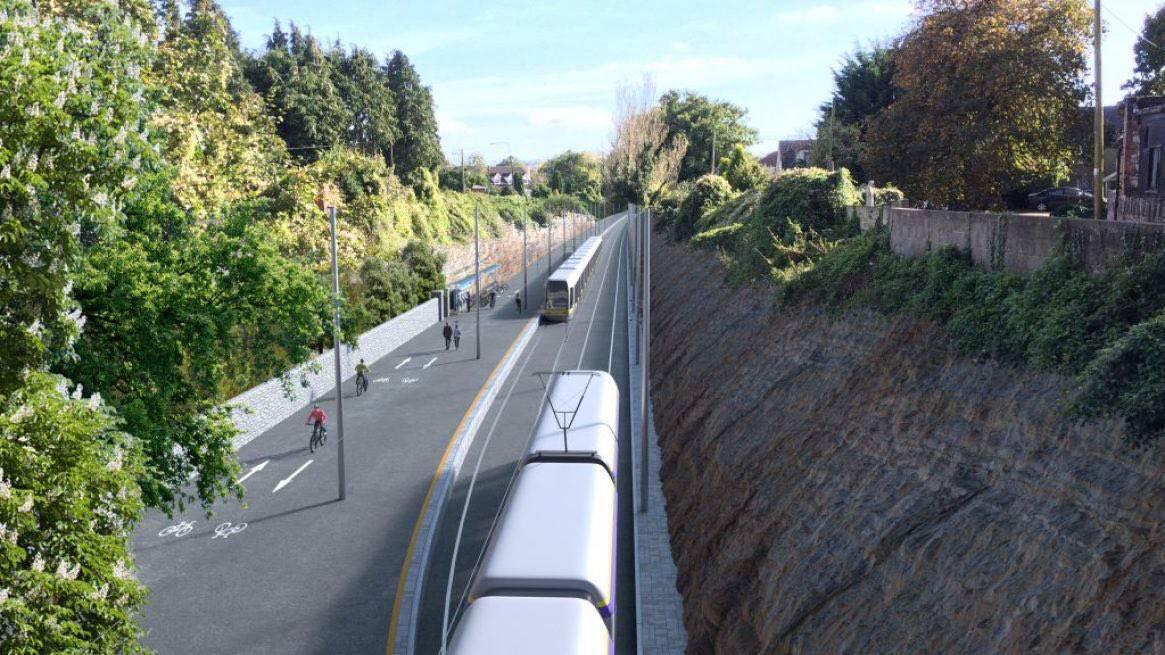
A computer-generated image of a light rail system operating in Blackrock, Cork on the old railway line, now a popular walking and cycling greenway. Why did Cork’s proposed light-rail system not make the fast-track list?

A computer-generated image of a light rail system operating in Blackrock, Cork on the old railway line, now a popular walking and cycling greenway. Why did Cork’s proposed light-rail system not make the fast-track list?

Last month, the Government announced a list of infrastructure projects that it intends to fast-track under the new Critical Infrastructure Act. 

The Cork Area Commuter Rail Programme is among them. Should Cork be pleased? Certainly. Should it be rejoicing? No, not really. Let me explain. 

A crude but useful analogy is to think of the Irish planning system as an animal skeleton. Dublin is the skull. Villages are the finger bones. Cork is perhaps a rib close to the heart. Each component has a predetermined place and function. As long as each bone knows its place and keeps its shape, the skeleton does its job.

But what happens if the skeleton’s DNA suddenly changes and the clavicle decides it would prefer to be a tibia instead? The skeleton model then begins to look less convincing. A skeleton cannot function if a bone starts developing in an unexpected way. 

Yet that is precisely what happens in real-world planning. Cities grow unevenly; technologies change and industries take root where they were least expected. A place that once performed a modest regional function can acquire national importance surprisingly quickly.

This is the weakness of a centralised planning system like our own. At first glance, it appears underpinned by a solid rationale, but that rationale breaks down when places like Cork develop in unexpected ways.

A better model might be a lattice: a structure that holds its parts together while allowing them to move and adapt. 

To borrow a principle associated with Dutch governance, the system should be centralised only to the extent necessary to hold the lattice together, while giving its extremities enough autonomy to develop in response to their own needs.

Cork light rail

This brings us to the crux of the matter: Cork’s proposed light-rail system, which did not make the fast-track list. The likely explanation is that the project is not yet sufficiently advanced to receive fast-track status. 

But that merely raises a bigger question: why must Cork depend on national institutions to bring a project of local importance into effect?

Because Ireland’s infrastructure development and funding system is highly centralised, Cork is not in a position to simply announce that it intends to build a light-rail network and then set about delivering it.

 TII head of light rail projects Paolo Carbone said it was hoped ground would be broken on the Cork Luas before the hundredth anniversary of the last trams to run in the city, which were taken out of service in 1931. Picture: Irish Examiner Archive
TII head of light rail projects Paolo Carbone said it was hoped ground would be broken on the Cork Luas before the hundredth anniversary of the last trams to run in the city, which were taken out of service in 1931. Picture: Irish Examiner Archive

Instead, it enters a process so bewildering it is almost impossible to explain. Before Cork can decide what kind of light-rail system it wants, the proposal must first make sense to people in Dublin. 

It has to fit the Government’s national plans for transport, development and public investment. 

Then it must survive a succession of assessments, approvals and funding decisions involving national and regional bodies. 

This means entering the world of the NPF, the NDP, the NTA, TII and the RSES. The acronyms may be confusing, but the hierarchy is clear. 

The project must fit a national plan and then wait to become a national priority. The city has a voice in the process, but it doesn’t set the agenda.

Light-rail systems in France

Compare this with how light-rail systems are developed in France. Numerous French cities of Cork’s scale or smaller, including Brest, Dijon, Tours and Avignon, now have tram or similar light-rail networks.

Nice provides a useful example. It is, of course, larger than Cork, but its tram system is one whose history I happen to know quite well.

Line 1 of the Nice tramway was opened in 2007. Line 2 was developed during the following decade, with construction beginning in 2013 and the full route opening in 2019. Further lines are currently being developed.

Garry Miley: 'Modern planning systems require a more sophisticated understanding of the relationship between national and local government so that cities and metropolitan areas can respond when local development pressures suddenly become impossible to ignore.'

The important thing about the Nice light-rail system — and the part Cork should take note of — is that it was promoted and commissioned locally by Métropole Nice Côte d’Azur. 

The Métropole, which effectively acted as the local authority, assembled the project and its financing and served as contracting authority. At various points in the process, Nice Côte d’Azur referred aspects of the proposal to France’s National Commission for Public Debate. 

The commission decided (and I’m simplifying here for clarity) that it did not warrant a full national debate because, while important to Nice, it was not a project of national significance.

The French state contributed funding and retained important regulatory functions, but the message was clear: this was principally a local and metropolitan project.

Implementation was not free from delays or controversies. The decision to run the tracks underground through the city centre has worked well (MacCurtain Street, take note). 

In my experience, however, some of the corridors providing access to the underground platforms are undersized and result in crowding during periods of heavy use. The main point is that the metropolitan authority had sufficient power to choose a partly underground route and to accept responsibility for the consequences.

The lesson for Cork

This is where Cork should find itself: with greater authority to make major infrastructure decisions, the capacity to organise a meaningful share of the funding and the responsibility to make whatever adjustments are necessary if a system does not initially operate as promised.

There will be occasions when central authority is essential to planning success. We cannot, for example, rely on co-operation between local authorities alone to deliver motorways and intercity rail networks. 

But modern planning systems require a more sophisticated understanding of the relationship between national and local government so that cities and metropolitan areas can respond when local development pressures suddenly become impossible to ignore.

Major infrastructure already takes long enough to design and procure. Exposing every significant urban project to the full complexity of the national planning framework — and then to political horse trading — cannot possibly improve the outcome.

There has to be a more direct and rational way of doing it.

Sometimes the centre’s most valuable contribution is to recognise that, when a decision properly belongs to a city, the best thing it can do is get out of the way.

  • Garry Miley is a lecturer at South East Technological University’s Department of Architecture

x

Your home for the latest news, views, sports and business reporting from Cork.

More in this section

Revoiced

Newsletter

Had a busy week? Sign up for some of the best reads from the week gone by. Selected just for you.

Cookie Policy Privacy Policy Brand Safety FAQ Help Contact Us Terms and Conditions

© Examiner Echo Group Limited