As Ireland's EV sales surge, is the age of oil-powered vehicles nearly over?
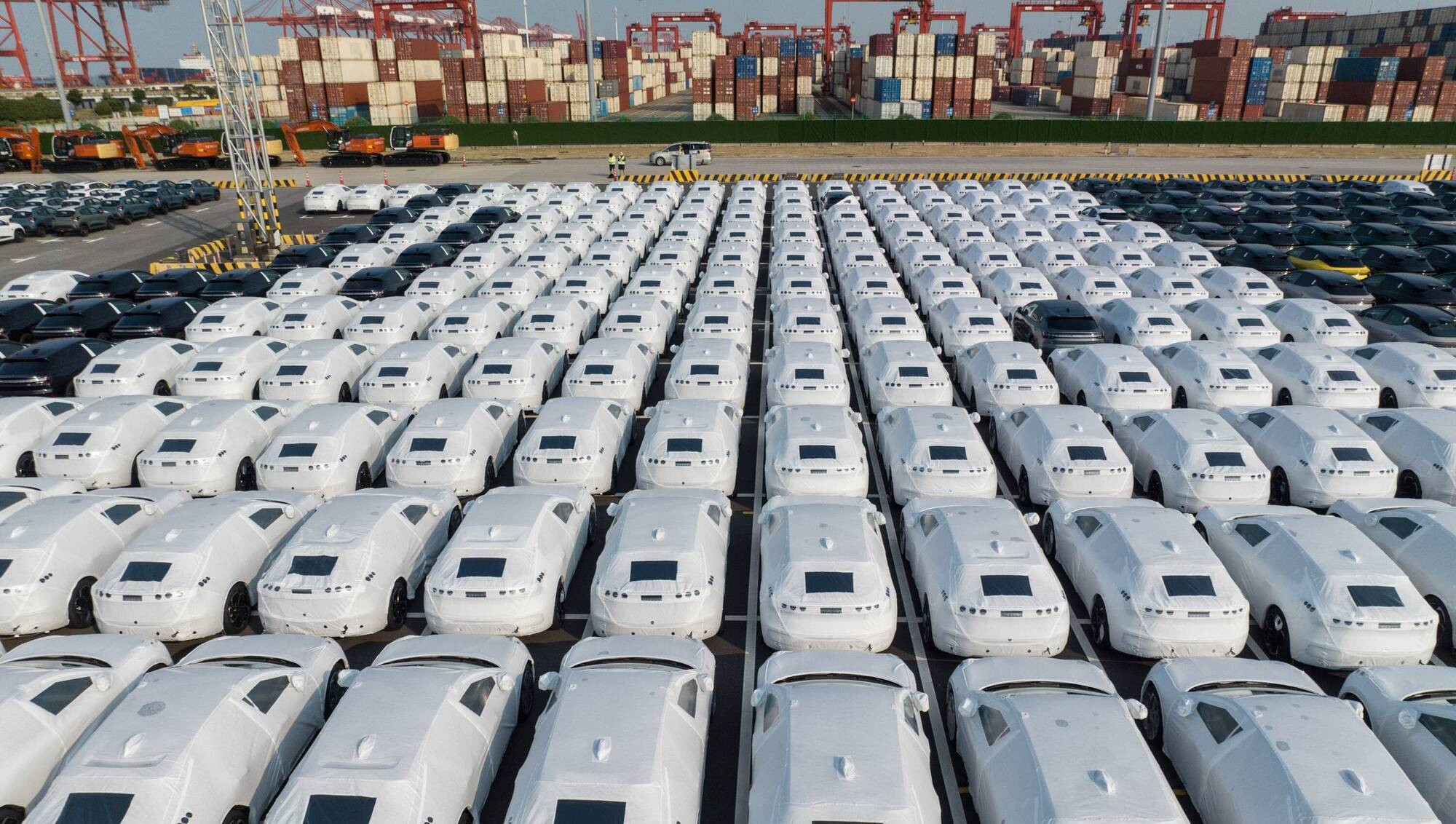
Electric vehicles bound for shipment at a port in China; Chinese manufacturers have recently unveiled new models boasting a 1,000-plus km range that can be fully charged in under 10 minutes. Picture: Bloomberg
Though it seems hard to imagine today, in the early years after the invention of the motor car in the 1880s, the nascent industry was dominated by electric vehicles (EVs).
Had this trend continued, the oil-soaked and bloody history of the last century and a quarter would likely have been radically different.

Ironically, efforts to develop the motor car were largely driven by the growing pollution crisis created by the manure produced by the vast number of horses used for transport.
A newspaper report from the late 1850s described the streets of New York as a “mass of reeking, disgusting filth, which in some places is piled to such a height as to render them almost impassable to vehicles”.
Read More
While electric and internal combustion engine (ICE) technologies jostled for dominance at the start of the 20th century, the introduction of the cheap, mass-produced Ford Model T in 1908 sounded the death knell for the short-lived EV age.
Although dirty and noisy, petrol-powered cars enjoyed the key advantage of having a longer range than EVs and being much faster to refuel, EVs established a niche largely for women drivers, who used them mainly for shorter local trips.
While Henry Ford sold 15m Model Ts, his wife Clara was unimpressed, choosing instead to drive a Detroit Electric.
Clara Ford, it turns out, was right after all, but it has taken a century for the long reign of the internal combustion engine to come to a juddering halt.
For many industry observers, 2026 signals the tipping point, the moment beyond which the terminal decline of fossil-fuelled motoring begins to gather unstoppable momentum.
For a glimpse into our near future, consider Norway. In 2015, one in 10 of its new cars sold were EVs. In 2025, it was 96%, rising to 98% this year, with just 12 new petrol cars sold so far in the entire country.
Meanwhile, in Denmark, four in five new cars sold so far this year are fully electric, while sales of second-hand ICE cars have collapsed.
Even in Germany, famous for its car-mad petrolheads and autobahns with no speed limits, the dam is beginning to break.
More than one in five new cars sold so far this year are fully electric, a jump of over 40% compared with 2025.
While not yet scaling the heights of our Nordic cousins, nearly 17,000 EVs were sold in Ireland in the first four months of 2026, a whopping 48% increase on last year, meaning one in four cars sold are fully electric.
At this rate, how long before many petrol stations become unviable?
The uptake of EVs has been dogged by roadblocks in the form of disinformation campaigns sponsored by fossil fuel interests and spread by right-wing media outlets to undermine public confidence in the new technology.
You may have heard that EVs are a fire hazard? In reality, ICE cars are far more likely to catch fire.
A senior official from the UK department of transport told a Lords committee investigation in 2024:
“There is an anti-EV story in the papers almost every day, nearly all of which are based on misconceptions and mistruths.”
Attacks on EVs as well as heat pumps and renewable energy generally have become the new form of climate denial.
Other persistent myths include the idea that an EV is more carbon-intensive than an ICE car. In reality, over the entire life of the vehicle, an EV emits vastly less carbon, even when powered by an electric grid run largely on fossil fuels.
The reason is simple: efficiency. For a typical diesel or petrol car, less than 20% of the energy in the fuel tank actually turns the wheels.
The rest is lost as heat, in transmission and through the gears. In stark contrast, almost 90% of the energy in an EV battery turns the wheels.
What’s more, EVs can operate as a virtual power station, instantly releasing energy back to the national grid when needed.
Motor manufacturers have invested billions in ever more sophisticated engines, but they ran into the brick wall of diminishing returns from a century-old technology that is inherently inefficient and highly polluting.
The 10-year total cost of ownership of an EV in Ireland is on average €15,000 less than its ICE equivalent, and crucially, 2026 sees EVs reach purchase price parity, thus removing a major stumbling block.
The last and perhaps most critical tipping point is in what has long been the Achilles’ heel of EVs: their lack of range and a patchy public charging infrastructure, leading to the very real phenomenon of “range anxiety”.
I have been an EV driver since 2018. Back then, the longest range EV available was extremely expensive and limited to below 400km of real-world driving.
I recently drove from south Dublin to Kilkenny, then on to Cork City, and back to Dublin the following day — a round journey of over 570km, all on a single charge.
Had I needed to top up, there are now plenty of high-speed chargers available along the way.
The battery on my new EV comes with a 10-year or 250,000km warranty, proof positive of the striking reliability of EV batteries.
With the US stuck in reverse gear, Europe is finally waking up to the EV revolution.
China has already powered ahead in the technological fast lane.
Chinese manufacturers have recently unveiled new models boasting a 1,000km-plus range that can be fully charged in under 10 minutes.
EV technology is spreading fast to trucks, buses, e-bikes, and, yes, tractors too.
The unstoppable ascendancy of the EV delivers a potentially fatal blow to the fossil fuel industry.
Last year, EVs cut oil demand globally by over 2m barrels a day; by 2040, experts believe it will be more than 20m barrels a day, wiping out a fifth of all demand for oil, and sending the planet-killing energy corporations into a death spiral of falling demand and falling prices.
Range anxiety is now being replaced with “pump anxiety”, as soaring fuel prices resulting from the Iran war have encouraged millions of people to finally scrap their pricey gas guzzlers.
Meanwhile, the Irish State will need to find new ways to equitably fund our road maintenance programme as it faces steep drops in revenue from fuel taxes.
Despite the last three decades of intergovernmental climate conferences and solemn commitments, oil consumption has continued to spiral.
Now, at the 11th hour, our best and final chance to avoid a fossil-fuelled collapse of the global climate system by mid-century has arrived, in the form of renewable energy and advanced battery technology.
The ICE age is over. If you haven’t yet taken the leap, now is the time. There’s not a minute to lose.
- John Gibbons is an environmental journalist and author of The Lie of the Land: A Game Plan for Ireland in the Climate Crisis